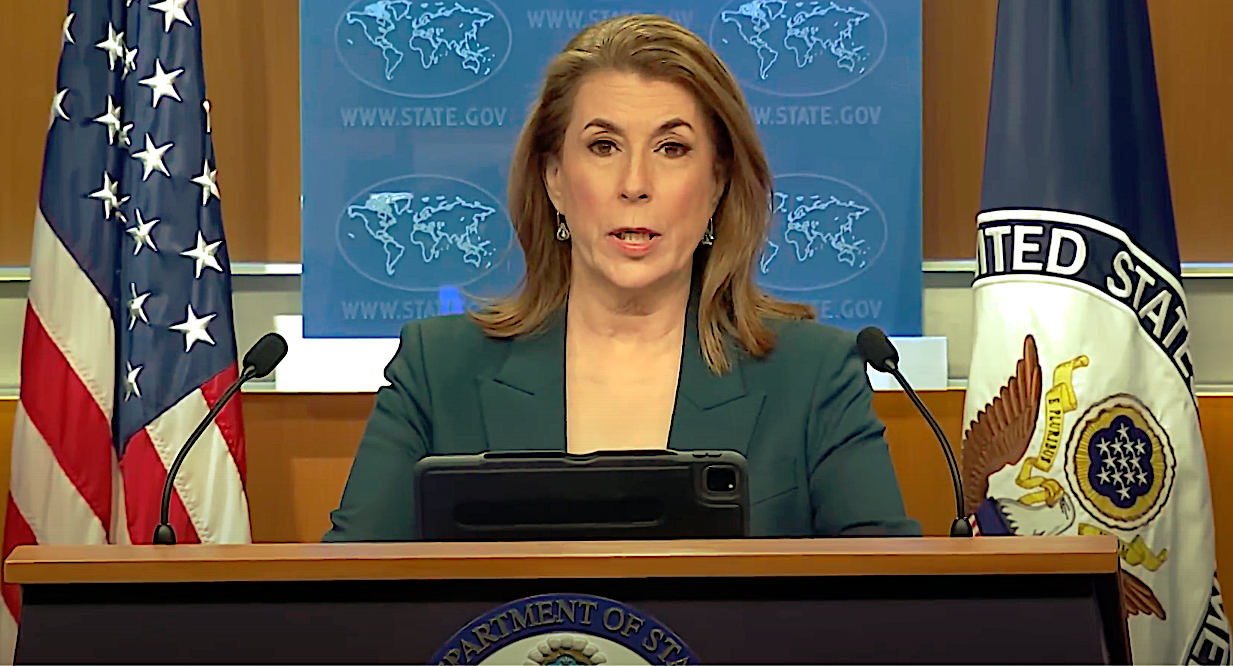
US State Department spokesperson, Tammy Bruce, during a press briefing in Washington on August 5, 2025.
U.S.-India Tensions Spike Amid Russia Oil Clash
Washington: The United States signalled potential secondary sanctions against countries like India for buying Russian oil, with State Department spokesperson Tammy Bruce hinting that President Donald Trump may soon make an announcement to this effect. “I would say that we’ve also seen a remark, perhaps a reflection of possible secondary sanctions, regarding the sale of oil, people who are – countries that are buying Russian oil, and that has been openly discussed by the President. But when it comes to things that are decided, we would wait for the President to say that,” Bruce said during a press briefing in Washington, which concluded at 3:15 p.m. EDT (12:45 a.m. IST, August 6).
The remarks highlight President Donald Trump’s tough stand on nations seen as sustaining Russia’s war in Ukraine, escalating tensions with India amid a critical U.S. diplomatic push. Bruce was also asked about Ukraine’s claim that India-made components were found in Russian drones, but she deflected, saying, “I will not characterise or remark on another nation’s comments about what they will or will not do,” deferring to Trump’s authority.
The allegation intensifies scrutiny of India’s trade ties, particularly as both India and China have vowed to continue Russian oil purchases. Bruce reiterated Trump’s economic leverage, stating, “President Trump has many tools in his tool chest,” including secondary sanctions that could target entities doing business with Russia. She added, “As a businessman, he likes to use… the tools that can make a difference with countries,” framing sanctions as part of Trump’s strategy to end global conflicts.
Also read: India Calls Out US, EU on Russia Trade Hypocrisy
India, in a Monday statement, rejected U.S. and European Union criticism as “unjustified and unreasonable,” accusing the West of hypocrisy. New Delhi defended its shift to Russian oil, now over 35% of its imports, as a response to market disruptions after the 2022 Ukraine conflict, a move initially encouraged by the U.S. to stabilise global energy markets. India cited the EU’s €67.5 billion goods trade and €17.2 billion services trade with Russia in 2024, alongside U.S. trade with Russia totalling around $4 billion, including uranium, palladium, fertilisers, and chemicals, to argue against selective pressure.
Trump’s 25% tariff on Indian goods, effective August 7, 2025, following his July 31 executive order, responds to his Truth Social claims that India profits from discounted Russian oil and resells it globally. India’s commerce ministry warned of disruptions to supply chains, particularly for pharmaceuticals and textiles, while economics professor Jayati Ghosh criticised the U.S. for ignoring its own Russian trade. Trump’s remarks labelling India and Russia “dead economies” drew bipartisan condemnation from India’s ruling Bharatiya Janata Party and opposition Congress party.
Bruce faced questions about President’s Special Envoy Steve Witkoff’s upcoming trip to Russia, aimed at addressing the Ukraine conflict. Reporters asked if Russia’s reported proposal for a limited air truce, halting drone and missile activity, would suffice to delay sanctions. “I won’t comment on what a diplomatic choice would be regarding what’s offered or what’s not offered,” Bruce replied, emphasising that such decisions rest with Trump, who is “not happy with Mr. Putin and Russia, but he remains committed to diplomatic solutions.” She noted Trump’s months-long efforts to broker a ceasefire, despite stalled U.S.-Russia talks.
With Witkoff’s Russia mission looming, the U.S. seeks to curb Russia’s war financing while navigating strained ties with India. The outcome of these diplomatic and economic efforts will likely shape whether negotiations or sanctions prevail.
– global bihari bureau