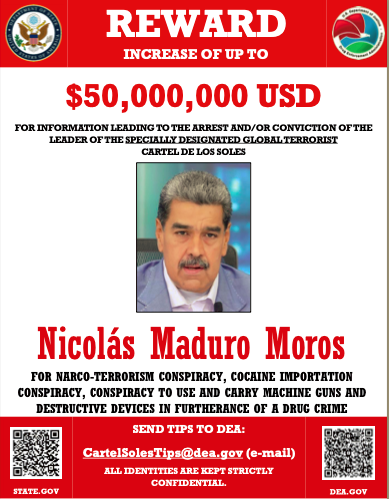
A US State Department poster of Venezuelan President Nicolás Maduro, who the US forces captured today.
U.S.–Venezuela Standoff Peaks with Sanctions and Warships
New York/Washington: Tensions between the United States of America and Venezuela reached a new peak today, December 19, 2025, as Caracas formally requested an emergency session of the United Nations (UN) Security Council while Washington unveiled a sweeping sanctions campaign targeting family members and associates of Venezuelan President Nicolás Maduro. The confrontation, spanning diplomatic, economic, and military dimensions, underscores the deepening crisis in U.S.–Venezuela relations and the fragility of regional stability.
The U.S. Department of the Treasury’s Office of Foreign Assets Control (OFAC) and the U.S. Department of State announced that seven immediate family members of individuals previously sanctioned — Carlos Erik Malpica Flores, a nephew of Maduro’s wife Cilia Flores, and Panamanian businessman Ramón Carretero Napolitano — would be added to the Specially Designated Nationals and Blocked Persons List (SDN List) under Executive Order (E.O.) 13850. The individuals sanctioned on December 19, 2025, are:
- Eloisa Flores de Malpica, mother of Malpica Flores and sister of Cilia Flores (DOB: Dec 1, 1948, Tinaquillo, Venezuela)
- Carlos Evelio Malpica Torrealba, father of Malpica Flores (DOB: Feb 20, 1947, Tinaquillo, Venezuela)
- Iriamni Malpica Flores, sister of Malpica Flores (DOB: Oct 15, 1975, Caracas, Venezuela)
- Damaris del Carmen Hurtado Perez, wife of Malpica Flores (DOB: Jul 3, 1975, Barinas, Venezuela)
- Erica Patricia Malpica Hurtado, daughter of Malpica Flores (DOB: Jun 14, 2001, Valencia, Venezuela)
- Roberto Carretero Napolitano, son of Ramón Carretero (DOB: Aug 20, 1976, Colon, Panama)
- Vicente Luis Carretero Napolitano, son of Ramón Carretero (DOB: Oct 6, 1966, Colon, Panama)
Treasury Secretary Scott Bessent said, “Maduro and his criminal accomplices threaten our hemisphere’s peace and stability. The Trump Administration will continue targeting the networks that prop up his illegitimate dictatorship.” The sanctions freeze all property in the United States or in the possession of U.S. persons and prohibit transactions with the designated individuals. Entities owned 50% or more by any blocked party are also subject to sanctions. Violations may trigger civil or criminal penalties, and financial institutions risk secondary liability for transactions involving blocked persons.
These December 19 measures expand upon December 11, 2025, OFAC designations, which included Malpica Flores, three nephews of Cilia Flores — Efrain Antonio Campo Flores and Franqui Francisco Flores de Freitas, the “narco-nephews” — and companies operating in Venezuela’s oil sector. Campo and Flores de Freitas were arrested in Port-au-Prince, Haiti, in November 2015 while arranging cocaine shipments to the United States, convicted in November 2016, and granted clemency in October 2022 by President Joe Biden, as part of a failed negotiation to restore democratic elections in Venezuela. The Trump administration reinstated sanctions in 2025, citing ongoing narcotics trafficking and corruption.
The sanctions target Venezuela’s oil sector, central to the Maduro regime’s revenue and its narco-corruption network. Designated companies and vessels include:
- Myra Marine Limited / WHITE CRANE (IMO: 9323429, Marshall Islands)
- Arctic Voyager Incorporated / KIARA M (IMO: 9285823, Panama)
- Poweroy Investment Limited / H. CONSTANCE (IMO: 9237773, Panama)
- Ready Great Limited / LATTAFA (IMO: 9245794, Panama)
- Sino Marine Services Limited / TAMIA (IMO: 9315642, Hong Kong)
- Full Happy Limited / MONIQUE (IMO: 9311270, Cook Islands)
These vessels were found to manipulate Automatic Identification System (AIS) signals to obscure their locations while transporting Venezuelan oil to Asia, linking state oil revenue directly to narco-financial operations involving the Malpica and Carretero families.
Historically, U.S. sanctions on Venezuela’s oil sector date back to January 28, 2019, when Petróleos de Venezuela, S.A. (PDVSA) was designated under E.O. 13850, and were further expanded on August 5, 2019, when President Donald Trump blocked PDVSA assets under E.O. 13884. These actions demonstrate continuity in U.S. policy to target Venezuela’s economic lifelines and the integrated narco-corruption apparatus.
In addition to economic measures, U.S. forces have conducted maritime interdictions, including the seizure of a Venezuela-linked tanker in early December 2025, which Caracas condemned as piracy. Venezuelan authorities also deployed naval patrols and escorted tankers to Asia in response, framing U.S. operations as a de facto maritime blockade. These operations form part of Operation Southern Spear, the largest U.S. naval deployment in the Caribbean in decades, which includes the USS Gerald R. Ford aircraft carrier, multiple guided-missile destroyers and cruisers, amphibious assault ships, a nuclear submarine, and supporting P-8 Poseidon maritime patrol aircraft and F-35 fighter jets, totalling approximately 15,000 personnel.
On the diplomatic front, Venezuela submitted a formal emergency request to the UN Security Council on December 19, invoking Chapter VI of the UN Charter to seek peaceful dispute resolution and protection against unilateral sanctions and maritime coercion. Analysts note that any resolution critical of the United States is likely to face a veto, leaving the session primarily as a platform for public diplomacy and narrative framing.
Global powers have responded with a mix of caution and support. China, via Foreign Ministry Spokesperson Guo Jiakun on December 18, 2025, stated: “China opposes all acts of unilateralism and bullying, and supports countries in defending their sovereignty and national dignity. Venezuela has the right to independently develop mutually beneficial cooperation with other countries. China supports Venezuela’s request for holding an emergency session of the UN Security Council.” Russia warned Washington against “fatal mistakes,” affirming support for Venezuelan sovereignty without committing military assistance. Mexico and other Latin American states urged restraint to avoid destabilising the Caribbean region.
UN Secretary-General António Guterres urged de-escalation and respect for international law. Security Council diplomats noted that while substantive enforcement is unlikely, the December 19 session will codify positions and allow Venezuela to present its grievances on a global stage.
Further legal measures accompanying the December 19 sanctions include Venezuela-related General License 5T, authorising certain transactions related to PDVSA 2020 8.5% bonds on or after February 3, 2026, and an amendment to FAQ 595, clarifying compliance for financial institutions and secondary liability under U.S. sanctions law.
By the end of December 19, 2025, Venezuela faces an unprecedented convergence of economic, maritime, and diplomatic pressure: U.S. sanctions have broadened to family networks and oil operations, U.S. naval forces maintain a high-profile presence in the Caribbean, and the UN Security Council session elevates the dispute to the international arena, where entrenched positions are unlikely to yield immediate relief. Analysts caution that the conflict underscores the interplay of narco-corruption, energy revenue, and global power politics, with consequences for regional stability and international norms.
– global bihari bureau