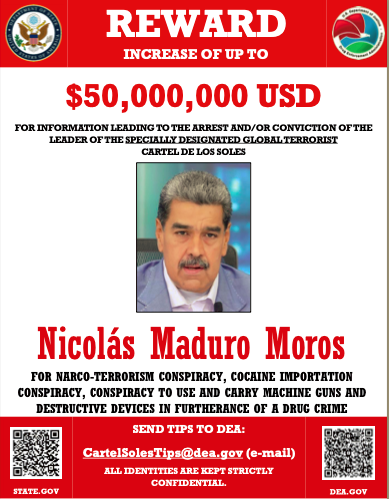
A US State Department poster of Venezuelan President Nicolás Maduro, who the US forces captured today.
Venezuela Crisis: Legal, Political Debate Intensifies
Trump Links Oil, Drugs in Venezuela Action
Florida/Caracas: In a dramatic escalation of tensions in the Western Hemisphere, U.S. President Donald J. Trump announced in a nationally televised press conference that American forces had conducted large-scale military strikes against Venezuela in the early hours of January 3, 2026. Trump stated that the operation resulted in the capture of Venezuelan President Nicolás Maduro and his wife, Cilia Flores, who, according to the president, had been flown out of the country. Speaking from his Florida residence, Trump framed the strikes as the culmination of a prolonged effort against what he described as a “narco-terrorist regime,” portraying Maduro’s government as a criminal enterprise rather than a legitimate sovereign authority.
“The United States of America has successfully carried out a large-scale strike against Venezuela and its leader, President Nicolás Maduro,” Trump said. “He has been captured, along with his wife, and flown out of the country.” Although the announcement was widely broadcast, independent confirmation of Maduro’s capture or location has not been provided. Venezuelan authorities have demanded proof of life and have not acknowledged that Maduro and Flores are in custody, highlighting a gap between U.S. claims and external verification.
Trump said U.S. forces had sustained no fatalities and no aircraft losses, though he acknowledged that one helicopter had been damaged and some personnel injured. He repeatedly described the operation as precise and carefully executed, and he portrayed it as a necessary action to restore security in the hemisphere. Secretary of State Marco Rubio reinforced the administration’s narrative, describing the Maduro government as a destabilising force that had long facilitated narcotics trafficking and corruption. Rubio presented the action as defensive and necessary, but he offered no operational specifics and did not address the status of Venezuelan Vice President Delcy Rodríguez in the press briefing.
Eyewitness accounts and reports from Caracas and surrounding regions described explosions and intense military activity before dawn, with smoke rising over major military facilities and urban areas. Power outages followed the reported strikes in several districts. Venezuelan officials condemned the strikes as an act of “criminal military aggression” and declared national emergency measures, calling for mobilisation against what they characterised as an invasion. Independent reporting confirms that explosions and smoke were observed over La Carlota airbase and Fuerte Tiuna military complex, while civilian panic was widespread as residents fled streets amid sirens and low-flying aircraft. While these reports confirm military activity, independent confirmation of the specific sequence of operations, target lists, and casualties has not been obtained.
Energy and oil were central to Trump’s remarks. Venezuela has the world’s largest proven oil reserves, and Trump said American companies would be involved in rebuilding and operating the country’s energy infrastructure. “We’re going to fix it,” he said, linking energy security with regional stability. Rubio also underscored the strategic importance of oil, describing a stable Venezuelan energy sector as beneficial to the hemisphere. Trump positioned the operation within the context of global strategic competition, explicitly identifying Russia and China as supporters of Maduro’s regime and warning that the United States would not tolerate rival influence in the Western Hemisphere. While he did not describe direct engagements with Russian or Chinese forces, his rhetoric underscored the geopolitical stakes globally.
On governance, Trump said the United States would temporarily oversee Venezuela “until there’s a safe, proper, and orderly transition.” He did not provide a detailed legal framework, timeline, or international mandate for such involvement. One of the most debated aspects of the operation concerns its legal basis under U.S. law. The United States Constitution gives Congress the power to declare war, while the president, as commander-in-chief, can direct military forces to respond to immediate threats. The War Powers Resolution of 1973 was designed to limit unilateral military action by the executive, requiring the president to notify Congress within 48 hours of committing armed forces and forbidding sustained engagement beyond 60 days without congressional authorisation. In the January 3 strikes, President Trump did not cite a specific congressional authorisation for the operation. He framed it as an enforcement action against criminal networks and a response to regional threats, which the administration could argue falls within the president’s powers to conduct law enforcement and counter-terrorism activities. However, legal scholars note that the scale of the strikes, the reported targeting of government infrastructure, and the claimed capture of a head of state raise questions about whether the action constitutes an act of war requiring explicit congressional approval. Members of Congress from both parties have expressed concern. Some argue that a unilateral military strike of this magnitude on foreign soil without consultation or a vote undermines Constitutional checks and balances, while others support the operation as a necessary measure to protect U.S. national security and regional stability. The absence of a public legal memorandum or resolution authorising the strikes has intensified debate over executive authority, the interpretation of counter-terrorism powers, and the limits of the War Powers Resolution. Legal experts suggest that, in addition to domestic considerations, the operation could also trigger scrutiny under international law, as the United Nations Charter prohibits the use of force against the territorial integrity or political independence of a state except in self-defence or with Security Council authorisation.
The January 3 strikes followed months of escalating U.S. pressure on Venezuela. Throughout 2025, the Trump administration steadily expanded economic, military, and legal tools aimed at undermining the Maduro government. In mid‑August, the United States deployed naval forces to the Caribbean to counter narcotics trafficking networks allegedly linked to the Venezuelan state. Warships and personnel conducted maritime patrols, intercepting vessels suspected of smuggling narcotics to the United States and other markets. By late 2025, U.S. forces had reportedly carried out at least thirty strikes on maritime targets associated with drug trafficking. These actions resulted in casualties among personnel aboard the targeted vessels, marking a shift from traditional counter-narcotics enforcement to direct kinetic military operations. In December, the United States escalated further with strikes on a Venezuelan coastal facility believed to be used for drug transhipment, alongside seizures of oil tankers suspected of carrying crude linked to the Maduro government. These moves, combined with tightened sanctions on Venezuelan oil exports and designations of Venezuelan officials under terrorism financing provisions, reflected a comprehensive U.S. strategy to pressure the Maduro regime. Trump’s public rhetoric in the months leading up to the strikes suggested a growing willingness to escalate militarily. He warned that further operations could be launched to counter narcotics trafficking and criminal networks, framing such actions as necessary to protect American citizens. The buildup of naval forces, interdiction of maritime traffic, and drone and air operations created an environment of heightened tension and foreshadowed the January 3 offensive. Analysts note that these prior actions illustrate the administration’s long-term planning and preparation for a decisive strike.
Also read: US Presses Venezuelan Oil with Fresh Sanctions, Warships
Responses from around the world were immediate and deeply polarised. Brazil condemned the operation as crossing an “unacceptable line,” urging the United Nations to respond, while other Latin American countries emphasised the need for peaceful resolution and respect for sovereignty. Official reactions from Moscow and Beijing were sharply critical. In an official statement issued on January 3, 2026, the Russian Foreign Ministry said: “In view of the confirmed reports about Venezuelan President Nicolas Maduro and his spouse being in the United States, we strongly urge the US leadership to reconsider their position and release the legitimately elected president of a sovereign country and his spouse. We highlight the need to create conditions for resolving any existing issues between the United States and Venezuela through dialogue.” China’s Foreign Ministry spokesman issued a statement saying: “China is deeply shocked by and strongly condemns the U.S.’s blatant use of force against a sovereign state and action against its president. Such hegemonic acts of the U.S. seriously violate international law and Venezuela’s sovereignty, and threaten peace and security in Latin America and the Caribbean region. China firmly opposes it. We call on the U.S. to abide by international law and the purposes and principles of the UN Charter, and stop violating other countries’ sovereignty and security.” European governments called for verification of U.S. claims and adherence to international law. The United Nations warned that unilateral military action against a sovereign nation could set a dangerous precedent. Information on civilian casualties and damage to infrastructure remains limited and unverified. Preliminary reports indicate widespread disruption, power outages, and panic among civilians in Caracas and surrounding regions. Analysts emphasise that while the U.S. government frames the operation as precise and limited, the humanitarian impact is still unfolding and remains difficult to assess independently.
While the Trump administration presents the operation as a decisive and precise military campaign, several critical aspects remain unverified. Independent confirmation of the capture of President Nicolás Maduro and his wife, Cilia Flores, is not available; Venezuelan authorities have neither acknowledged their removal nor provided proof of life, leaving a significant gap between U.S. claims and on-the-ground reality. The status of Vice President Delcy Rodríguez and other senior officials has not been publicly clarified, and no verified operational details—such as target locations, strike sequencing, or engagement with Venezuelan forces—have been released. Eyewitness accounts report explosions and smoke over key military facilities and widespread panic among civilians, but casualty numbers, infrastructural damage, and humanitarian impact remain largely unconfirmed. Furthermore, while Trump and Rubio emphasise the strategic and economic rationale of the strikes, including U.S. involvement in Venezuelan energy, specific plans, contracts, or post-strike economic measures have not been disclosed. These gaps underscore that, while the operation dominates global headlines and signals a bold U.S. approach to hemispheric security, the full scope, consequences, and human impact of the strikes remain uncertain, and independent verification will be essential in the coming days.
This operation marks a bold, unilateral move by the Trump administration, reminiscent of past U.S. interventions like Panama in 1989 with the capture of Manuel Noriega, but on a larger scale, given Venezuela’s geopolitical ties to Russia and China. The lack of congressional consultation raises valid constitutional questions, and bypassing international norms risks alienating allies and escalating tensions with global powers. Humanitarian fallout could be severe, with power outages and panic already reported, and a power vacuum might lead to chaos or migration crises. Trump frames it as a win for hemispheric security, but critics see it as imperial overreach. Time will tell if this “precise” strike achieves its goals or backfires into broader conflict; for now, it is a high-stakes gamble dominating global headlines.
https://www.youtube.com/live/SsdkClL2_bg?si=9hL3pqgP5MX6ycIj&t=2837
– global bihari bureau