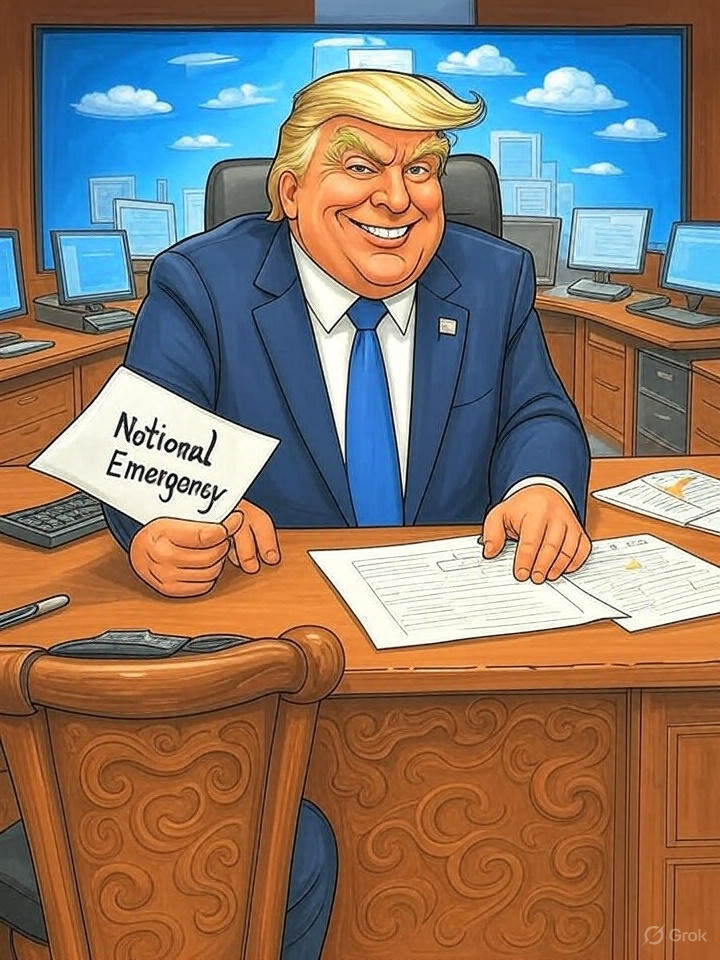
AI-generated image
Trump Targets Brazilian Justice with Tariffs, Sanctions
Washington: In a dramatic escalation of tensions, the United States has imposed sweeping sanctions on Brazil, targeting Supreme Court Justice Alexandre de Moraes and levying a 40 per cent tariff on select Brazilian imports. President Donald J. Trump today declared a national emergency, invoking the International Emergency Economic Powers Act (IEEPA) and the National Emergencies Act, citing actions by the Brazilian government that he claims threaten U.S. national security, foreign policy, and economic interests. The executive order, paired with sanctions under the Global Magnitsky Human Rights Accountability Act, responds to allegations of free speech violations, human rights abuses, and political persecution in Brazil, marking a significant shift in U.S.-Brazil relations.
The primary focus of U.S. ire is Justice Moraes, whom the White House accuses of abusing his judicial authority to suppress dissent and target political opponents. According to a White House press statement, Moraes has issued secret orders compelling U.S.-based social media platforms to censor content protected by the First Amendment, including posts by American citizens. These orders, justified as measures against “disinformation,” “fake news,” or “anti-democratic” content, have demanded that U.S. companies ban accounts, block fundraising capabilities, modify content moderation policies, and disclose sensitive user data of U.S. persons. Notably, Moraes is overseeing the criminal prosecution of a U.S. resident for speech made on American soil, a case the U.S. views as an egregious overreach. When U.S. companies resisted these demands, Moraes imposed hefty fines, ordered suspensions of their operations in Brazil, and threatened executives with criminal prosecution, actions the U.S. describes as coercive and harmful to its economic interests.
The U.S. also criticises Brazil’s treatment of former President Jair Bolsonaro, who faces multiple criminal charges related to the 2022 runoff election. The Brazilian Supreme Court’s decision to mandate a trial for Bolsonaro is labelled by the White House as politically motivated, contributing to a deliberate breakdown in Brazil’s rule of law. This persecution, the U.S. argues, fosters politically driven intimidation and threatens the integrity of Brazil’s 2026 presidential election, undermining democratic governance and human rights. These actions, combined with Moraes’ judicial overreach, are seen as conflicting with U.S. values of promoting free expression, fair elections, and respect for human rights globally.
To counter these threats, the executive order imposes a 40 per cent ad valorem duty on certain Brazilian imports, effective from 12:01 a.m. eastern daylight time on August 6, 2025, seven days after the order’s issuance. Exemptions include critical goods such as silicon metal, pig iron, civil aircraft parts, metallurgical grade alumina, tin ore, wood pulp, precious metals, energy products, and fertilisers. Goods already in transit before the effective date and entered before October 5, 2025, are also exempt, as are donations like food, clothing, and medicine intended to relieve human suffering, unless they undermine U.S. national security or are coerced. The tariffs, which apply in addition to existing duties except those under section 232 of the Trade Expansion Act of 1962, also stack with duties from Executive Order 14257, addressing trade deficits. The order further mandates that goods entering foreign trade zones after the effective date be admitted as “privileged foreign status” to ensure compliance.
Sanctions on Moraes, enacted under E.O. 13818, target him for “serious human rights abuses,” including arbitrary detentions, flagrant denials of fair trial guarantees, and violations of free expression. The U.S. accuses Moraes of authorizing politically motivated police raids, arrests, bank account freezes, and passport confiscations, as well as jailing individuals without trial for social media posts. These actions, the White House contends, not only suppress dissent in Brazil but also infringe on the rights of U.S. citizens and companies, chilling free expression domestically and threatening American economic interests through coercive measures like fines, prosecutions, or market exclusion.
The executive order establishes a framework for monitoring and potential escalation. The Secretary of State, in consultation with the Secretaries of the Treasury, Commerce, and Homeland Security, the U.S. Trade Representative, and other senior officials, is tasked with monitoring Brazil’s response and recommending further actions if necessary. The order allows for modifications if Brazil retaliates, such as by raising tariffs on U.S. exports, in which case the U.S. could increase the duty rate correspondingly. Conversely, if Brazil addresses these concerns and aligns with U.S. interests on free speech and democratic governance, the order could be revised to ease measures. The Secretary of State is also directed to submit recurring reports to Congress, ensuring oversight of the national emergency and actions taken.
The implications of these measures are profound. Supporters argue that the U.S. is defending its sovereignty and First Amendment rights, protecting citizens and businesses from foreign overreach while holding Moraes accountable for human rights abuses. The tariffs aim to pressure Brazil into reconsidering its policies, while exemptions for critical goods reflect an effort to balance economic pressure with stability. Critics, however, warn that the tariffs could strain economic ties with Brazil, a key trading partner, potentially disrupting supply chains and raising costs for consumers. The broad scope of the measures, despite exemptions, raises concerns about retaliatory trade barriers or diplomatic fallout in a region already marked by political polarisation. The Global Bihari news portal notes the sanctions’ focus on Moraes’ actions, suggesting they reflect a broader U.S. commitment to countering censorship, but questions remain about the long-term impact on bilateral relations.
As the U.S. and Brazil navigate this crisis, the international community watches closely. The clash over free speech, human rights, and economic coercion could reshape U.S.-Brazil relations, with potential ripple effects for global trade and democratic norms. The U.S.’s structured approach, with delegated authority and congressional reporting, signals a commitment to managing the situation, but the outcome depends on Brazil’s response and the delicate balance between asserting national interests and maintaining diplomatic ties.
– global bihari bureau