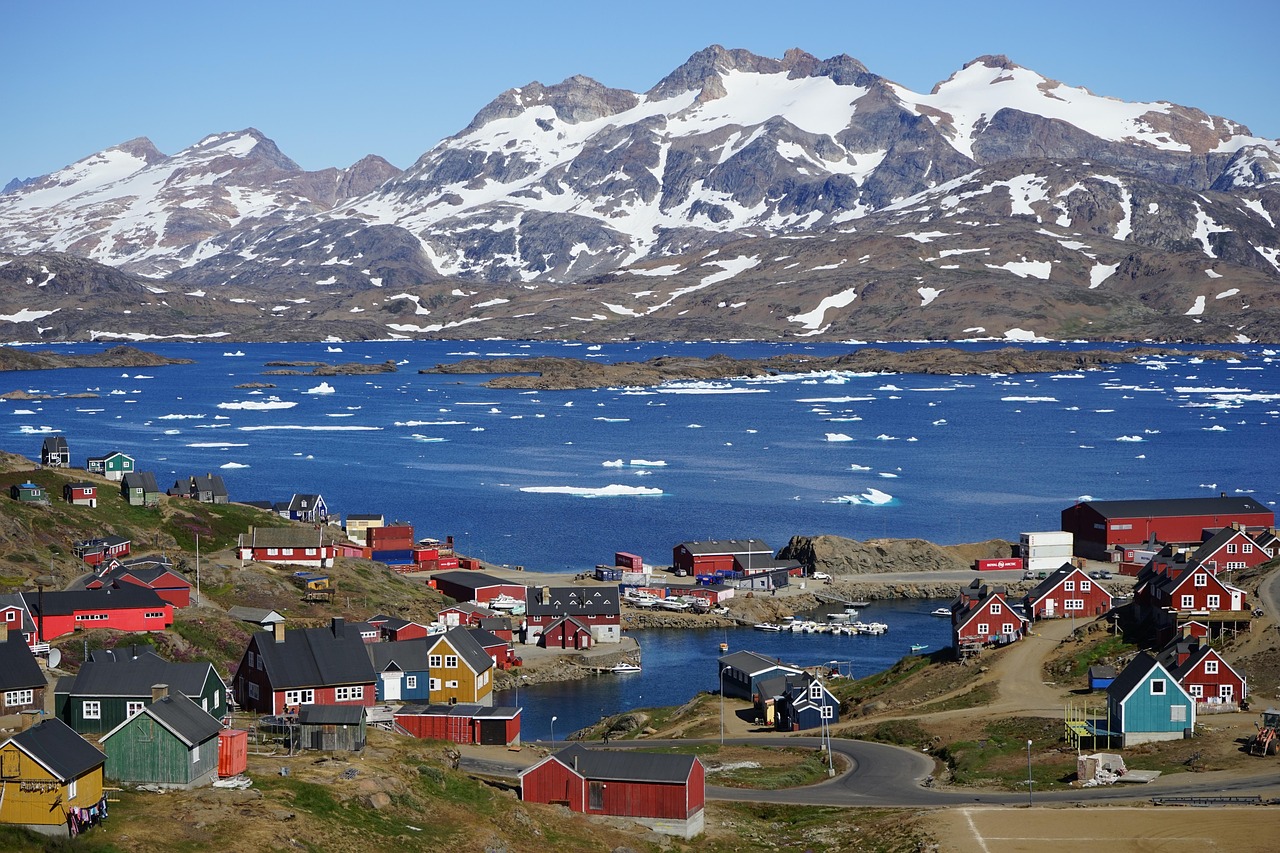
Tasiilaq, Greenland
US Signals Strategic Options on Greenland, Details Venezuela Oil Operations and Political Plan
Washington: The United States today underscored that it is maintaining broad strategic flexibility regarding Greenland, including potential military options, while simultaneously providing an extensive outline of operations in Venezuela, where the U.S. continues to enforce sanctions and control oil exports. Secretary of State Marco Rubio told reporters that discussions with Denmark regarding Greenland are scheduled for next week, but declined to comment in detail on military measures, emphasising instead that every U.S. President retains the right to act to protect national security interests globally. Rubio highlighted the historical context of Greenland, noting that previous administrations, including President Truman’s, had explored its acquisition, and that President Trump had raised the issue in earlier terms, underscoring the Arctic island’s continuing strategic significance.
Turning to Venezuela, Rubio and Secretary of War Pete Hegseth outlined a three-phase plan aimed at stabilising the country, managing its energy resources, and facilitating a political transition. Rubio described the phases as stabilisation, recovery, and transition, emphasising that the United States currently holds significant leverage over Venezuela’s interim authorities through the enforcement of sanctions and direct control over oil exports. He stressed that these measures are already being implemented and are producing tangible leverage on the ground.
The stabilisation phase focuses on preventing chaos in Venezuela, with U.S. control over oil exports forming a central component. Rubio confirmed that earlier this week, on January 5 and 6, 2026, U.S. authorities seized two vessels carrying Venezuelan crude: one linked to Iran’s Revolutionary Guard Corps (IRGC) and another flagged under Russia. He explained that these shipments, totaling between 30 and 50 million barrels, had been blocked due to sanctions and quarantine measures, and that the United States plans to sell the oil at market rates. Proceeds will be managed in a manner intended to benefit the Venezuelan people rather than the Maduro regime, preventing diversion of funds through corruption or mismanagement. Rubio described the leverage gained through these operations as “tremendous” and central to the stabilisation effort, noting that Venezuelan authorities understand that cooperation with the United States is essential for moving oil and generating revenue to prevent economic collapse.
Hegseth added that the U.S. military is prepared to continue enforcing the oil blockade, including additional tanker seizures if required. He emphasised that the operations are highly sophisticated, integrated with ongoing U.S. deployments across the Mediterranean, Middle East, and Indo-Pacific, and do not impose additional costs on U.S. taxpayers, as existing forces are already deployed globally. Hegseth stressed that the U.S. administration is “an administration of action,” highlighting the precision, planning, and operational reach of the military in executing these measures.
The recovery phase is designed to create conditions for national reconciliation and economic rebuilding. Rubio explained that this includes opening Venezuela’s markets to U.S. and Western companies, ensuring fair access, and fostering political processes that allow the opposition to participate meaningfully in governance. This phase also encompasses potential amnesty or release of opposition figures and efforts to rebuild civil society institutions that were undermined under the previous regime. Rubio emphasised that these measures aim to support Venezuelans in shaping their own recovery while transitional authorities operate under U.S. oversight.
The transition phase, which overlaps with stabilisation and recovery, focuses on facilitating a broader political transformation. Rubio stressed that while the United States provides guidance and leverage, the outcome rests with the Venezuelan people. He emphasised that the administration’s role is to create conditions for positive change, rather than dictate outcomes.
Rubio addressed concerns raised by some senators who had suggested the administration was “winging it” in Venezuela. He countered that detailed briefings had been provided to Congress, outlining the operational plan and ongoing coordination with PDVSA, Venezuela’s state oil company. He noted that U.S. control over oil exports is already shaping the decisions of interim authorities and producing tangible results on the ground.
The briefing also included a discussion of operational costs and timelines. Rubio and Hegseth emphasised that the oil seizures and enforcement measures are being conducted within existing deployments and are not expected to impose additional costs on U.S. taxpayers. Rubio acknowledged that the process will not yield overnight results, stressing that although public expectations often favour immediate outcomes, stabilisation and recovery efforts require careful management and time to achieve sustainable impact.
The briefing highlighted broader geopolitical and operational considerations. Analysts note that the seizure of IRGC-linked and Russian-flagged vessels elevates the situation from a regional dispute to a matter involving international maritime law, freedom of navigation, and global energy markets. The interception of these vessels underscores the United States’ capacity to project operational influence across multiple theatres while exercising economic leverage over a sanctioned state. Observers also point to the potential ripple effects on global supply chains, as the temporary disruption of Venezuelan crude exports can influence shipping schedules, insurance coverage, commodity pricing, and industrial supply networks.
Venezuelan authorities have publicly acknowledged the need to cooperate with the United States to move oil and generate revenue, suggesting a pragmatic alignment with U.S. objectives on economic stabilisation, even as broader political tensions remain. While the Maduro regime continues to assert sovereignty rhetorically, practical reliance on U.S.-managed export channels indicates a partial acceptance of operational realities on the ground.
In addition to bilateral and operational discussions, Secretary Rubio spoke on January 6 with the foreign ministers of the Group of Seven (G7) major democracies. The leaders discussed the United States’ ongoing counternarcotics operations in the Caribbean, the recent arrest of Venezuelan President Nicolás Maduro, and the need to ensure a proper and judicious transition of power in Venezuela. They also reiterated support for continuing negotiations to end the Russia‑Ukraine war and reaffirmed the importance of continued cooperation on shared security and diplomatic priorities. This engagement reflected a coordinated diplomatic effort among leading democracies to align on stability efforts in the Western Hemisphere and beyond.
Today’s briefing demonstrates a complex and multi-layered approach by the United States, combining diplomacy, sanctions enforcement, maritime operations, economic leverage, and political oversight to influence Venezuela’s governance while maintaining strategic flexibility globally. From Greenland to the Caribbean, the administration is signalling both its global reach and operational sophistication, reinforcing that U.S. strategy integrates economic, military, and political tools to achieve objectives while retaining the ability to respond to emerging international threats.
– global bihari bureau