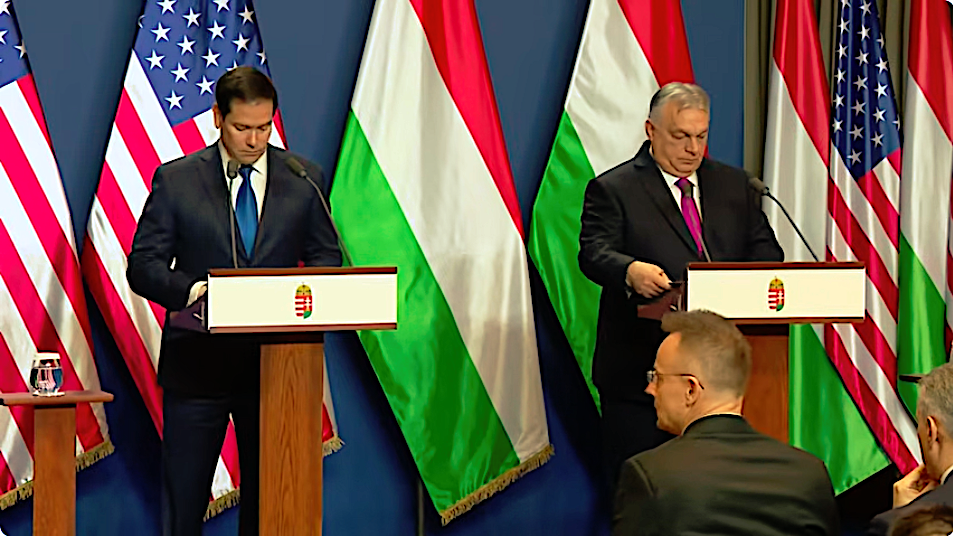
Secretary Rubio holds a joint press availability with Hungarian Prime Minister Viktor Orban, in Budapest today.
U.S. Advances Euratom-Aligned Nuclear Projects
Rubio Pushes Nuclear Partnerships in Slovakia, Hungary
Bratislava/Budapest: United States Secretary of State Marco Rubio, on February 15–16, 2026, announced major civil nuclear cooperation initiatives with Slovakia and Hungary, describing them as strategic steps to strengthen regional energy security, advance mutual national security objectives, and support long-term industrial and technological competitiveness in Central Europe. U.S. officials highlighted that these initiatives are designed to meet the region’s growing electricity demands from artificial intelligence, data-driven industries, and advanced manufacturing, while providing a framework for decades of bilateral cooperation in civilian nuclear energy.
In Hungary, Secretary Rubio signed a U.S.–Hungary Civil Nuclear Intergovernmental Agreement establishing a framework for long-term cooperation in nuclear energy. The accord underscores U.S. support for making Hungary a regional hub for the development of Small Modular Reactors (SMRs), a next-generation class of nuclear plants designed for flexibility, scalability, and cost-efficiency. Rubio encouraged Hungary to select U.S. SMR technology for future projects and reaffirmed that Holtec International stands ready to assist Hungary with spent nuclear fuel management through a dry cask storage system designed for maximum security, safety, and operational flexibility, subject to approval by the Hungarian parliament.
During a joint press conference in Budapest today, Secretary Rubio and Prime Minister Viktor Orban highlighted the strengthening of U.S.-Hungarian relations, particularly in the realm of civilian nuclear cooperation. The leaders emphasised that the newly signed agreement builds upon a historic November meeting at the White House and is expected to foster further collaboration in energy, trade, and investment. Orban underscored Hungary’s record of attracting U.S. investments, including 17 projects approved since January, and reaffirmed the country’s commitment to energy security, citing ongoing cooperation in oil, gas, and nuclear energy. Rubio noted that the bilateral partnership reflects not only aligned national interests but also a personal rapport between the Prime Minister and the U.S. President, which has facilitated tangible outcomes such as sanctions waivers on Russian energy and enhanced economic cooperation.
Both leaders also addressed broader geopolitical concerns, stressing that Hungary maintains strategic flexibility in engaging with global partners, including China, while remaining firmly committed to NATO obligations and U.S.-Hungarian cooperation. Rubio further highlighted America’s ongoing efforts to mediate the Russia-Ukraine conflict, framing the U.S.-Hungary relationship as a key component in promoting regional stability. Orban, in turn, reaffirmed Hungary’s readiness to host a potential peace summit in Budapest, demonstrating a willingness to leverage the country’s strategic position for international diplomacy while maintaining transparency and open dialogue with the United States.
In Bratislava yesterday, Slovakian Prime Minister Robert Fico and Secretary Rubio elaborated on the ongoing civil-nuclear cooperation between Slovakia and the United States. Fico explained that the intergovernmental agreement, which entered into force on 13 February, enables the construction of a new 1,200-megawatt nuclear block, potentially involving a multinational consortium led by Westinghouse. He emphasised Slovakia’s interest in advancing this project with full U.S. technical and regulatory support, highlighting its importance for energy security and diversification. Rubio added that the United States welcomes Slovakia’s initiative, noting that American engagement and expertise are designed to ensure safe, efficient, and mutually beneficial implementation of the nuclear project, reflecting a model of bilateral cooperation that strengthens strategic energy ties.
The project in Slovakia will begin with the launch of the Front-End Engineering and Design (FEED) study, the critical preconstruction phase for the new large nuclear reactor. Funded by the United States and conducted by Westinghouse, the study will focus on technical planning and site preparation, accelerating construction using advanced U.S. nuclear technology. This work will be carried out under the Department of State’s Foundational Infrastructure for Responsible Use of Small Modular Reactor Technology (FIRST) Program, which helps partner countries establish nuclear energy systems that are safe, secure, and responsibly governed while complying with international safeguards and nonproliferation norms.
The U.S. State Department described these initiatives as significant achievements under Executive Order 14299, “Deploying Advanced Nuclear Reactor Technologies for National Security,” issued by President Donald Trump. Officials noted that the projects collectively represent over 15 billion dollars in potential U.S. business opportunities and are expected to support thousands of American jobs, reinforcing both economic and strategic objectives.
U.S. officials framed the Central European agreements within the long-standing legal and policy framework of United States–European Atomic Energy Community (Euratom) cooperation on peaceful nuclear energy and nonproliferation. Since the Euratom Treaty entered into force in 1958, Europe’s civil nuclear sector has operated under a supranational legal and safeguards regime designed to ensure nuclear technology is used exclusively for civilian purposes. The United States established formal cooperation with Euratom through bilateral agreements beginning the same year, creating a verified legal basis for nuclear trade, technology transfer, research collaboration, and safeguards implementation under International Atomic Energy Agency (IAEA) oversight. U.S. officials present the Slovakia and Hungary agreements as extensions of existing transatlantic nuclear cooperation rather than stand-alone commercial arrangements.
Because both Slovakia and Hungary became members of the European Union and Euratom in 2004, any U.S.-supported reactor construction, SMR deployment, or spent fuel management project must operate under Euratom safeguards, European Union nuclear safety regulations, and IAEA verification. Analysts note that this ensures the new projects are embedded in Europe’s collective civilian nuclear governance and nonproliferation framework, rather than functioning as purely bilateral ventures.
The agreements also reflect a broader shift in transatlantic nuclear cooperation toward diversification of technology and fuel supply chains. For decades, much of Central Europe’s nuclear infrastructure—including Slovakia, Hungary, the Czech Republic, and Bulgaria—has relied on Russian-designed VVER reactors and associated fuel services. By promoting U.S. reactor designs and SMR technology under Euratom supervision, Washington is aligning its exports with the European Union’s post-2022 energy security policy, aimed at reducing dependence on single-source suppliers while maintaining strict safety, regulatory, and nonproliferation standards.
Analysts highlight the dual nature of the projects: they are peaceful civilian energy initiatives conducted under international safeguards, while also advancing strategic objectives in energy resilience, industrial capacity, and regional stability. In U.S. statements, “peaceful use” refers to electricity generation and regulatory compliance, whereas “strategy” reflects broader economic, technological, and security goals achieved through diversified supply chains and transatlantic cooperation.
Compared with earlier United States–Euratom cooperation with Western European nuclear powers such as France and the United Kingdom, the Central European initiatives represent both a geographic and functional shift. Earlier cooperation focused on research collaboration, regulatory alignment, and mature reactor fleets already integrated into global markets. Slovakia and Hungary, by contrast, are undertaking new-build reactors, SMR deployment, and fuel-cycle management in countries seeking to modernise and diversify their nuclear sectors, while fully operating within the supranational Euratom and IAEA frameworks.
U.S. officials emphasise that the initiatives also reinforce more than 70 years of American leadership in nuclear safety, security, and nonproliferation. They demonstrate how civil nuclear cooperation is increasingly being used as a tool linking energy policy, industrial competitiveness, and regional stability.
With Slovakia entering the engineering phase of a new large reactor and Hungary preparing to expand cooperation on SMRs and spent fuel management, the announcements signal a new chapter in U.S.–Central European nuclear collaboration, framed as both an economic opportunity and a pillar of long-term regional security.
– global bihari bureau