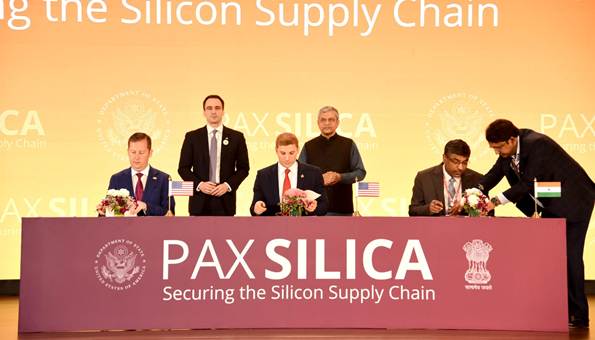
New Delhi: The United States and India formally signed the Pax Silica Declaration on February 20, 2026, marking India’s accession to a coalition of nations focused on secure technology, artificial intelligence (AI), and critical mineral supply chains. The agreement emphasises the principle that economic security and national security are closely linked and establishes a framework for technological cooperation between the two countries.
The signing ceremony was attended by U.S. Ambassador to India Sergio Gor, Under Secretary of State for Economic Affairs Jacob Helberg, and Indian Secretary of the Ministry of Electronics and Information Technology Shri S. Krishnan. The declaration sets out commitments by both nations to support regulatory frameworks that encourage AI innovation, promote secure and trusted AI ecosystems, and facilitate cross-border investment in emerging technologies.
Speaking at the ceremony, Jacob Helberg, United States Under Secretary of State for Economic Growth, Energy, and the Environment, described the declaration as “not merely an agreement on paper, but a roadmap for a shared future.”
Invoking the shared democratic histories of both nations, he stated, “Today, as we sign the Pax Silica declaration, we say no to weaponised dependency, and we say no to blackmail. Together, we affirm that economic security is national security.
Highlighting the broader ambition behind the initiative, he added, “We are securing the full stack of the future, the minerals deep in the earth, the silicon wafers in our labs and fabs, and the intelligence that will unleash human potential. Pax Silica is our declaration that the future belongs to those who build.”
Echoing this sentiment, Sergio Gor, U.S. Ambassador to India, described India’s entry into Pax Silica as both “strategic and essential.”
“Pax Silica is the coalition that will define the 21st century economic and technological order,” he said. “It is designed to secure the entire silicon stack, from the mines where we extract critical minerals, to the fabs where we manufacture chips, to the data centres where we deploy frontier AI.”
Understanding the democratic foundation of the partnership, Ambassador Gor remarked, “Pax Silica is about whether free societies will control the commanding heights of the global economy. We choose freedom. We choose partnership. We choose strength.”
India joins Pax Silica as the tenth member, alongside Australia, Israel, Japan, Qatar, South Korea, Singapore, the United Arab Emirates, and the United Kingdom. The United States indicated that additional countries are expected to join Pax Silica in the future. The initiative is designed to strengthen technological resilience among member nations and ensure access to critical resources and infrastructure essential for advanced computing and AI. The coalition emphasises collaboration on research, supply chains, and pro-innovation policies while avoiding restrictive regulatory measures that could impede development.
The agreement builds on the objectives of the Transforming the Relationship Utilising Strategic Technology (TRUST) initiative, previously outlined by the United States and India. The declaration formalises the two countries’ intention to foster secure AI systems, support domestic and cross-border innovation, and maintain robust technological capabilities. India’s participation brings technical expertise, capacity for processing and refining critical minerals, investment in AI infrastructure, and experience in trusted technologies.
Implications of India Joining Pax Silica
India’s accession provides a platform to coordinate with other member nations on AI, digital infrastructure, and critical minerals, strengthening its integration with global technology supply chains. By participating, India gains access to a multilateral framework for collaboration on secure technologies, supply chain security, and innovation-friendly regulations. This formalises India’s ongoing efforts to develop domestic capabilities in semiconductors, electronics, and AI while maintaining alignment with international standards.
The declaration allows India to actively contribute to establishing trusted technology ecosystems, supporting cross-border research, and facilitating private sector participation in advanced technology development. India’s inclusion reinforces its position among leading democracies in coordinating standards, policies, and research in critical technology sectors, ensuring both economic and national security objectives are supported.
In summary, India’s signing of the Pax Silica Declaration consolidates its role in a coalition of nations committed to secure and reliable technology. It strengthens domestic priorities in AI, semiconductors, and critical minerals while providing an institutional framework for multilateral collaboration, research, and innovation, enhancing India’s technological and economic resilience.
– global bihari bureau