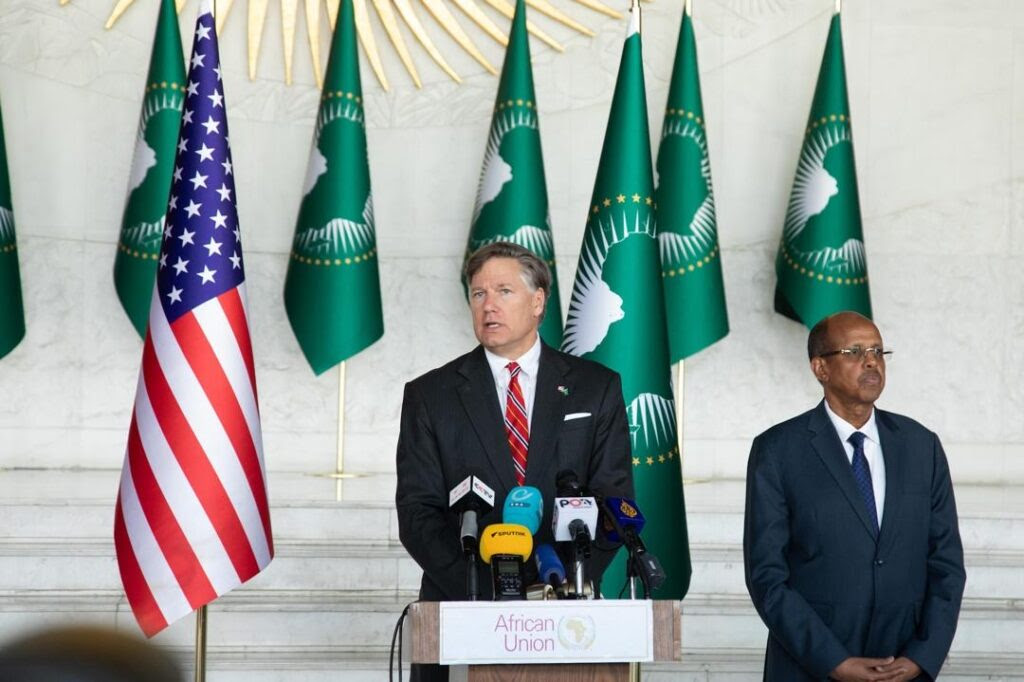
Deputy Secretary of State Christopher Landau and AUC Chairperson Mahmoud Ali Youssouf i Addis Ababa today.
New U.S.–AU Working Group to Advance Africa Infrastructure
Washington and AU Set Framework for Private Sector Investment
Addis Ababa: The United States and the African Union Commission (AUC) have formally established the U.S.–AUC Strategic Infrastructure and Investment Working Group (SIWG), a new platform intended to coordinate and advance private sector participation in infrastructure and related economic projects across Africa. The agreement was announced today following high‑level discussions in Addis Ababa between U.S. Deputy Secretary of State Christopher Landau and African Union Commission Chairperson Mahmoud Ali Youssouf. The announcement followed a joint commitment by both sides to strengthen economic engagement between the United States and African nations through the African Union framework, with a focus on identifying and supporting investment opportunities that facilitate trade and regional integration.
The SIWG is designed to bring together senior officials and technical experts from the United States and the African Union to identify and advance opportunities for private sector investment in AU‑backed infrastructure projects and initiatives. According to a joint statement issued by the U.S. Department of State and the African Union Commission, the working group will coordinate efforts to promote economic partnerships that create jobs, support trade, and enhance economic security in both the United States and across Africa. It will enable engagement in areas such as transport and logistics infrastructure, digital connectivity, regional energy networks, and supply chains for critical minerals and commodities.
Officials from both sides noted that the working group’s activities are intended to align with African Union development priorities, including the long‑term continental framework known as Agenda 2063 and its associated flagship programmes. One such priority is the Programme for Infrastructure Development in Africa (PIDA), which provides a common framework for African stakeholders to build infrastructure networks that facilitate integrated transport, energy, and communication systems to support intra‑African trade and competitiveness. Under PIDA, regional development corridors — such as transport links that span multiple countries — are identified to promote cross‑border connectivity and economic activity, reflecting long‑standing AU objectives to address infrastructure deficits. PIDA projects have been coordinated with the African Union Commission, the African Development Bank, and other regional institutions to improve access and connectivity across the continent.
The SIWG is also linked to the objectives of the African Continental Free Trade Area (AfCFTA), a trade agreement that aims to create a continent‑wide market by reducing tariffs and non‑tariff barriers among signatory African states. The AfCFTA framework, when fully implemented, is expected to facilitate smoother movement of goods and services across national borders, enhance market access, and support integrated regional value chains. These goals are central to the African Union’s economic integration agenda and are reflected in the working group’s focus on infrastructure that enables trade facilitation.
In reaction to the launch of the working group, African Union officials emphasised that it provides a formal mechanism to coordinate investment planning in areas deemed critical for development. Chairperson Youssouf met with Deputy Secretary Landau in Addis Ababa to discuss the scope of the initiative, noting that the group will enable AU member states and Regional Economic Communities to participate in planning and executing infrastructure and related projects. AU representatives also pointed to ongoing continental efforts to strengthen integration and monitor progress through mechanisms such as the 2025 Africa Integration Report, which assesses performance in regional integration and highlights areas where policy reforms and infrastructure development remain priorities for advancing integration under Agenda 2063.
The United States and the African Union have framed the SIWG as part of a shift from traditional aid‑centred engagement toward a focus on investment‑driven partnerships that involve the private sector. U.S. government officials described the working group as a framework to facilitate investment opportunities that attract commercial interest, generate employment, and support economic growth. This reflects broader efforts in recent years to expand U.S. economic ties with African countries, including programs that have sought to increase two‑way trade and investment. According to U.S. government figures, since 2021, the United States has helped close hundreds of two‑way trade and investment deals across African countries worth billions of dollars, supporting sectors such as infrastructure, energy, healthcare, and digital connectivity.
U.S. engagement with African economies has included support from agencies such as the International Development Finance Corporation (DFC), which has committed financing to infrastructure projects, including railway corridors that link mineral production regions to ports. One example is the Lobito Corridor project, supported by multilateral and bilateral partners, which aims to link mines in the Democratic Republic of Congo and Zambia to the Atlantic port of Lobito in Angola, enhancing transportation capacity and access to global markets. Such projects exemplify how infrastructure planning is increasingly seen as intertwined with economic and trade objectives.
The SIWG’s consultation and engagement process is expected to begin in the coming months, with both U.S. and AU officials indicating that early technical exchanges will focus on identifying priority sectors and project pipelines. Discussions will also aim to establish investment frameworks and implementation timelines, ensuring that both sides can coordinate on regulatory environments and conditions that facilitate private sector involvement. The working group structure is intended to support ongoing dialogue between U.S. government agencies, AU departments, and member states, reinforcing coordination on strategic economic projects.
Officials have pointed to multiple areas of focus — including transport, energy, digital infrastructure, and health security — that are expected to form part of the working group’s agenda. Investments aimed at expanding digital connectivity are seen as relevant not only for communication but also for supporting e‑commerce and secure data systems across African markets. Efforts to improve health security infrastructure, including medical supply chains and systems for pandemic response, are also being linked to broader economic engagement plans, reflecting priorities articulated in recent international cooperation initiatives.
Regional connectivity remains a central theme for both African Union development planning and the working group’s mandate. Under Agenda 2063, interconnected infrastructure — spanning highways, rail links, and energy transmission networks — is considered fundamental to facilitating trade and economic integration. The AU’s development planning frameworks have highlighted numerous priority projects that span multiple regions and countries, underscoring the scale and complexity of implementing continental infrastructure.
African Union representatives have reiterated that the working group will provide a platform for structured planning and engagement on projects that reflect both continental and national development objectives. They note that the involvement of AU member states and Regional Economic Communities is essential for aligning infrastructure priorities with broader regional integration goals.
The United States has engaged in multiple high‑level efforts to strengthen economic ties with African countries in recent years. A notable milestone was the United States–Africa Leaders Summit held in Washington in 2022, which brought together heads of state, U.S. government officials, and business leaders to discuss cooperation on health, climate change, and economic partnerships. In the years since, U.S. engagement initiatives have included efforts to facilitate private sector investment in African markets, support clean energy projects, and expand digital infrastructure partnerships.
By establishing the SIWG with the African Union, the United States and the AU aim to create a formal mechanism for continued economic dialogue and project coordination. Both sides have signalled that private sector involvement and technical consultations will play a key role in shaping the working group’s activities as they unfold. The group’s work is expected to take place against the backdrop of ongoing efforts to strengthen economic ties, improve regional connectivity, and support integrated markets across the African continent.
– global bihari bureau