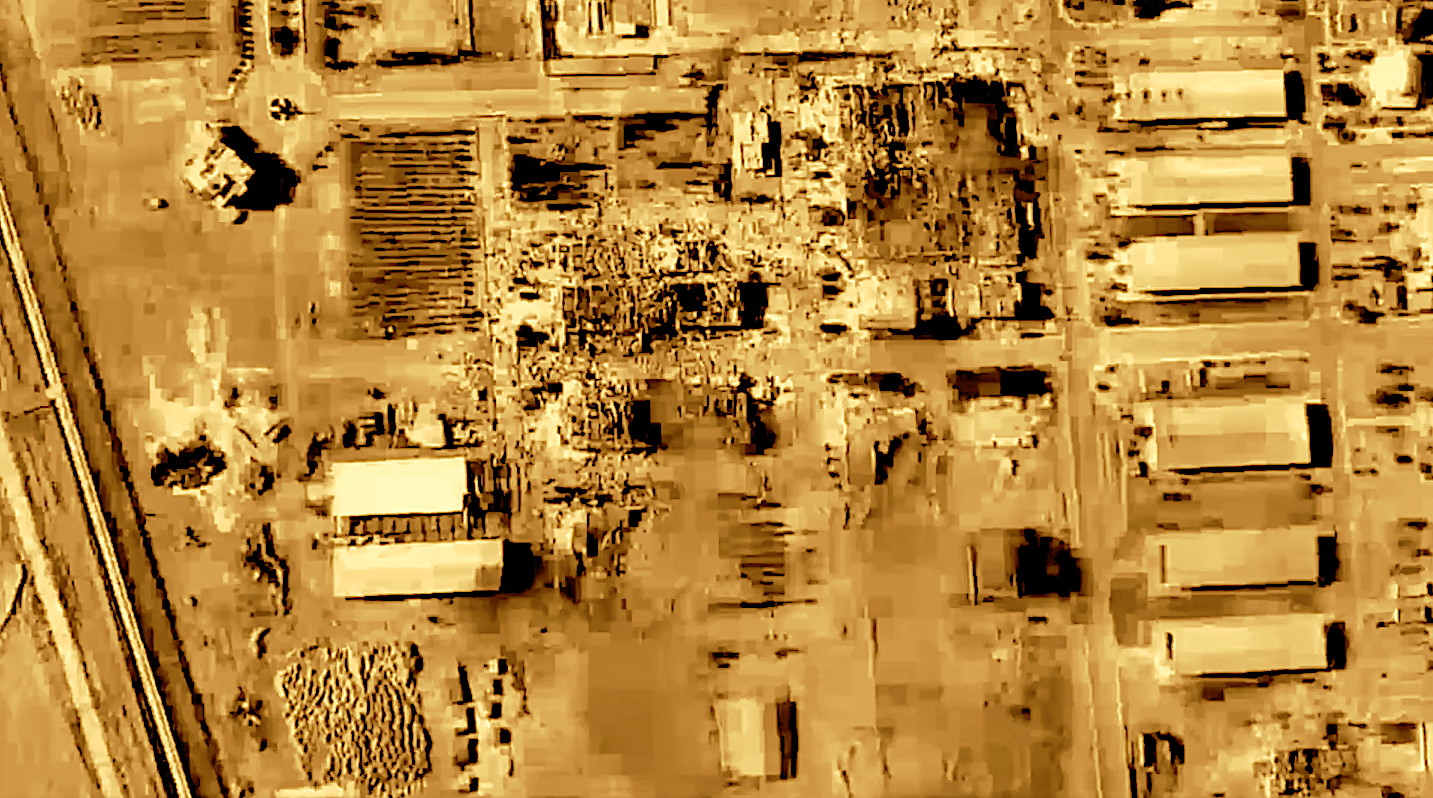
The destroyed nuclear site in Isfahan in western Iran where Israel claimed reconversion of enriched uranium was taking place. This is the stage following enrichment in the process of developing a nuclear weapon. IDF had already struck the site in the operation’s opening blow—and last night, it struck it again in a wide-scale strike.

American President Donald Trump’s cautious diplomatic approach belied Israeli Prime Minister Benjamin Netanyahu’s expectations, leaving Israel to face Iran’s threat alone. Trump’s absence from the Geneva talks between Iranian and European officials that concluded inconclusively yesterday, and his reluctance to fully join the war, per his two-week window to assess diplomatic prospects with Iran, have frustrated Netanyahu, who at the June 18, 2025, cabinet meeting, awaited a U.S. decision on joining the fight within 24-48 hours. Reports indicate he pushed for U.S. backing for strikes on Iran’s nuclear sites, seeking joint action to counter the nuclear threat.
This prioritisation of talks over immediate military escalation, coupled with the U.S.’s absence from the June 20 Geneva negotiations, contrasts with Netanyahu’s evident hope for robust U.S. military support, as seen in his June 18 cabinet meeting, awaiting a U.S. decision on joining the fight. Yesterday’s Geneva talks ended without progress, with Iran’s Foreign Minister Abbas Araghchi rejecting zero enrichment as a “red line” and demanding an Israeli ceasefire before further negotiations. The cancellation of U.S.-Iran talks in Oman further underscores the diplomatic impasse.
Trump’s actions suggest a divergence. On June 11, he urged Netanyahu to halt Iran attack threats, warning they undermined nuclear talks, and pressed for ending the Gaza war, as confirmed by sources. Trump also reportedly vetoed an Israeli plan to assassinate Iran’s Supreme Leader Ayatollah Ali Khamenei, citing concerns it would inflame the conflict, reflecting a preference for restraint over escalation. Earlier, in May 2025, Trump’s Middle East trip excluded Israel, focusing on Saudi Arabia, Qatar, and the UAE, and he negotiated with Iran and Hamas without Israeli input, prompting Israeli media to note a perceived “total breakdown” in Israel’s regional influence. Trump’s perceived frustration with Netanyahu, stemming from his push for Iran strikes and delays in Gaza ceasefire talks, led to an independent U.S. approach, reshaping the region without Israel’s central involvement.
The importance of the U.S. intervention in ending the Israel-Iran conflict swiftly cannot be overstated. The U.S.’s diplomatic influence, as noted by the US State Department Spokesperson Tammy Bruce’s reference to America’s role as Ukraine’s biggest supporter, positions it to mediate between Iran’s demand for an Israeli ceasefire and Israel’s security imperatives, potentially halting the 248 civilian deaths reported by United Nations experts.
While Trump has bolstered Israel with military aid since the conflict’s onset, his independent regional diplomacy has now apparently sidelined Israel, creating tension but not abandonment, as Iran’s fierce retaliation and the conflict’s intensity underscore the stakes of their relationship. This diplomatic sidelining, while not constituting military abandonment, has left Israel navigating a complex regional landscape with less U.S. alignment than anticipated.
Yet, the U.S.’s firm stance, articulated by Bruce, that Iran must not acquire a nuclear weapon, aligns with Israel’s objectives but adds tension to diplomatic efforts. Bruce, in the June 20 briefing, highlighted Secretary of State Marco Rubio’s upcoming trip to The Hague for NATO discussions and Special Envoy Steve Witkoff’s contacts with Iranian officials as part of ongoing efforts to facilitate talks.
However, Trump’s call for Iran’s “complete give-up,” voiced after leaving the G7 summit early on June 17, 2025, contrasts sharply with Iran’s insistence on an Israeli ceasefire, complicating prospects for a resolution. Although Trump has belied Netanyahu’s expectations, it can be said that the US President has not left Israel in the lurch. Since the conflict began, 14 U.S. cargo planes have delivered military equipment, part of 800 since the Gaza war’s onset, bolstering IDF operations, including the successful strikes on Iranian commanders and nuclear sites. Trump’s public support post-strikes, describing them as “a very successful attack” on June 13, and his alignment with Israel’s concerns about Iran’s nuclear progress—evidenced by a June 19 White House statement noting Iran’s nuclear bomb capability is weeks away—demonstrate continued backing. A reported U.S.-Israel misinformation campaign to lull Iran suggests coordination, not abandonment.
But Trump’s absence from key diplomatic talks and independent regional engagements, despite providing military aid to Israel since the conflict’s onset, has frustrated Israel, sidelining it diplomatically but not abandoning it militarily. This nuanced dynamic underscores the complexity of U.S.-Israel relations under Trump as the conflict escalates, with Israeli airstrikes and Iranian retaliation intensifying the regional crisis.
The failure of the Geneva talks, coupled with Iran’s refusal to negotiate without an Israeli pause, suggests that without U.S. involvement, military escalation persists, as seen in the intensified strikes and Iran’s threats of harsher retaliation.
As the Israel-Iran conflict rages into its ninth day on June 21, 2025, international alarm is mounting as diplomacy remains. The latest escalation came overnight on June 20-21, when Israeli warplanes struck Iran’s nuclear facilities in Isfahan and western Iran, deepening “Operation Rising Lion.” The Israeli Defense Forces (IDF) reported the strikes targeted a uranium reconversion site critical for nuclear weapon development, with IDF Spokesperson Brigadier General Effie Defrin referring to the site where reconversion of enriched uranium takes place. “We had already struck the site in the operation’s opening blow—and last night, we struck it again in a wide-scale strike to reinforce our achievements.” The IDF also intercepted 40 Iranian unmanned aerial vehicles (UAVs) that night, sustaining a 99% interception rate for over 470 UAVs since the operation began on June 13. These strikes aim to dismantle Iran’s nuclear and proxy networks, with the IDF eliminating Quds Force commanders Behnam Shahriyari, responsible for weapons transfers to Iran’s proxies, and Saeed Izadi, a key Hamas coordinator linked to the October 7, 2023, attack, in strikes over 1,000 kilometres from Israel. As per the latest updates at the time of going to the press tonight, the IDF struck F-14 fighter jets belonging to the Iranian Armed Forces in central Iran. Additionally, Israeli Air Force fighter jets were currently striking military infrastructure in central Iran.
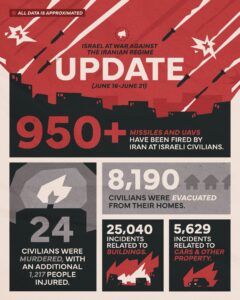
Iran’s response, expectedly, has been fierce, with missile and drone attacks damaging a hospital in Beersheba and residential areas in Tel Aviv and Haifa. UN experts reported 24 civilian deaths in Israel and 224 in Iran, with 90% of Iranian casualties being civilians. On June 20, Iran’s President Masoud Pezeshkian posted on X, “We have always sought peace and tranquility, but in the current circumstances, the only way to end the imposed war is to ‘unconditionally stop’ the enemy’s aggression and provide a definitive guarantee to end the adventures of Zionist terrorists forever. Otherwise, our responses to the enemy will be harsher and more regrettable.” Supreme Leader Ayatollah Ali Khamenei, on June 21, praised public rallies after Friday prayers yesterday, signalling Iran’s resilience and national unity in the face of Israeli aggression.
The U.S.’s ability to coordinate with allies, highlighted by Rubio’s planned The Hague discussions, could unify international pressure to enforce compliance with international law, as urged by UN experts who warn of a collapsing legal order. On June 20, these UN experts condemned Israel’s strikes as a “flagrant violation” of international law, citing attacks on nuclear facilities, energy infrastructure, and civilian targets, including Iran’s state television, which killed three media workers. They also criticised Iran’s retaliatory strikes for violating principles of proportionality, distinction, and precaution.
The International Atomic Energy Agency (IAEA) has confirmed damage to Iran’s Natanz enrichment facility but reported no radiation leaks at Natanz or the Bushehr Nuclear Power Plant, though IAEA Director General Rafael Grossi, referenced by Bruce, warned of the catastrophic risks of military action near nuclear sites. Unconfirmed reports, acknowledged by Bruce, of Iran using human shields in Kermanshah and a Chinese cargo plane heading to Iran, pending U.S. review, add layers of complexity to the crisis.
Direct U.S. engagement, leveraging Witkoff’s channels and Trump’s two-week deadline—aligned with intelligence indicating Iran’s proximity to a nuclear weapon—could create urgency for a negotiated pause, averting the catastrophic nuclear risks Grossi highlighted. Trump, of course, has a task at hand, but will he deliver on time to minimise the destruction?