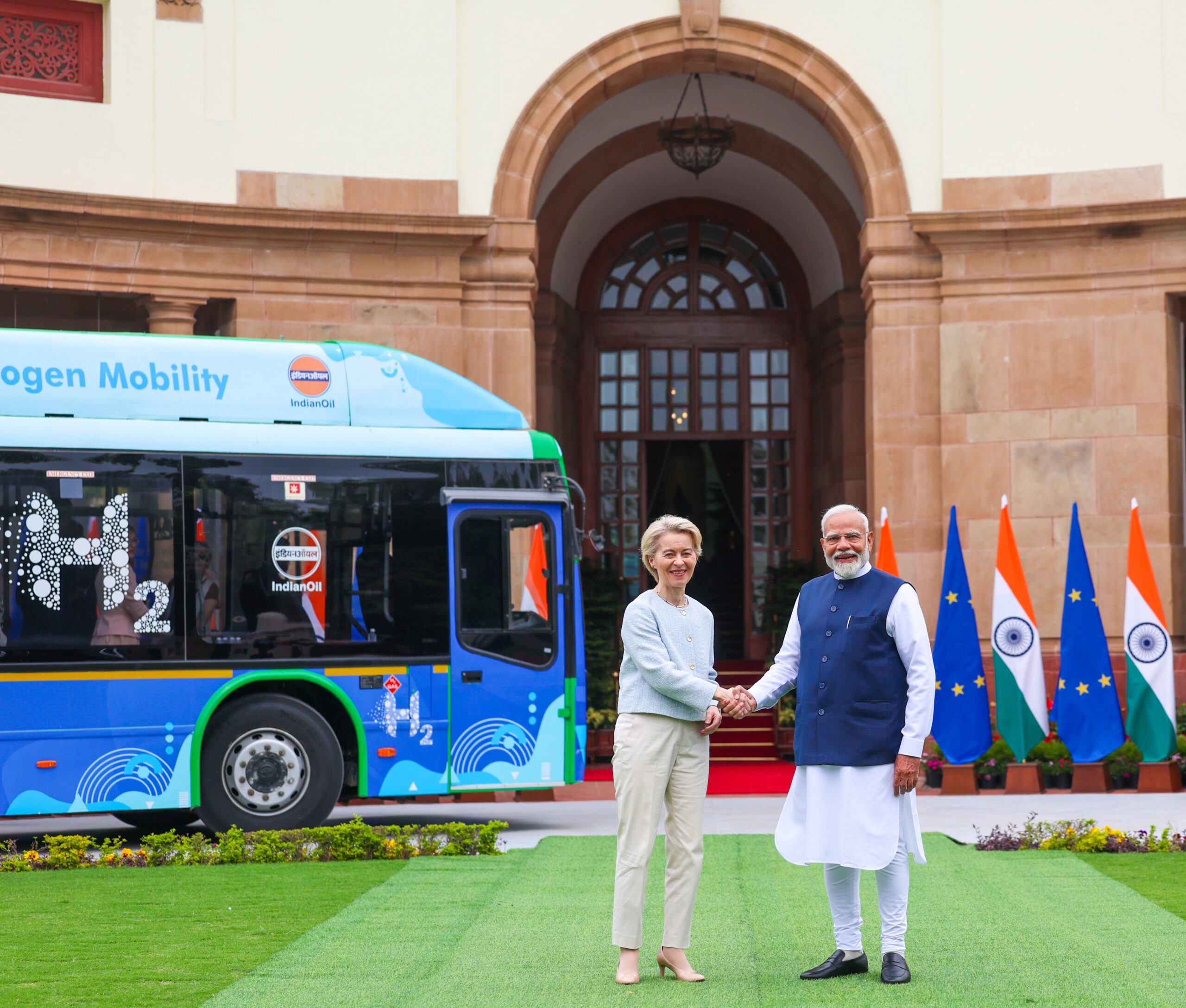
President of the European Union Commission Ursula von der Leyen with Indian Prime Minister Narendra Modi in New Delhi on February 28, 2025.

The United States President Donald Trump’s return to the White House has shattered the global order, severing transatlantic bonds and driving the European Union and the United Kingdom to forge new alliances, with India emerging as a central force in a multipolar world.
On May 19, 2025, the European Union and the United Kingdom signed a historic pact in Brussels, a direct response to Trump’s relentless attacks on Western unity. This agreement, born from the fallout of Trump’s divisive policies, draws inspiration from India’s non-alignment doctrine, first articulated by Jawaharlal Nehru at the 1955 Bandung Conference, where he declared, “We do not want to be tied to any bloc” (18 April 1955). West Germany’s Konrad Adenauer cautioned at the time, “Neutrality often aids the stronger aggressor” (15 June 1955).
Today, as Trump’s United States retreats into isolation, the EU seeks strategic autonomy and turns to India, a civilizational state whose diplomatic patience heralds a new era of global realignment. Europe’s pivot to India reaffirms Nehru’s dream of a multipolar world.
Trump’s actions have dismantled the post-1945 world order. On January 20, 2025, his second inauguration unleashed a torrent of rhetoric that strained ties with Europe. At a Pennsylvania rally on 15 March 2025, he labelled the North Atlantic Treaty Organisation “obsolete baggage” and described Europe as “a guest feasting on the United States’ treasury.” On April 10, 2025, speaking to Texas donors, he denounced the European Union’s Green Deal as “economic murder” for United States workers and mocked Germany as “Putin’s energy slave.” Each remark, delivered with Trump’s characteristic bravado, was a deliberate blow to the transatlantic bond. Yet, Europe has responded with resolve. A senior official from the Élysée Palace, France’s presidential office, confided in February 2025, “Trump’s disdain has freed us to sever the leash.”
European leaders made concerted efforts to repair the relationship. On February 24, 2025, French President Emmanuel Macron visited Washington, followed by United Kingdom Prime Minister Sir Keir Starmer on March 3. Italian Prime Minister Giorgia Meloni and German Chancellor Friedrich Merz met Trump in March and April, respectively, discussing defence spending, trade imbalances, and the ongoing conflict in Ukraine. On May 10, 2025, at the European Political Community Summit in Albania, Starmer, Macron, Merz, Polish Prime Minister Donald Tusk, and Ukrainian President Volodymyr Zelenskyy jointly contacted Trump to address geopolitical concerns, including the North Atlantic Treaty Organisation’s future, trade disputes, and regional stability. Despite claims of “substantive steps,” Trump’s deep scepticism of alliances remained unshaken, leaving Europe to question the effectiveness of these diplomatic overtures.
Europe’s press has echoed this shift with clarity. On May 5, 2025, France’s Le Monde declared, “Trump has deemed Europe expendable. The European Union must shed illusions of eternal partnership.” Germany’s Der Spiegel, on April 20, 2025, urged Europe to “unlearn its dependency,” asserting, “Our strength lies in stability, diplomacy, and endurance.” The European Council on Foreign Relations, in its April 2025 report titled No Longer Partners: A Post-Atlantic Europe, stated, “The transatlantic alliance is effectively dead. Autonomy is now a matter of survival.” This awakening carries urgency, as Europe has long relied on the United States’ security through the North Atlantic Treaty Organisation’s Article 5, invoked after the September 11, 2001, attacks to support the United States’ efforts in Afghanistan. During the 2008 financial crisis, European central banks aligned with the United States Federal Reserve to stabilise markets. Trump, however, views these acts as debts owed, not shared successes.
Trump’s threats to abandon the North Atlantic Treaty Organisation or demand a 5% Gross Domestic Product defence spending target have exposed Europe’s vulnerabilities. On March 15, 2025, he reiterated this ultimatum, unsettling the alliance.
While 23 of the North Atlantic Treaty Organisation’s 32 members meet the 2% Gross Domestic Product target, a 5% goal remains unattainable. The NATO Summit in The Hague, scheduled for June 10, 2025, will test the alliance’s cohesion, with Secretary General Mark Rutte, appointed on October 1, 2024, advocating increased European spending.
The European Union, however, is forging its own path. On January 15, 2024, Brussels allocated €7.5 billion to the European Defence Union, establishing new command centres. On March 15, 2025, it launched the European Defence Industrial Strategy and appointed a Defence Commissioner. France and Poland’s proposals for defence bonds face resistance from Germany and the Netherlands. The United Kingdom rejoined the European Union’s Military Mobility Project under Permanent Structured Cooperation on February 1, 2025. Bilateral agreements, such as the United Kingdom–Germany Trinity House Agreement of October 15, 2024, strengthen Europe’s defence capabilities, as noted by the European Council on Foreign Relations.
On March 20, 2025, European Commission President Ursula von der Leyen addressed the European Parliament in Strasbourg, proclaiming, “Europe will no longer be collateral damage in United States elections. We are a sovereign force.”
This resolve, born from Trump’s provocations, marks a defining moment. Former Italian Prime Minister Enrico Letta, on May 10, 2025, remarked, “Trump has unified Europe—not with friendship, but with fire.”
The European Union–United Kingdom pact of May 19, 2025, is a bold declaration of independence, committing €100 billion to a defence innovation fund, establishing a unified command structure by 2026, and securing climate cooperation and mineral supply chains independent of United States technology or Chinese influence. European defence spending is projected to reach €400 billion by 2026, a 40% increase from pre-Trump levels. Ironically, the United Kingdom, whose Brexit decision once threatened European unity, now champions “strategic sovereignty” with fervour.
Trump’s policies have ended the United States’ unipolar dominance. The European Union’s Gross Domestic Product of $18.8 trillion in 2024 rivals that of the United States, and its population of 450 million surpasses it. Regulatory frameworks like the General Data Protection Regulation shape global markets. The European Union’s commitment to end Russian gas imports by 2027 reinforces its energy autonomy. Meanwhile, China’s Belt and Road 2.0 initiative and Russia’s “no-limits” partnership with Beijing exploit the United States’ retreat, creating new global tensions.
India stands at the forefront of this realignment. On February 10, 2025, the European Union–India summit in New Delhi, attended by Ursula von der Leyen, revitalised the 2021 India–European Union Strategic Partnership. Trade negotiations, advancing toward a free trade agreement by December 2025, project €500 billion in bilateral trade by 2030.
Cooperation in artificial intelligence, quantum computing, and the co-development of sixth-generation fighter jets underscores India’s rising influence. India’s defence exports are expected to exceed $5 billion in 2025, a tenfold increase since 2015. The Indian rupee’s share in global trade finance has quadrupled since 2022, and Indian technology firms command 28% of Europe’s cloud computing market. As a Brussels-based think tank, Bruegel, noted on May 5, 2025, “The United States’ retreat under Trump opens not just risk, but opportunity.” A Brussels analyst remarked, “India is the only major power to outlast every empire from Alexander to the United States. They measure time differently.”
India’s strategic patience enables it to navigate a complex global landscape. External Affairs Minister S. Jaishankar noted in 2024, “Non-alignment was never about neutrality. It was about multiple alignments.” India balances ties with the United States, the European Union, and the Global South, comprising nations like Brazil and Indonesia, positioning itself as a swing power. Yet, it faces significant challenges: the United States’ volatility under Trump, the European Union’s economic fragility, China’s hostility, and Russia’s limitations demand precise diplomacy. India must resist permanent alliances while avoiding indecision’s paralysis. As Jawaharlal Nehru wrote in The Discovery of India (1946), “The future belongs to those who can marry ancient wisdom to modern power.”
Following Operation Sindoor, a tense ceasefire between India and Pakistan, both nuclear-armed nations, India has intensified its campaign to expose Pakistan’s terror networks globally. Europe, now unshackled from the United States’ influence, is a receptive audience. The European Union–United Kingdom pact marks a monumental shift, ending the United States-centric post-World War II order. India’s diplomatic success depends on humility, not bravado. Its recent clash with Pakistan revealed the limits of posturing and tough talk, urging introspection. Declaring “we don’t want preachers” lacks the finesse of statecraft. As Winston Churchill said, “Diplomacy is the art of telling someone to go to hell in such a way that they ask for directions.” A skilled diplomat remains a friend to an enemy while advancing strategic goals, discerning underlying currents over surface waves.
India faces a historic opportunity, unmatched since its independence in 1947. Trump’s dismantling of transatlantic trust has thrust India into the spotlight—not merely for its military or economic strength, but for its civilizational continuity and demographic vitality. The question is not whether India will rise as a great power—its trajectory is inevitable—but whether it can transcend petty geopolitics to shape a 21st-century world order. India’s readiness hinges on embodying a serious, united, and visionary nation, resisting the role of anyone’s subordinate, including Trump’s fleeting offers of “friendship,” which have yielded little. The “hedgehog strategy”—cultivating layered relationships while safeguarding core interests—guides India’s approach. With the European Union, India must prioritise technology and trade partnerships; with the United States, maintain military ties without dependency; with the Global South, champion development without imposing rigid ideologies.
As India dispatches all-party delegations to highlight Pakistan’s terror activities worldwide, a newly independent Europe, unshackled from the United States and the United Kingdom’s influence, stands ready to listen and amplify India’s concerns. The European Union–United Kingdom pact is not a mere reset but a reckoning, heralding a world where India’s voice carries significant weight. Diplomacy, rooted in quiet grace, will define India’s success. India stands at a Churchillian moment, its ability to blend ancient wisdom with modern power shaping its global legacy.
*The writer is a Delhi-based senior journalist, strategist, author of several books, and expert on defence and foreign affairs. He is the founder of the UNESCO-associated think tank Golden Signatures.The views expressed are personal.