

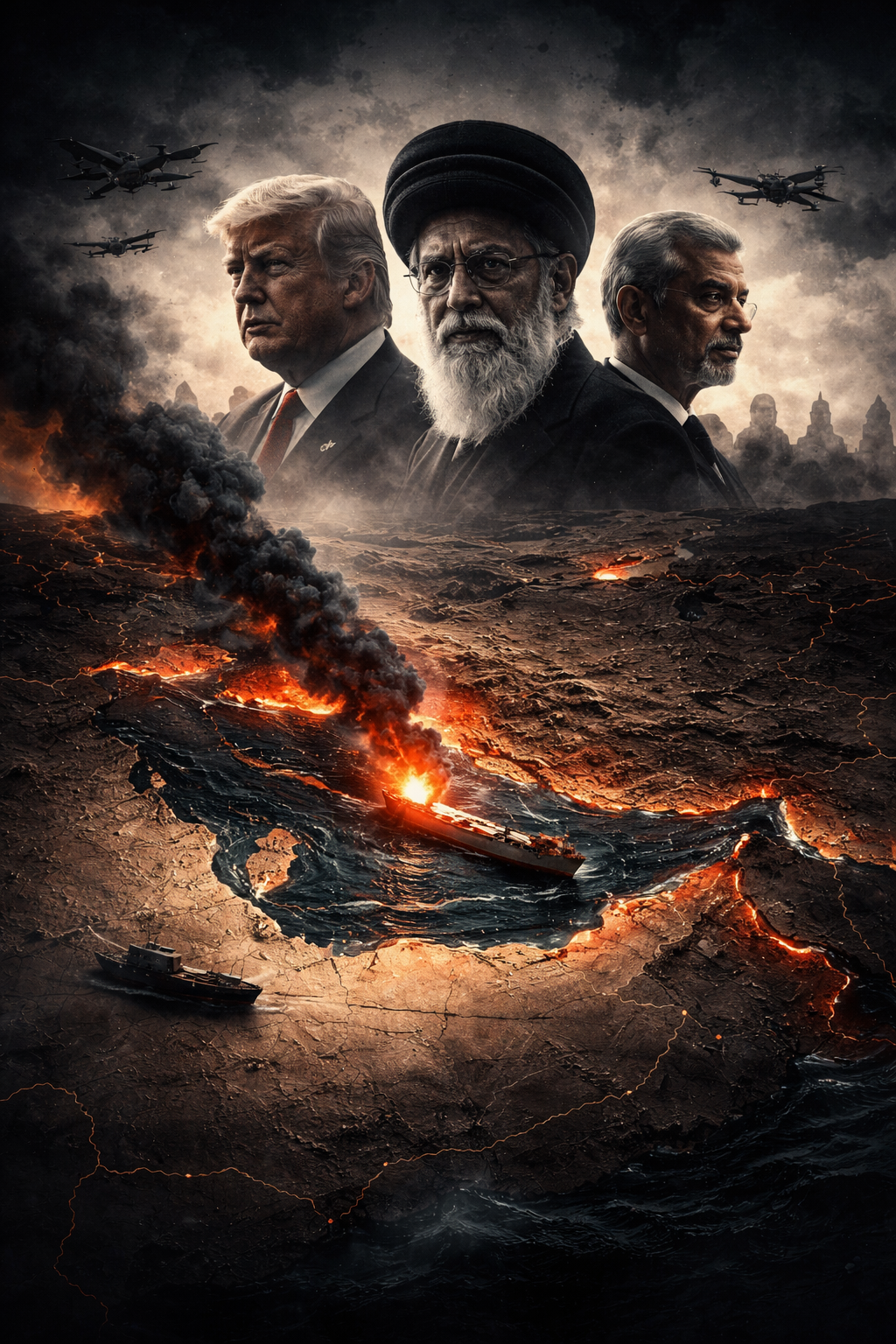
AI Generated Image
 By Deepak Parvatiyar*
Pause in Washington, Defiance in Tehran
Trump’s Break Meets Iran’s Unmoved Resolve
There are moments in geopolitics when power is not tested by action, but by the failure of action to compel a response. March 23, 2026, was one such moment. The United States paused; Iran did not. And in that asymmetry lay the true story of the day.
When U.S. President Donald J. Trump announced a five-day postponement of planned strikes on Iranian energy infrastructure, the immediate effect was not relief in Tehran, nor recalibration in its posture. Iran neither acknowledged the pause as a concession nor responded as if pressure had eased. Instead, it continued to project defiance—strategic, rhetorical, and operational—suggesting that the pause, rather than altering the trajectory, had exposed the limits of coercive signalling under contested conditions.
This moment did not emerge suddenly. It was the midpoint of a sequence already in motion—an ultimatum issued, a refusal delivered, and a pause that followed not from compliance, but from resistance.
In the days leading up to the announcement, President Trump had issued a 48-hour ultimatum to Iran, linking maritime access in the Strait of Hormuz with the possibility of direct strikes on energy infrastructure. The deadline compressed decision-making into a narrow window, signalling urgency and intent. Yet Tehran’s response was immediate and unyielding. It rejected the premise of external pressure, reinforced its posture on sovereignty, and signalled readiness to absorb escalation rather than concede under duress.
As the deadline expired, the expected progression—from warning to execution—did not materialise. Instead, Washington stepped back, announcing a five-day pause framed as the outcome of “productive conversations.” The shift altered the optics of the sequence. What began as a demonstration of pressure concluded, at least temporarily, as an exercise in recalibration.
As the situation continues to evolve through March 24, the limits of that recalibration are already visible on the ground. The conflict’s kinetic dimension shows no corresponding pause. Iranian forces have continued missile activity toward Israeli territory, with reported impacts in urban areas, underscoring that the operational tempo has not aligned with Washington’s pause. Tehran has rejected suggestions of substantive engagement with the United States, characterising such claims as misinformation aimed at influencing financial markets rather than reflecting diplomatic reality. U.S. officials have clarified that the pause is narrowly scoped—restricted to energy-related targets—while broader military pressure on Iran’s defence capabilities continues.
In New Delhi, the ripple effects were immediate. An all-party meeting was convened to assess the evolving situation, reflecting growing concern over energy security, maritime stability, and the wider strategic implications for India. The development underscored a defining feature of the crisis: decisions taken in one capital were no longer contained—they transmitted instantly across political, economic, and security domains far beyond the immediate theatre.
That recalibration, therefore, unfolded not in isolation, but within a dense and simultaneous web of diplomatic activity spanning multiple continents—revealing how modern crisis management operates across parallel tracks rather than linear channels.
On the same day, U.S. Secretary of State Marco Rubio engaged in a series of conversations that, taken together, map the breadth of American diplomatic outreach in a moment of strain. His call with External Affairs Minister Subrahmanyam Jaishankar focused on regional stability, energy security, and the risks surrounding maritime routes through the Strait of Hormuz. A parallel conversation with National Security Advisor Ajit Doval indicated that coordination extended beyond formal diplomacy into security-level engagement.
Yet the diplomatic map extended far beyond South Asia. Rubio’s conversation with Canadian Foreign Minister Anita Anand included discussions on Iran as well as Haiti—an issue that surfaced across multiple engagements, illustrating how geographically distant theatres intersect within crisis diplomacy. His call with Kenyan President William Ruto added another dimension, covering bilateral cooperation, regional stability, and ongoing operations such as Operation Epic Fury, alongside Kenya’s role in Haiti’s security efforts. Rubio’s acknowledgement of Kenya’s condemnation of Iranian actions in the Gulf reflected the broader alignment signalling taking place across regions.
Taken together, these conversations reveal a critical reality: diplomacy during high-intensity geopolitical moments is not sequential but simultaneous. Each engagement addresses a different layer—energy security, regional stability, alliance alignment, or parallel operations—yet all contribute to a broader strategic environment in which perception, signalling, and coordination evolve in real time.
Within this environment, Trump’s pause appears less as an isolated decision and more as a node within a larger, iterative process. The sequence—ultimatum, resistance, postponement—aligns with the logic of coercive diplomacy, where pressure is applied through deadlines and threats, but outcomes depend on the adversary’s willingness to absorb or deflect that pressure. Iran’s refusal to yield transformed the meaning of the pause. It was no longer simply a tactical delay; it became a reflection of contested leverage.
This carries implications not only for the immediate crisis but also for Trump’s political standing—both domestically and internationally. At home, the sequence raises questions about credibility among constituencies that equate strength with follow-through. A declared ultimatum followed by a pause risks being interpreted as hesitation rather than calibrated restraint. Among allies, particularly in Europe where strategic caution toward escalation remains pronounced, the pause may be viewed as necessary recalibration. Yet divergence in priorities complicates alliance cohesion, reinforcing perceptions of uneven alignment within Western responses.
Internationally, the optics are sharper. For adversaries and non-aligned observers alike, the sequence invites comparison with earlier moments in U.S. strategic history where overwhelming capability did not translate into immediate compliance. While such parallels must be applied cautiously, the underlying question they raise remains pertinent: what happens when power encounters resistance that is willing to endure rather than concede?
Iran’s posture in this context is not without cost. Reports of losses among senior figures underscore the intensity of the pressure it faces. Yet these losses have not translated into strategic capitulation. Instead, Iran has demonstrated an ability to maintain operational coherence, sustain deterrence, and continue projecting influence through both state and proxy channels. This resilience—whether framed as defiance or endurance—is central to understanding the limits of coercive frameworks in the current crisis.
Financial markets, for their part, responded with calibrated caution. Brent crude hovered in the mid-to-high $90 range, while West Texas Intermediate remained slightly lower. Equity markets registered modest gains, safe-haven assets adjusted marginally, and volatility indicators remained elevated. The reaction mirrored the geopolitical environment itself—alert, responsive, but unconvinced that underlying risks had fundamentally shifted.
India’s role unfolds within this interconnected landscape not as a primary driver but as a stabilising participant navigating multiple dependencies. Its engagement with Washington, combined with its coordination across the Gulf, reflects a pragmatic emphasis on energy security and maritime stability. The safeguarding of Indian-flagged LPG tankers such as Shivalik and Nanda Devi illustrates the tangible stakes underlying its diplomacy. India’s approach balances strategic autonomy with interdependence, positioning it as a quiet but consequential actor within a networked crisis environment.
Beyond diplomacy and markets, the operational picture remains layered and fluid. The confrontation between Iran and Israel continues through intermittent exchanges involving missiles and drones, maintaining a level of tension that stops short of full-scale war but sustains a constant risk of escalation. Gulf states remain exposed through their proximity to critical energy corridors, where even limited disruptions can ripple across global systems. Meanwhile, proxy actors—whether aligned with Iran or operating within broader regional dynamics—ensure that instability persists independently of high-level diplomatic engagement.
Trump’s pause, when viewed through multiple interpretive lenses, reflects domestic political calculation, alliance management pressures, and the iterative logic of coercive diplomacy. Yet it also reflects constraint—the recognition that action, once taken, cannot easily be reversed, and that signalling without escalation may serve immediate strategic needs.
But the defining feature of this moment lies elsewhere. It lies in the fact that the pause did not compel a corresponding shift from the other side. Iran’s posture remained steady, its signalling unchanged. In that divergence between intent and outcome, the limits of unilateral pressure became visible.
March 23, therefore, should not be read as a conclusion. It is a moment within motion—a pause that revealed as much as it delayed. In the choreography of modern geopolitics, where decisions ripple across diplomacy, markets, and battlefields simultaneously, such moments matter not for what they stop, but for what they expose.
And what this one exposed is a system in which power is still contested, outcomes remain uncertain, and even the strongest signals can meet a silence that answers them.
*Senior journalist

👌👌
Wow!!
“There are moments in geopolitics when power is not tested by action, but by the failure of action to compel a response. March 23, 2026, was one such moment. The United States paused; Iran did not. And in that asymmetry lay the true story of the day.”
Wow!!
“There are moments in geopolitics when power is not tested by action, but by the failure of action to compel a response. March 23, 2026, was one such moment. The United States paused; Iran did not. And in that asymmetry lay the true story of the day.”