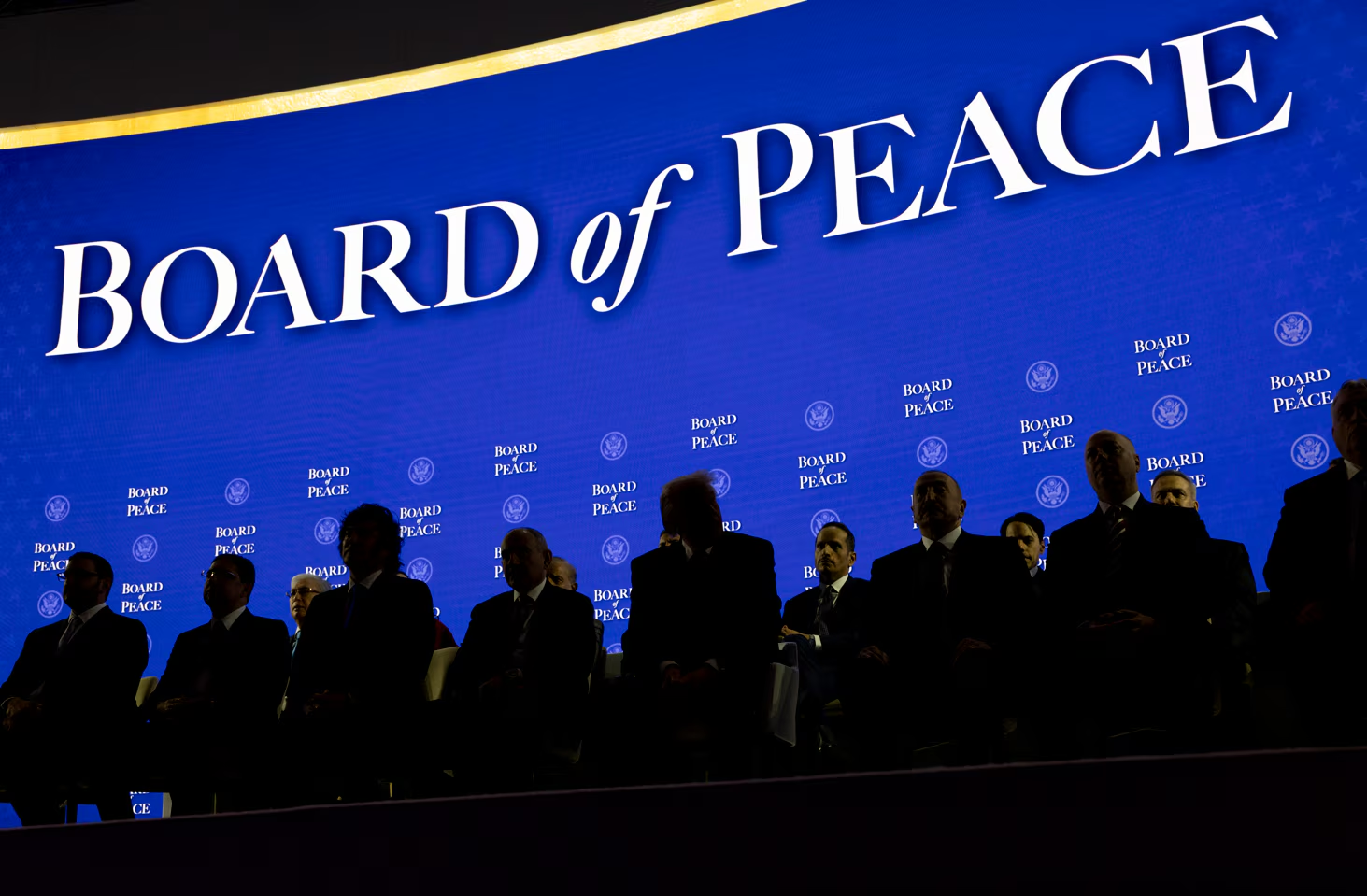
Photo Source: WEP 2026
Gaza Peace Board Launched at Davos; UN Probe Stays Independent
Davos/Geneva/Gaza/New York: An international diplomatic initiative titled the ‘Board of Peace’ was formally launched today on the sidelines of the World Economic Forum in Davos, marking the most significant multilateral effort to date to establish a post-conflict governance, security, and reconstruction framework for the Gaza Strip following the prolonged Israel–Hamas war.
Announced by United States President Donald Trump, the Board of Peace is envisaged as an international oversight body tasked with guiding Gaza’s transition from active conflict to stabilisation and reconstruction. The initiative forms part of a broader U.S.-backed peace roadmap first outlined in late 2025 and subsequently endorsed by the United Nations Security Council.
The launch of the plan coincided with reaffirmations from the United Nations Human Rights Council’s Commission of Inquiry on the Occupied Palestinian Territory, including East Jerusalem, and Israel, which pledged that investigations into alleged war crimes and human rights violations linked to the conflict would continue independently of any political or diplomatic process.
Mandate and Structure
According to official briefings, the Board of Peace is designed to operate as a transitional international supervisory mechanism rather than a governing authority. Its proposed mandate includes overseeing humanitarian assistance, coordinating large-scale reconstruction, supporting interim administrative arrangements, and monitoring progress toward longer-term political and governance reforms.
A technocratic body referred to as the National Committee for the Administration of Gaza is expected to manage day-to-day civilian affairs, while the Board would provide strategic oversight. The framework emphasises that the Palestinian Authority remains the internationally recognised governing entity, with any expanded role contingent upon administrative and security reforms.
Security arrangements under the plan include the deployment of a United Nations-mandated International Stabilisation Force, tasked with supporting law and order, assisting local policing structures, and facilitating demilitarisation. Disarmament of armed groups in Gaza is identified as a central pillar of the plan, with reconstruction assistance and funding flows linked to progress on security benchmarks.
International Endorsement and Legal Context
The Board of Peace gained formal international recognition following the adoption of UN Security Council Resolution 2803 in November 2025, which welcomed the establishment of an international mechanism to support Gaza’s post-war transition and authorised a time-bound stabilisation mission.
Today, Srinivasan Muralidhar, Chair of the UN Human Rights Council’s Commission of Inquiry, noted that the Board of Peace had been established pursuant to a plan submitted to and approved by the Security Council, but stressed that this development did not alter the Commission’s mandate.
“As a Commission of Inquiry, we see our task as investigating violations of human rights,” Mr. Muralidhar said. “That task we understand to be the mandate that the UN has given us, and we will continue with that mandate.”
The Commission of Inquiry, one of the Human Rights Council’s highest investigative mechanisms, was established by the Council’s 47 Member States in May 2021. UN officials reiterated that accountability processes would continue independently of diplomatic initiatives, including the Board of Peace.
Accountability and Human Rights Investigations
The Commission’s renewed commitment comes amid continued international scrutiny of alleged violations committed during the conflict. In September last year, the Commission’s then Chair, former UN High Commissioner for Human Rights Navi Pillay, stated that Israel had committed genocide against Palestinians in Gaza following the Hamas-led attacks of October 2023, which killed approximately 1,200 people in Israel and triggered the war. Israel has strongly rejected the allegation.
Muralidhar emphasised that the Commission’s mandate extends to all parties to the conflict. “We need to investigate violations of human rights by all duty-bearers and in both territories,” he said, expressing hope that the Commission’s findings would eventually contribute to judicial or adjudicatory processes.
He added that the Commission plans this year to investigate attacks by armed Palestinian militias within the territories, underlining the panel’s independence and its commitment to examining abuses without political alignment.
Responding to questions on the newly launched Board of Peace, Muralidhar said he expected the peace plan “to accommodate the interests of all the people in the conflict zone.”
Participation and Diplomatic Response
At the Davos launch, around 30 to 35 countries were reported to have signalled support or participation, out of nearly 50 invited. Countries publicly associated with the initiative include the United Arab Emirates, Saudi Arabia, Turkey, Albania, Bulgaria, and Kosovo.
Several European states, including France, the United Kingdom, Norway, and Sweden, have adopted a cautious position, citing the need for clarity on governance authority, funding mechanisms, and coordination with existing UN institutions. India did not sign on at the launch, maintaining its position in favour of humanitarian access, dialogue, and a negotiated two-state solution.
The funding architecture of the Board of Peace has also attracted attention, with reports suggesting that levels of participation may be linked to substantial financial contributions. Supporters argue that predictable funding is essential for reconstruction, while critics warn of unequal influence in decision-making.
Press Conference in Geneva
Separately, at a press conference in Geneva today, members of the Commission of Inquiry condemned the reported killing of three Palestinian journalists in central Gaza in an Israeli airstrike earlier in the week.
“When you’re killing a journalist, it means you have something to hide,” said Commissioner Florence Mumba. “Without journalists, many people in other corners of the world wouldn’t know what is happening. We are concerned about the disruption of journalists’ work and hope they will not be deterred.”
The commissioners, who serve in an independent and unpaid capacity and do not work for the United Nations Secretariat, stressed that press freedom remains essential for accountability during conflict and post-conflict transitions.
Next Steps
While the signing of the Board of Peace charter on 22 January 2026 marks a diplomatic milestone, substantial elements of the initiative remain under development. These include operational guidelines, funding commitments, rules of engagement for the stabilisation force, and benchmarks for political transition.
Diplomats caution that implementation will depend on sustained ceasefire conditions, regional cooperation, and engagement by local actors. As parallel accountability mechanisms continue their work, the coming months are expected to determine whether the Board of Peace evolves into an effective transitional framework or remains a contested diplomatic proposal.
– global bihari bureau