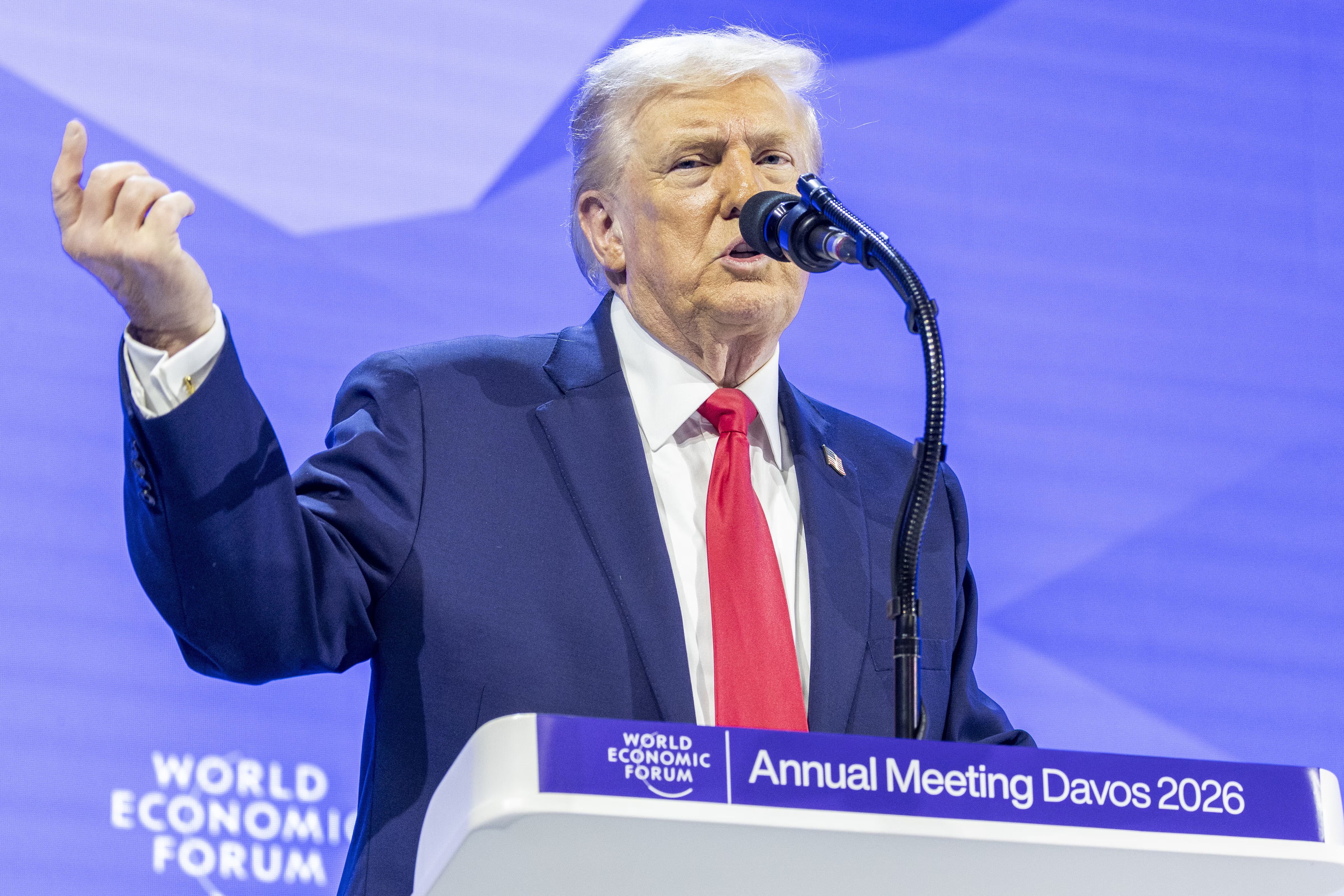
Donald J. Trump at the WEF on January 21, 2026.
Trump Links U.S. Power to Global Order at WEF 2026
Reasserts U.S. Centrality, Pushes Greenland and NATO Demands
Davos: United States President Donald Trump opened his address at the World Economic Forum on Day 3 of the event with a line that encapsulated the tone of his intervention: “so many respected business leaders, so many friends, few enemies.” In borrowing that phrasing, he signalled a recognition — explicit and self‑acknowledged — that his policies have been polarising among allies as well as audiences. In his own narrative, this tension arises from what he portrays as decades of under‑reciprocated American leadership and sacrifice, whether in defence, economic engagement, or industrial competition. Trump then used nearly every major section of his speech to argue, assert, and reassert that the United States is not only central to the global order but, in his framing, under-credited and taken for granted by “friends” who have benefited from U.S. power and prosperity without sufficiently supporting it in return.
Observers and participants reported a notably tense and unpredictable atmosphere before and during Trump’s address at Davos. In the hours and days leading up to his speech, his controversial push to acquire Greenland dominated discussions among delegates, NATO officials, and European leaders, turning what is usually a forum focused on economic cooperation into, in effect, an emergency diplomatic arena. When Trump took the stage, the plenary hall was full. Reporters noted that representatives from European Union member states appeared tense and attentive, with some shifting in their seats or scanning the room as the plenary absorbed Trump’s assertive opening.
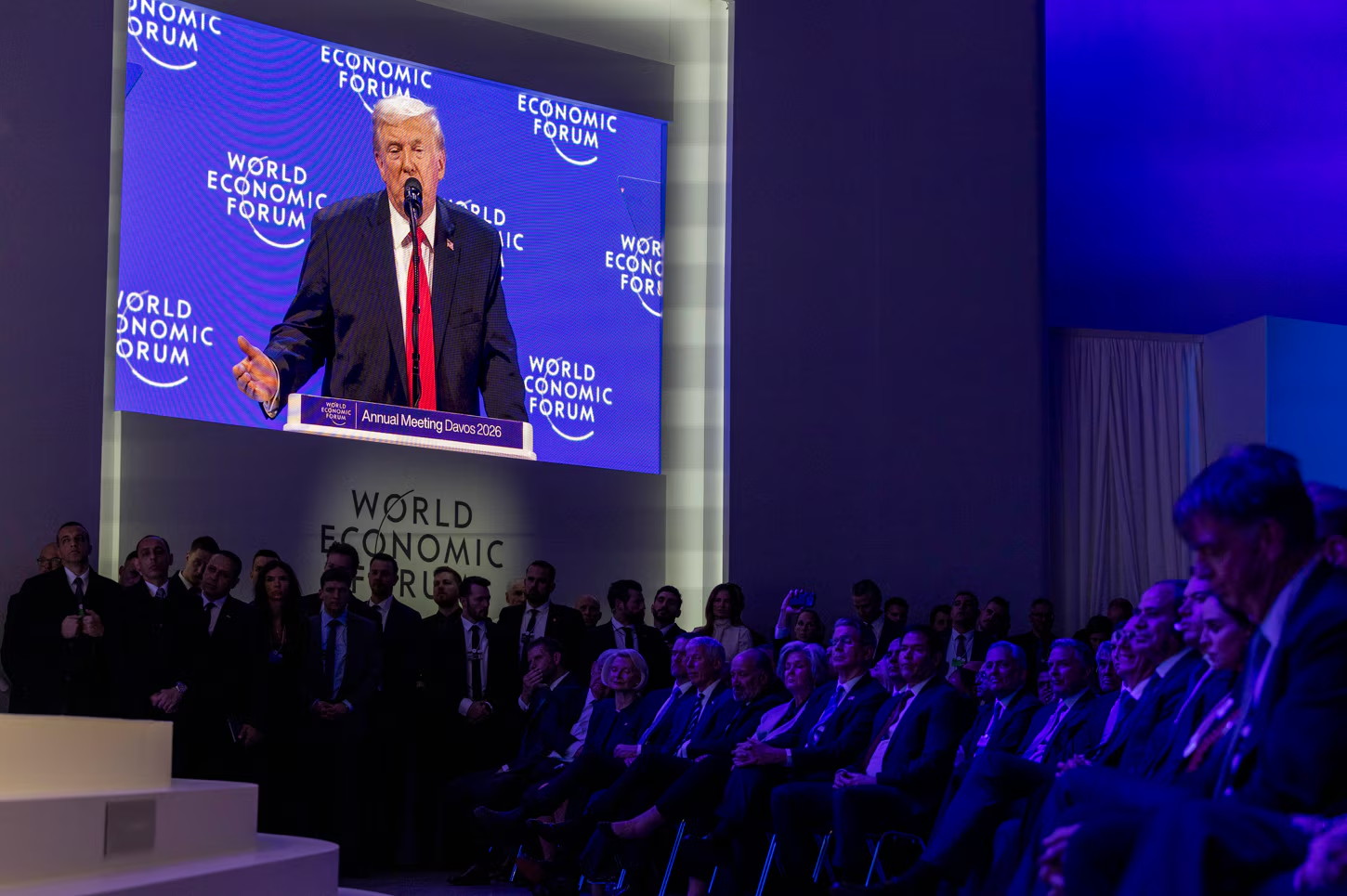
The crowd remained largely silent as he began, with polite but restrained applause at the conclusion. Some delegates were visibly uneasy with his insistence on negotiations over Greenland and his linkage of territorial demands to NATO and tariffs. In contrast, others brightened when he explicitly reiterated that military force was “not on the table.” Global markets showed immediate reactions: equities dipped, safe-haven assets strengthened briefly, and indices later partially rebounded when Trump disavowed force, reflecting uncertainty over both diplomatic and trade ramifications.
Trump proceeded to outline what he cast as a series of domestic and global achievements under his administration. On Greenland, he emphasised Denmark’s perceived underinvestment, stating it was “very expensive,” costing hundreds of millions per year, while he argued the United States had both the capability and right to secure it for national and international security. He linked Greenland to NATO, asserting that Europe had benefited for decades from U.S. defence but had failed to contribute proportionally. “NATO has treated the United States of America very unfairly,” he said, insisting that rich member states must now step up as the U.S. continues to assist Ukraine.
Trade tariffs emerged as a key tool in Trump’s framing of economic leverage. He repeatedly described them as “judicious” instruments that allowed the U.S. to extract fairer terms, citing Switzerland as a case study where tariffs were carefully applied rather than maximised. He explicitly tied these policies to domestic growth and debt reduction, asserting that if economic growth continued at projected levels, the U.S. could transition from $36–37 trillion in debt to a balanced budget, augmented by reductions in waste and fraud — notably citing $19 billion lost to fraud in Minnesota alone.
On the global economic and technological front, Trump highlighted U.S. supremacy in artificial intelligence and frontier technologies, noting $500 billion invested in the previous year. He described a Mark Zuckerberg facility “basically the size of Manhattan,” including on-site electricity generation, emphasising that surplus energy would feed local grids. These examples reinforced his narrative of American innovation, global competitiveness, and technological leadership in an era where China remains a close economic competitor. Trump reiterated his personal diplomatic ties with Xi Jinping, noting prior interventions were “severely interrupted by CO,” and recounted lessons from Marco Rubio in diplomacy, emphasising the importance of negotiation, patience, and influence even in competitive contexts.
Russia and Ukraine occupied a significant portion of Trump’s remarks. He portrayed the situation as a “bloodbath” with drones killing thousands weekly, and outlined a hands-on approach through his envoys, including Jared Kushner and Steve Kov, in attempting to mediate a ceasefire. He described the complexity of balancing Zelenskyy and Putin’s interests, stressing that failure to achieve a deal would be “stupid” on both sides. Trump positioned U.S. engagement as indispensable to preventing escalation, framing the American role as a stabilising force in conflicts that could otherwise spiral into major war.
The Middle East section underlined U.S. military intervention as the precondition for regional peace. He claimed to have “wiped out the Iran nuclear threat like nobody can believe” and emphasised precision operations against Soleimani and al-Baghdadi as integral to countering the resurgence of ISIS. Trump described coordinated use of B2 bombers and Tomahawk missiles to neutralise threats in Gaza, asserting these actions enabled broader agreements with 59 countries to stabilise the region. He repeatedly stressed that without these military preconditions, peace deals with the United Arab Emirates (UAE), Saudi Arabia, and Qatar could not have been signed.
Venezuela also featured prominently in Trump’s strategic framing. He cited increased U.S. domestic oil and gas production, nearly doubling output, supplemented by Venezuelan reserves. The narrative emphasised energy independence and national security, integrating domestic economic benefits with foreign resource access.
Trump repeatedly returned to his personal narrative of peacemaking, referencing Operation Sindoor and, notably, the claimed India-Pakistan ceasefire, a point previously disputed by Indian authorities. He presented these interventions as extensions of a broader worldview in which U.S. leadership, backed by military, economic, and technological superiority, was central to global stability.
Børge Brende, President of the World Economic Forum, moderated Trump’s session, posing questions that addressed Greenland, NATO, trade tariffs, China, and Ukraine. Brende prompted Trump to clarify the rationale for American unilateralism in these areas, eliciting detailed explanations of strategic cost‑sharing, expected diplomatic outcomes, and the balancing of competition with China and Russia. Brende also questioned the President on AI investments and Venezuela’s energy production, prompting Trump to frame these initiatives as central to maintaining U.S. technological and economic primacy.
To his question on economic sustainability, AI, and the risk of recession, Trump responded by framing growth as the central mechanism to manage debt, alongside judicious tariffs, technological investments, and the elimination of fraud. He asserted that economic strength is both a domestic imperative and a foundation for U.S. leverage in global affairs.
Trump concluded with reiterations of American exceptionalism, the U.S. economy’s strength, and personal acknowledgement of contributors to U.S. success. The overarching narrative emphasised that the United States is under-recognised for its centrality in securing global stability, advancing economic progress, and executing precise military interventions, while advocating continued assertive leadership in Greenland, NATO, the Middle East, and technological competition with China.
European leaders reacted cautiously, with some privately critiquing his assertive tone on Greenland and NATO contributions. Officials underscored the unusual nature of the speech for Davos, noting that it veered sharply into American unilaterism and individualised diplomacy, rather than multilateral consensus. Public statements were tempered, reflecting ongoing concerns about U.S. expectations for alliance burden-sharing and territorial ambitions in the Arctic.
– global bihari bureau