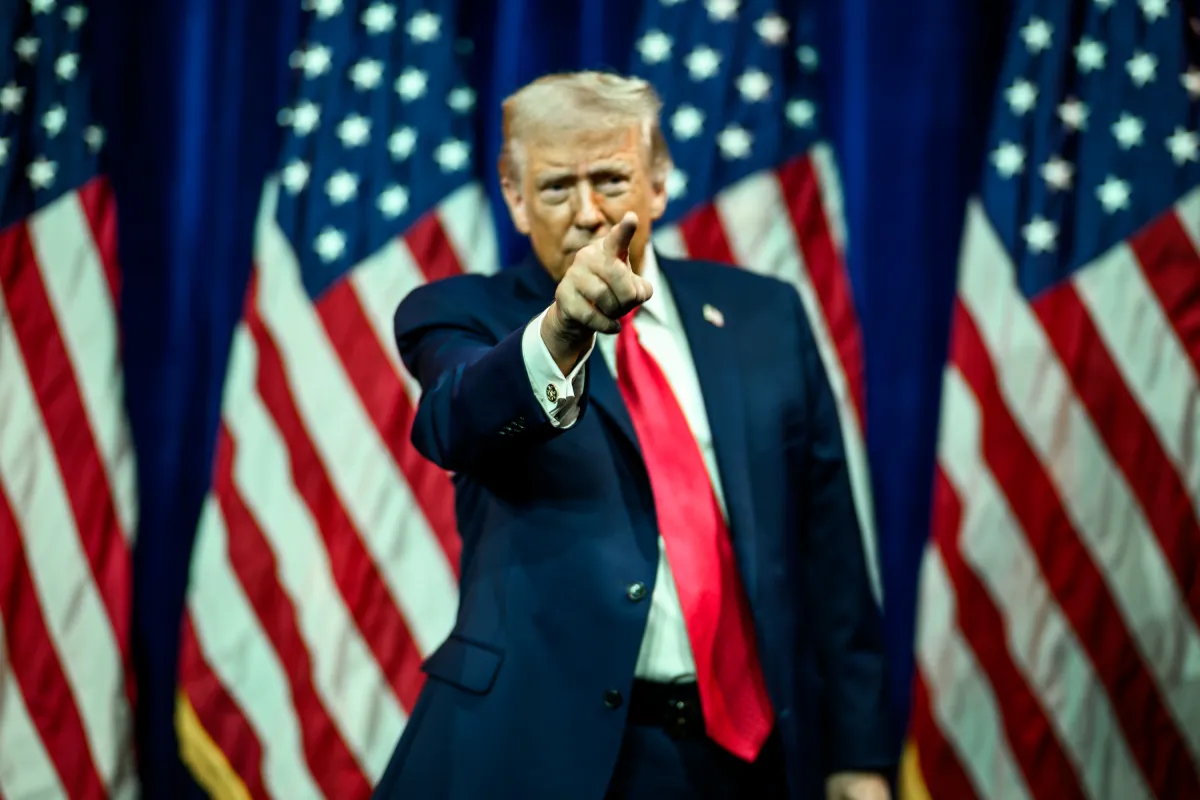
Donald Trump. Photo source: White House
Trump’s Venezuela Move Tests Congress, Constitution
Congress Scrutinises Trump’s Venezuela Operation
Venezuela Operation Sparks New Impeachment Debate
Washington: President Donald Trump’s decision to authorise a surprise U.S. military operation in Venezuela, resulting in the capture of President Nicolás Maduro and an announcement that vast quantities of Venezuelan oil would be transferred under U.S. control, has triggered one of the most severe Constitutional confrontations of his second term. What the administration initially portrayed as a decisive blow against a criminal regime has rapidly evolved into a far-reaching political and legal crisis, with impeachment no longer a peripheral threat but the central organising principle of the national debate.
From the outset, Trump himself framed the operation through the lens of domestic political survival. In remarks to Republican lawmakers and in public appearances, he warned that if Democrats were to retain control of the House after the 2026 midterm elections, impeachment proceedings over Venezuela would follow. He cast the anticipated challenge not as a response to Constitutional violations but as a partisan effort to punish strength and reassert what he described as failed norms of restraint. That framing, amplified by conservative media, effectively placed impeachment at the heart of the administration’s own narrative rather than allowing it to emerge solely from the opposition.
Democrats responded by escalating both rhetoric and institutional action. On January 3, Democratic National Committee Chair Ken Martin issued a forceful condemnation of the operation, describing it as unConstitutional and illegal, accusing the President of misleading the public, and asserting that the intervention amounted to regime change undertaken for economic gain rather than national security. Martin argued that the United States was being committed to the long-term management of another country without congressional consent and warned that such unilateral action struck at the core of the Constitutional separation of powers.
As the political conflict intensified, electoral developments fed directly into the impeachment discourse. On January 6, Democrats retained control of the Virginia state Senate in a closely watched special election, with Dr Mike Jones winning Senate District 15 and preserving a Democratic trifecta in the state. Party leaders quickly cited the result as evidence that voters were recoiling from Trump’s unilateralism and embracing candidates who emphasised Constitutional limits and economic accountability. The election became less a local contest than a symbolic data point in a rapidly nationalised argument over executive power.
Congress moved swiftly to assert oversight. Within two days of the operation becoming public, the House Foreign Affairs Committee convened an emergency session to question Pentagon and State Department officials about the planning, legal justification, and execution of the raid, with a particular focus on why Congress had not been notified in advance. Senate Foreign Relations and Armed Services leaders announced parallel inquiries, seeking clarity on the mission’s objectives, the chain of command, and the administration’s intentions regarding governance and resource control in post-Maduro Venezuela.
The legislative timeline underscores how quickly the issue escalated. On January 4, Trump publicly reiterated his claim that impeachment threats were politically motivated. On January 5, House Democrats issued subpoenas seeking internal legal assessments, operational planning documents, and communications between the White House and defence officials. That same day, senior administration figures participated in closed-door briefings with congressional leadership amid growing frustration over what lawmakers described as incomplete disclosures. By January 7, Congress was preparing for broader classified briefings for rank-and-file members, with committee hearings expected to intensify later in the week rather than having already concluded.
War powers legislation soon became a focal point of the confrontation. Resolutions invoking the War Powers Act were introduced in both chambers to challenge the President’s authority to initiate the operation without explicit congressional approval. In the Senate, the measure failed narrowly, 51–49. In the House, a parallel resolution was defeated 222–213, with five Republicans joining Democrats in support. Though unsuccessful, the votes exposed cracks within the President’s party and provided a formal legislative record that impeachment advocates have already begun citing as evidence of bipartisan concern.
Republican dissent has emerged as one of the most consequential aspects of the unfolding crisis. Senators Rand Paul, Mike Lee, Todd Young, Lisa Murkowski, and Dan Sullivan publicly questioned the legality and Constitutional basis of the operation, with several emphasising Congress’s exclusive authority to authorise acts of war. In the House, Representatives Thomas Massie, Marjorie Taylor Greene, Don Bacon, Mariannette Miller-Meeks, and another Republican lawmaker raised alarms about the absence of congressional authorisation and the precedent such action could set. Together, these voices have complicated claims of unified Republican backing and lent credibility to arguments that opposition to the operation is rooted in Constitutional principle rather than partisan alignment.
Behind the scenes, concerns extended into the administration itself. Reports indicate that some senior aides and military officials privately questioned the timing, legal grounding, and strategic coherence of the raid, particularly the decision to proceed without notifying Congress and the potential diplomatic consequences of capturing a sitting head of state. While these internal disagreements have not been aired publicly by the White House, lawmakers have cited them as further justification for aggressive oversight and subpoena authority.
The operational facts of the raid remain central to impeachment deliberations. U.S. forces dismantled elements of Maduro’s security apparatus and captured him during a rapid assault. The administration announced that between 30 and 50 million barrels of Venezuelan oil would be placed under U.S. oversight for transfer to American markets, a move that intensified accusations of economic motivation. Reports from the ground indicated that hundreds of Venezuelan security personnel and civilians were killed in the engagement, underscoring the human cost of the intervention. Trump described the mission as “very violent but necessary,” a phrase now frequently cited by critics as emblematic of executive overreach.
International reaction compounded domestic pressure. Brazil, China, and several other governments condemned the operation as a violation of Venezuelan sovereignty, while Russia warned that the action risked destabilising the region. Latin American regional bodies cautioned that unilateral military interventions erode long-standing norms of non-interference. Inside Venezuela, pro-Maduro militias mobilised in major cities, opposition figures warned of renewed internal conflict, and civilians reported displacement and insecurity, highlighting the disconnect between Washington’s political debate and conditions on the ground.
Economic considerations have also fed into impeachment arguments. Analysts estimate that securing oil assets, maintaining stability, and managing a political transition could cost the United States billions of dollars. Democratic lawmakers have emphasised these projected expenses as evidence that Trump’s unilateral decision exposes taxpayers to long-term financial risk without congressional consent, further reinforcing claims of abuse of power.
Legal scholars have increasingly framed the crisis as a stress test of Constitutional norms. While presidents have historically initiated limited military actions without formal declarations of war, capturing a foreign head of state and assuming de facto control over national resources stretches existing precedents. Comparisons have been drawn to debates surrounding Iraq in 2002 and Libya in 2011, underscoring the recurring tension between executive initiative and legislative authority but also highlighting how far the Venezuela operation appears to go beyond earlier cases.
Congressional hearings have grown progressively more pointed as lawmakers seek to assemble a comprehensive evidentiary record. Officials have been pressed on the legal rationale for the raid, the decision-making process within the executive branch, contingency planning for governance in Venezuela, and the risks of escalation. Testimony and documents collected through subpoenas are being evaluated with an eye toward potential articles of impeachment, particularly on grounds of unConstitutional overreach, abuse of power, and misrepresentation to Congress.
Procedurally, impeachment would unfold in familiar but politically fraught stages. Drafting formal articles would follow the completion of hearings and document review, after which the House would vote on whether to impeach. A Senate trial would require a two-thirds majority for conviction, a threshold that underscores the importance of Republican dissent in determining whether impeachment becomes a symbolic rebuke or a consequential check on Presidential authority.
Public opinion reflects the nation’s divisions. Surveys conducted in the days following the operation show the electorate nearly split, with a plurality supporting the action on national security grounds and a comparable share viewing it as executive overreach. Independent voters remain sharply divided, and in competitive districts, the Venezuela operation has already emerged as a defining campaign issue, linking Constitutional accountability to electoral consequences ahead of the 2026 midterms.
Democratic leaders insist that impeachment is not a political weapon but a Constitutional obligation, arguing that failure to respond would normalise unchecked executive power. The presence of Republican critics has reinforced that argument, suggesting that the debate transcends party loyalty and touches on the institutional balance that underpins the republic.
What began as a dramatic foreign intervention has thus become a defining domestic reckoning. The capture of Maduro may shape Venezuela’s future, but its most enduring impact may be felt in Washington, where the boundaries of Presidential authority, congressional oversight, and democratic accountability are being tested in real time. As hearings deepen and impeachment calculations sharpen, the episode stands as a reminder that the exercise of power abroad can reverberate with Constitutional consequences at home.
– global bihari bureau