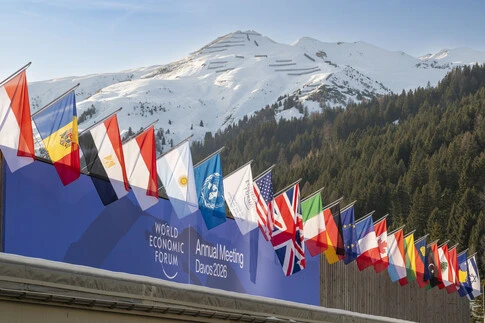
Photo source: WEF
Von der Leyen, Macron Push Back Against U.S. Tariffs
Davos: On the second day of the World Economic Forum (WEF)’s annual meeting in the Swiss Alps, what was meant to be a forum for cooperation amid rising global challenges instead highlighted a deepening rift between longtime allies. The spotlight shifted decisively to Greenland, a strategically vital Arctic territory, and the escalating tensions between the United States and Europe that have made it one of the defining dramas of the 2026 forum.
In the grand setting of Congress Hall, French President Emmanuel Macron’s early address set a sombre yet urgent tone. Framing the world as entering a period of instability, he reminded delegates that 2024 saw a record surge in conflicts and that the erosion of international norms had reshaped geopolitical competition. Against this backdrop, Macron argued that Europe could no longer take stability for granted. His speech blended geopolitical critique and economic strategy, calling for what he termed an “effective multilateralism” — one that defends democratic values, fortifies collective security, and advances Europe’s economic competitiveness in sectors like artificial intelligence, quantum technologies, and space. The message was not just defensive; it was a clarion call for Europe to assert strategic leadership in an unpredictable world.
But as Macron spoke, the shadow of Greenland loomed large. A short walk from the forum’s formal sessions, U.S. Treasury Secretary Scott Bessent attempted to defuse a situation that had taken on broader geopolitical ramifications. In a candid conversation on the sidelines, Bessent urged European partners to avoid hasty retaliation and emphasised that United States–Europe relations remain strong, even amid controversy. He dismissed some of the louder speculation in the press as overreaction and warned against retaliatory measures that could spiral into wider trade conflict. His advice was simple: “Take a deep breath and let things play out,” underscoring a desire in Washington to manage tensions without unravelling the alliance. Complementing this perspective, U.S. Commerce Secretary Howard Lutnick downplayed the dispute as a “kerfuffle,” highlighting internal U.S. voices advocating measured diplomacy over dramatic escalation.
Also read: Greenland Row Rocks Davos
Yet beneath the surface calm that Bessent and Lutnick projected, European responses were increasingly robust. European Commission President Ursula von der Leyen used her own special address at Davos to lay out a firm, forward-leaning position, one that clearly diverged from the American narrative. Von der Leyen labelled the threatened U.S. tariffs as “a mistake, particularly between long‑term partners,” and stressed that the sovereignty and territorial integrity of Denmark and Greenland are non‑negotiable. In doing so, she struck a delicate balance: affirming Europe’s shared interest in Arctic security while rejecting what she described as coercive trade tactics that could undermine the foundations of alliance trust.
Von der Leyen went further, announcing that the EU is preparing a comprehensive set of measures to enhance Arctic security and regional resilience, including economic investment, defence infrastructure, and strategic partnerships. Her remarks broadened the debate from a narrow trade dispute to a conversation about Europe’s future role in a rapidly shifting global architecture. She emphasised that Europe does not seek confrontation but believes alliance relationships must be anchored in predictability, trust and respect for sovereign choices. At the same time, Canadian Prime Minister Mark Carney’s opposition to tariffs reinforced the growing consensus among allies that coercive economic measures would be counterproductive.
Adding to the complexity, discussions at the forum revealed that the Greenland dispute intersects with broader questions about alliance cohesion and global stability. Denmark has insisted that any deliberations on Greenland’s future must involve Copenhagen and Nuuk directly. NATO allies have stressed the importance of maintaining a rules-based approach to Arctic security, underscoring that this issue could have wider implications for transatlantic trust. Even as sessions on artificial intelligence, sustainability, and economic growth continued, Greenland commanded attention across the forum, illustrating how strategic geography, trade, and sovereignty converge to shape global order.
By the close of Day 2, it was evident that the WEF theme of “A Spirit of Dialogue” faced one of its most substantive tests. The Greenland row has transformed the forum from a venue for broad cooperation into a crucible of transatlantic contention. For many delegates, the question now is whether this dispute — born of strategic priorities, economic anxieties, and sovereign concerns — can be resolved through negotiation, or whether it signals deeper shifts in international alignments.
As discussions evolved and leaders prepared for further engagements, the consensus among many participants was that Greenland is more than a territorial dispute. It has become a litmus test for diplomacy, alliance cohesion, and the capacity of close partners to navigate disagreement while preserving long-term strategic cooperation.
– global bihari bureau