Silent Champions: India’s Historic Deaflympics Journey
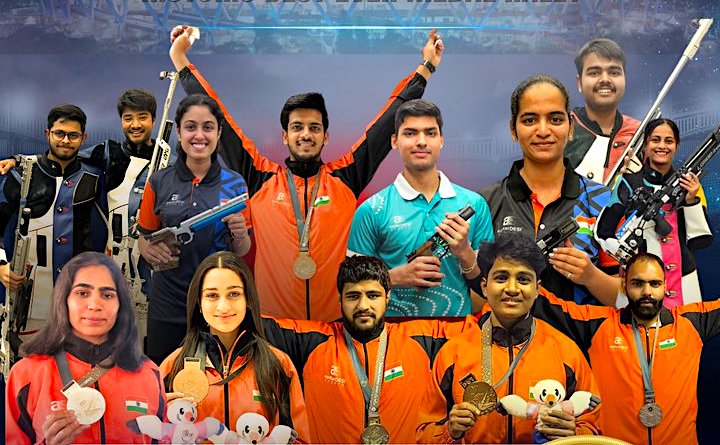
Tokyo/New Delhi: When the floodlights shimmered over the final session at the 2025 Summer Deaflympics in Tokyo, and the last scorecards went up, India had done something extraordinary. The scoreboard read: 20 medals in total — 9 gold, 7 silver, 4 bronze. That tally secured India a historic sixth place on the overall medal table — its best‑ever performance in the Deaflympics.
The Deaflympics itself is a unique global sporting festival: founded nearly a century ago to give deaf and hard‑of‑hearing athletes a platform equal to the Olympics. Every four years, competitors from around the world — stripped of auditory cues such as starter pistols or referee whistles — come together to compete under standard rules, but with adaptations like visual signals, light flashes or flags, ensuring the playing field honours silence yet celebrates excellence. The Tokyo Games, held from 15 to 26 November 2025, marked the 25th Summer Deaflympics and the first time the honour of hosting came to Japan. Nearly 78 countries participated, with approximately 2,840 athletes competing across 209 events in 18 sports.
For India, the success in Tokyo was more than just medals — it was a statement of resilience, courage, talent, and quiet determination. The journey of many of its athletes to the podium was rooted in years of struggle, modest resources, silent training grounds, and the need to battle both sporting and societal odds.
The lion’s share of India’s medals — sixteen — came from shooting. On that range, silence was not a handicap, but a canvas. There, rifles and pistols spoke louder than cheers. Among the standout stories was that of Mahit Sandhu. Over the course of the Games, she accumulated four medals, including two gold — her crowning glory being the women’s 50 metre Rifle 3‑Positions final, where her composure and skill translated into gold. Her performance became a beacon for many young athletes who once believed that their hearing impairment might hold them back. Alongside her was the young but stoic shooter Dhanush Srikanth. He opened India’s tally with a gold in the men’s 10 m air rifle, setting a new Deaf Final World Record with a final score of 252.2 — proof that for him, focus and precision were sharper than any sound. This was not just a victory, but redemption for years of solitary practice and silent ambition.
Then came the pistol shooters. In a tense mixed 10 m air pistol event, the pair of Abhinav Deshwal and Pranjali Prashant Dhumal clinched gold, reaffirming that when teamwork, trust, and discipline converge, deafness becomes inconsequential. Others added to the tally as well — the shooting medal count rising to represent the bulk of India’s success in Tokyo.
But the triumph was not bound to the firing range alone. On the manicured greens of Tokyo’s golf course, Diksha Dagar delivered a performance of calm grit and mastery, shooting to gold in the Women’s Individual Golf event and reminding the world that sport and silence can co‑exist beautifully. Elsewhere, when India’s wrestlers stepped onto the mat, they did more than fight for medals — they fought for recognition. One of them, Sumit Dahiya, clinched gold in men’s 97 kg freestyle wrestling — a symbolic breakthrough far beyond wrestling mats. It sent a message: that the world of combat sport, often loud and boisterous, could welcome those whose courage was unvoiced, whose strength spoke louder than sound.
As the results came in, the sense of achievement spread. For the athletes themselves, the medals validated years of silent perseverance. For their families and coaches — often overlooked — it was vindication. For the larger deaf sporting community in India, a wave of hope. And for the nation, a quiet revolution: deaf athletes, once relegated to the sidelines, were now among the champions. The response back home was swift, proud, heartfelt. Political leaders acknowledged the feat, sports officials took notice, and across towns and cities — from bustling metros to small villages — deaf athletes were no longer in the shadows. Prime Minister Narendra Modi posted on X: Heartiest congratulations to our Deaflympians for their extraordinary performance at the 25th Summer Deaflympics 2025 in Tokyo. With a historic best-ever medal tally of 20 medals, including 9 Golds, our athletes have once again proven that determination and dedication can lead to outstanding results. Compliments to every athlete, coach and support staff. The entire nation is proud of you all!”
The 20 Indian medallists at Tokyo 2025
Gold
Sumit Dahiya — Men’s 97 kg Freestyle Wrestling
Diksha Dagar — Women’s Individual Golf
Dhanush Srikanth — Men’s 10 m Air Rifle (Shooting)
Abhinav Deshwal — Men’s 25 m Sports Pistol (Shooting)
Anuya Prasad — Women’s 10 m Air Pistol (Shooting)
Pranjali Prashant Dhumal — Women’s 25 m Sports Pistol (Shooting)
Mahit Sandhu — Women’s 50 m Rifle 3‑Positions (Shooting)
Abhinav Deshwal & Pranjali Dhumal — Mixed 10 m Air Pistol Team (Shooting)
Dhanush Srikanth & Mahit Sandhu — Mixed 10 m Air Rifle Team (Shooting)Silver
Amit Krishan — Men’s 86 kg Freestyle Wrestling
Abhinav Deshwal — Men’s 10 m Air Pistol (Shooting)
Mohammed Murtaza Vania — Men’s 10 m Air Rifle (Shooting)
Shourya Saini — Men’s 50 m Rifle 3‑Positions (Shooting)
Pranjali Prashant Dhumal — Women’s 10 m Air Pistol (Shooting)
Mahit Sandhu — Women’s 10 m Air Rifle (Shooting)
Mahit Sandhu — Women’s 50 m Rifle Prone (Shooting)Bronze
Lowa Swain — Women’s Kumite 50 kg (Karate)
Kushagra Singh Rajawat — Men’s 50 m Rifle Prone (Shooting)
Komal Waghmare — Women’s 10 m Air Rifle (Shooting)
Mixed Team: Mohammed Murtaza Vania & Komal Waghmare — Mixed 10 m Air Rifle (Shooting)
What happened in Tokyo is important not just for the tally sheet, but for identity and dignity. For decades, deaf sport has struggled for visibility globally, often overshadowed by able-bodied or Paralympic streams. The Deaflympics was formed nearly 100 years ago to bridge that divide — to provide a platform that treats deaf athletes with the same seriousness as any other Olympian. But despite its history and scale, recognition has often been patchy. The 2025 edition in Tokyo, therefore, was more than a Games — it was a reaffirmation of purpose. It reminded the world that silence does not mean inability; that coordination, discipline and skill can flourish without sound; and that aspiration is universal.
As the final lights went out in Tokyo and athletes began to return home, India carried with it not just medals, but stories — stories of silent mornings on shooting ranges, of disciplined practice, of the long arcs of training and hope, of battles fought in quiet resolve. Those stories will now echo in hearing and non‑hearing ears alike. For every young deaf athlete in India who had ever feared that their dreams were too quiet to ever matter, Tokyo 2025 showed that not only did they matter, but that they could shine.
And for Global Bihari readers, this is not just a report of medals. It is a chronicle of triumph over silence, a portrait of victory redefined, and an invitation to believe that where there is talent, determination, and opportunity — success will follow, whether the crowd cheers or watches in silence. The journey for many begins now.
– global bihari bureau