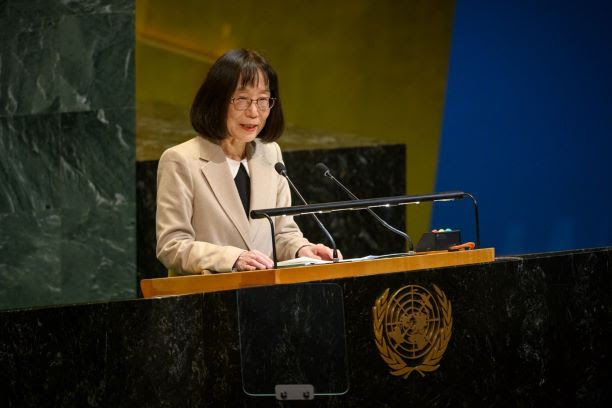
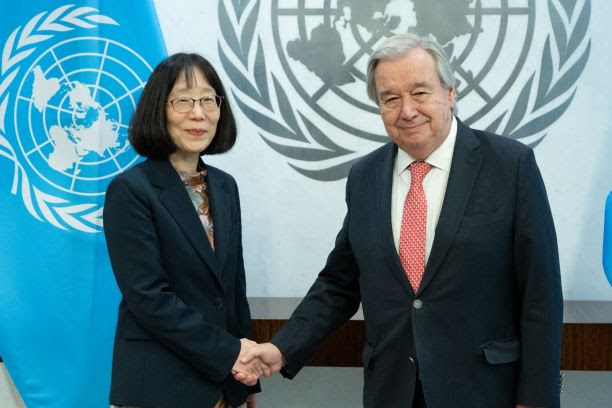
ICC President Tomoko Akane addresses the United Nations General Assembly 34th plenary meeting ©UN Photo/Loey Felipe
Tomoko Akane Slams Coercion at UN; Claims ICC Faces Attacks
New York: In a stark reminder that the machinery of international justice runs on fragile rails, International Criminal Court (ICC) president Judge Tomoko Akane laid bare the court’s precarious existence before the United Nations General Assembly on November 11, 2025, painting a picture of an institution besieged by sanctions, arrest warrants, and cyberattacks – all aimed at its judges and prosecutors.
“During the reporting period, attacks, threats and coercive measures against the Court and its officials have persisted, and continue to pose a serious threat to the administration of justice by the Court and to the global fight against impunity,” Akane said, her voice steady but the implications chilling. She didn’t name names, but the subtext was clear: U.S. sanctions imposed earlier in 2025 on ICC officials, including Prosecutor Karim Khan and judges, following arrest warrants for Israeli leaders over Gaza – those very measures have forced a “transformative shift” in the court’s security, with upgraded digital defences and external partnerships now a “key priority.” Civil society workers and international justice advocates have felt the heat too, targeted in a broader assault that Akane framed as an existential risk: “When these Judges are pressured, threatened, or undermined, the credibility of international law itself is weakened.” One can’t help but probe the irony – the court born from Nuremberg’s ashes, designed to hold the powerful to account, now pleading for protection from the very powers that built the post-war order.
Akane’s address, marking the ICC’s annual report (A/80/342) for August 2024 to July 2025, wove this vulnerability into a tapestry of hard-won progress amid unrelenting headwinds. Congratulating new UNGA President Annalena Baerbock, she tied the ICC’s 80th year to the Nuremberg Tribunal’s anniversary, where judges like her reflected on “the foundation of international criminal justice and the universality of the need to pursue justice for the victims of atrocity crimes through fair judicial proceedings.” Yet, she noted dryly, “crimes that shock the conscience of humanity continue to plague this world,” a nod to the 20th century’s “millions of children, women and men” who inspired the Rome Statute.
The court, she stressed, targets individuals, not states – but when states lash back with coercive tools, the line blurs. “Respecting judicial independence is an investment in the stability of that order,” Akane urged, calling on UN members to act “both individually and collectively, in defence of the Court and the principles enshrined in the Rome Statute.”
Sceptics might question if that’s even possible when superpowers like the U.S. – not an ICC member – wield sanctions as foreign policy, or when Russia launches its own spurious arrest probes against ICC judges over Ukraine warrants.
Like the International Court of Justice (ICJ) president Iwasawa Yuji before her, Akane also turned to the court’s grind, and detailed a “high workload” with 382 decisions issued, but 33 public arrest warrants languishing unexecuted – a damning statistic that underscores cooperation’s fragility. States parties bear legal duties under Part 9 of the Statute, she reminded, yet “the obligation to arrest and surrender is one of the means to give effect to the obligation to cooperate.” In Darfur, Sudan – referred by UN Security Council Resolution 1593 in 2005 – Trial Chamber I convicted former Janjaweed commander Ali Muhammad Ali Abd-Al-Rahman on October 6, 2025, of 27 counts of crimes against humanity and war crimes from 2003–2004, after sifting 1,861 evidence pieces and 74 witnesses. “This is an encouraging example that shows that, even if with a delay, justice can and will be done,” Akane said, with 1,591 victims participating and reparations pending. Libya’s situation, another Security Council referral, saw Pre-Trial Chamber warrants unsealed, including against Khaled Mohamed Ali El Hishri, arrested in Germany on July 16, 2025, for murder, torture, and rape at Mitiga Prison – poised to be the first confirmation from there. Libya’s May 12, 2025, declaration accepting ICC jurisdiction through 2027 offers a rare bright spot, though the prosecutor’s roadmap eyes investigation wrap-up by year’s end.
Also read: World Court Flags Workload Crisis Ahead of 80th Year
Akane spotlighted procedural firsts, like the absentia confirmation against Lord’s Resistance Army chief Joseph Kony on November 6, 2025 – all charges upheld after 18 years of the victim’s wait. “Such in absentia proceedings might be the only way for the victims to express their views and concerns,” she noted, urging actors to secure his surrender. In Afghanistan, warrants targeted Taliban Supreme Leader Haibatullah Akhundzada and Chief Justice Abdul Hakim Haqqani for gender persecution since 2021. The Palestine situation drew fire: warrants for Israeli PM Benjamin Netanyahu and ex-Defence Minister Yoav Gallant for starvation as warfare and murder/persecution in Gaza, with the Hamas commander’s later withdrawal due to death. The Philippines saw former President Rodrigo Duterte surrender on March 12, 2025, for drug war murders, with confirmation ongoing. Active probes in Ukraine and Venezuela simmer under seal, while Pre-Trial Chamber II deemed the Central African Republic case against Edmond Beina inadmissible under complementarity – a nod to genuine domestic probes.
Trials pressed on: Alfred Yekatom and Patrice-Edouard Ngaïssona were convicted on July 24, 2025, of Seleka-anti-Balaka clashes in Bangui and western CAR (2013–2014), sentenced to 15 and 12 years, with 1,965 victims involved. Al Hassan, Mali’s Timbuktu tormentor, got 10 years in November 2024, trimmed by 12 months on appeal. Appeals Chamber handles Yekatom/Ngaïssona and Abd-Al-Rahman, plus two reparations judgments. Victims – 18,000 participants last year – anchor it all: “The Court gives victims a voice, a space to tell their stories, and the hope that truth will be acknowledged and responsibility established.” In Uganda, Trial Chamber IX’s Ongwen reparations – €750 symbolic to 49,772 victims – were confirmed April 7, 2025; Akane, fresh from last month’s visits to affected communities in Uganda, pressed states for funding: “Contributions, even symbolic, send a powerful political message.” They affirm the legitimacy of the ICC, demonstrate solidarity with victims, and reinforce the international community’s commitment to peace, justice and accountability.
Universality reached 125 states parties as of January 1, 2025, for the first time since its establishment, with Ukraine’s accession bringing membership to approximately two-thirds of the international community across all regions. Cooperation with UN entities, in line with the 2004 Relationship Agreement, remains vital, as detailed in paragraphs 86 to 97 of the written report. Akane closed with a plea: “Sustaining the international rule of law is a perpetual endeavour which requires collective action… Yet, we are constantly reminded of the fragility of this endeavour.” Echoing ICJ President Iwasawa, she affirmed the ICC’s impartial mandate, but the unspoken query lingers – in a multipolar world of selective outrage, can one court truly transcend?
– global bihari bureau