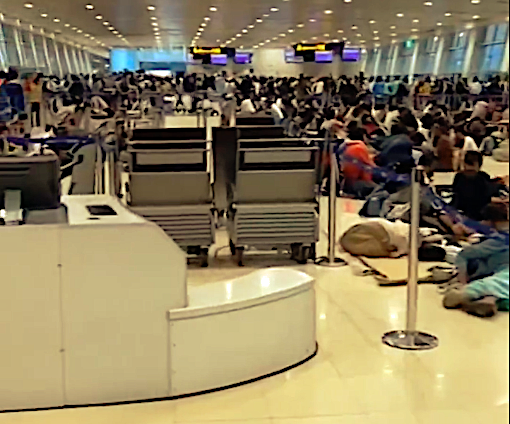
Photo source: X
Thousands of Cancellations and Market Panic as IndiGo Reels
Pilot-Rule Shock Exposes Fragility of IndiGo Operating Model
New Delhi: IndiGo’s week-long operational collapse has moved from an aviation disruption to a full-blown corporate and regulatory crisis, as cancellations crossed the 2,000-flight mark and the Directorate General of Civil Aviation (DGCA) deepened its investigation into what it has now signalled may be a planning failure rather than an unforeseeable operational accident. The airline told regulators that the turmoil arose from a “combination of factors” — new pilot duty-time and rest-rule requirements, crewing and rostering breakdowns, and technical challenges — and asked for more time to determine a single root cause. The account, while accurate in describing the immediate triggers, has already raised questions about whether the underlying driver was an aggressive growth strategy operating on minimal staffing buffers.
The controversy stems from the rollout of revised Flight Duty Time Limitations (FDTL), which were designed to expand pilots’ rest periods and tighten restrictions on night-time duties. These regulations were notified in advance and were introduced explicitly for safety; their effects were never meant to cripple airlines. When the rules were enforced, IndiGo’s schedules buckled almost immediately — and not because of unpredictable events like weather or geopolitical closures, but because the airline did not have sufficient surplus manpower to absorb higher rest requirements without compromising its flying programme. In response, the government temporarily suspended certain night-duty elements of the new FDTL rules for IndiGo alone to stabilise operations, while simultaneously issuing a show-cause notice demanding detailed accountability.
The financial market’s reaction was swift, and punishment was severe. Shares of InterGlobe Aviation, IndiGo’s parent company, dropped nearly 8% on Monday alone and roughly 16% over the past week, wiping out an estimated USD 4–4.5 billion in market value. Analysts and rating agencies pointed to “significant lapses” in operational and manpower planning, with Moody’s calling the episode “credit negative” and warning of earnings volatility in the current quarter. Brokerages have begun marking down price targets as they now factor in refunds, compensation, lost revenue and possible regulatory penalties.
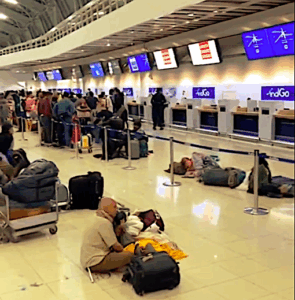 Airport-level data reinforces the scale of the disruption. Delhi, Bengaluru and Hyderabad saw the highest cancellations on Monday, a mix of triple-digit and high double-digit cancellations in a single day. Pune alone reported 50 cancellations on Sunday. Regional operations were not spared — high-frequency and short-haul segments connecting cities in the northeast experienced disproportionate disruption, revealing that the underlying crewing imbalance affected the airline’s entire route architecture rather than isolated long-haul operations. IndiGo maintains that it has operated more than 1,800 flights per day in recent days and that on-time performance has improved steadily; that may be true on aggregate, but the lived passenger experience at airports still reflects unpredictability and last-minute changes.
The crisis also spilt into other transportation sectors. Indian Railways added additional coaches to long-distance trains to accommodate stranded passengers, a rare move that signals the severity of the strain and the wider mobility implications of the aviation disruption. Meanwhile, refund queues and rebooking requests have flooded airport counters and customer-service channels, straining passenger trust during the busiest travel month of the year.
What is unfolding is not merely a difficulty in absorbing a regulatory change but an audit — public, financial and operational — of IndiGo’s business model. For years, the airline has built market dominance on relentless capacity expansion and strict cost discipline. Such a model demands flawless planning and constant hiring to maintain resilience. When one variable — in this case, mandatory increases to pilot rest time — shifts the equation, the margin for error vanishes instantly. The company’s explanation that several triggers coincided is accurate but strategically evasive: it doesn’t explain why a regulatory timetable that was known in advance collided so violently with operations. Whether that collision stemmed from insufficient hiring, flawed forecasting, gaps in rostering systems, or an institutional expectation that last-minute exemptions would always be available is now central to the DGCA’s investigation.
Also read: IndiGo Crisis Day 6: Flight Cancellations Continue
The regulator’s posture is becoming increasingly consequential. A narrowly technical reading could close the matter with fines and mandatory corrective actions. A broader reading — one that embraces passenger safety optics and investor scrutiny — could mean long-term oversight of IndiGo’s rostering systems, reporting mechanisms and staffing plans. Such a precedent would not only affect IndiGo but compel the entire domestic aviation sector to reassess the sustainability of running high-frequency networks on thin crew margins.
Two developments will shape the story in the coming weeks. The first is the DGCA investigation: whether it attributes the collapse to coincidental operational stress or to systemic failures in organisational planning. The second is IndiGo’s response in the next six weeks: clear hiring numbers, visible strengthening of pilot availability on roster, updated rostering processes and transparent reporting to regulators. If these moves materialise quickly, the crisis will be remembered as a costly shock and not a structural inflection point. If they do not, IndiGo faces the possibility of prolonged regulatory intervention, continuing market punishment and a reputational wound at a time when passengers have more options — and less patience — than ever.
– global bihari bureau