Ruchira Kamboj
Ruchira Kamboj’s Bombshell: 120 Nations Demand Real UNSC Reform
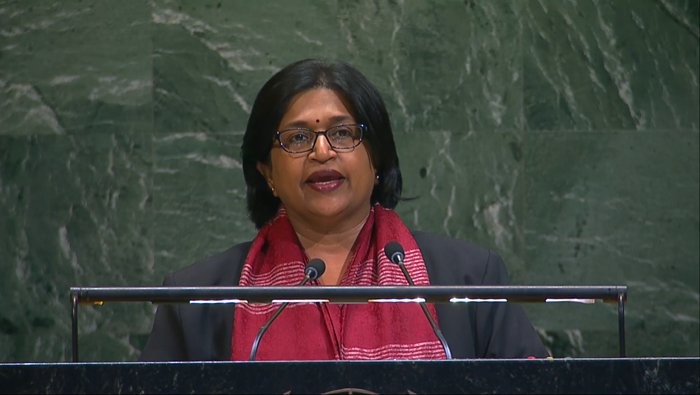
New York: India’s Permanent Representative to the United Nations (UN), Ruchira Kamboj, opened her November 18 statement in the intergovernmental negotiations on Security Council reform by describing the process as a “theatre of the absurd.”
Speaking during the 80th session of the General Assembly, under Agenda Item 121 on revitalisation, Kamboj argued that the open-ended format has perpetuated a cycle of repetition without advancing concrete outcomes for nearly two decades. She called for a redesigned approach, including a shift to text-based negotiations with attribution, establishment of fixed timelines, and expansion of permanent membership to address underrepresentation in regions such as Africa, Asia-Pacific, and Latin America.
Kamboj linked these reforms to the Council’s effectiveness, noting its challenges in responding to contemporary crises like those in Ukraine, Gaza, and Sudan, and emphasised that delays exacerbate the body’s legitimacy deficit.
The statement, delivered on behalf of the Group of Four (G4—Brazil, Germany, India, and Japan), built on prior G4 positions outlined in joint interventions, such as the November 2022 call for a consolidated negotiating text to break the impasse. Kamboj reiterated India’s support for comprehensive reform across all five negotiation clusters—categories of membership, question of veto, Security Council working methods, relationship between the Council and the General Assembly, and size and composition—while advocating limits on veto usage to prevent obstruction.
Following India’s intervention, several delegations expressed alignment or partial support. Brazil’s Permanent Representative, Ronaldo Costa Filho, on November 18, endorsed the G4 framework, highlighting the need for text-based progress and two permanent African seats to reflect geopolitical shifts. Japan’s Permanent Representative, Kazuyuki Yamagi, also on November 18, backed Asian representation and proposed sunset clauses for veto rights as a bridging mechanism, consistent with G4 efforts to facilitate P5 (permanent five members: United States, United Kingdom, France, Russia, China) engagement.
South Africa’s representative, conveying the African Union’s position later that day, referenced the Ezulwini Consensus and Sirte Declaration, seeking two permanent African seats with veto rights and five non-permanent ones; the statement noted convergence with G4 demands for format changes to move beyond preliminary discussions. The Ezulwini Consensus, adopted by the African Union at an Extraordinary Summit in Ezulwini, Swaziland (now Eswatini), on March 7–8, 2005, and reaffirmed in the Sirte Declaration in July 2005, outlines Africa’s demands for “not less than two permanent seats” with full privileges including the veto, plus five non-permanent seats, to rectify historical underrepresentation; it opposes the veto in principle but insists on its extension to all permanent members if retained, and rejects any reform excluding these elements. This position, coordinated through the African Union’s Committee of Ten (C-10), underscores that Africa—comprising 54 UN member states and over 70% of the Security Council’s agenda—requires veto parity to address “historical injustice.”
On November 19, Germany’s Permanent Representative, Jürgen Böhmer, reaffirmed G4 coordination while suggesting a hybrid model of expanded permanent and non-permanent seats to enhance efficiency. Indonesia, speaking for the Association of Southeast Asian Nations (ASEAN) on November 19, underscored regional equity, aligning with India’s veto balance concerns in the context of Indo-Pacific stability. The Maldives, as chair of the Alliance of Small Island States (AOSIS), supported time-bound processes and linked reform to veto exemptions for climate resolutions, extending the rationale of Kamboj’s critique on the Council’s adaptability. Caribbean Community (CARICOM) members, including Jamaica and Trinidad and Tobago, voiced support in November 19 statements, emphasising the role of expansion in amplifying small developing states’ input on development and security.
Earlier related inputs, such as the joint statement by Mexico, Slovenia, and Spain delivered by Slovenia’s Samuel Žbogar on November 13, advocated goal-oriented text-based talks, which have been referenced in the current cluster. The European Union, via María Reyes Fernández on November 10, backed inclusivity under the UN80 Initiative but stopped short of endorsing specific veto restrictions.
Counterpoints emerged prominently from P5 and opposing groups. The United States’ Permanent Representative, Linda Thomas-Greenfield, in her November 17 opening remarks, voiced support for limited expansion, including potential G4 inclusion, but tied it to full consensus among permanent members. France’s Nicolas de Rivière and the United Kingdom’s Barbara Woodward, both on November 18, suggested voluntary veto restraints for mass atrocity situations but rejected binding constraints, framing them as Charter-compatible gestures. Russia’s Deputy Permanent Representative, Dmitry Polyanskiy, on November 19, upheld the veto’s inviolability, citing its application in over 30 Ukraine-related resolutions since 2022 and deeming restrictions a threat to sovereignty. China’s Permanent Representative, Fu Cong, on November 18, recognised African underrepresentation but prioritised regional balance, expressing caution on additional Asian permanent seats.
Pakistan’s Permanent Representative, on behalf of the Uniting for Consensus (UfC) group—including Italy, South Korea, and Turkey—spoke on November 18 against new permanent seats, proposing instead an increase in non-permanent ones to mitigate gridlock risks; this stance, critiqued by Kamboj in prior sessions for lacking timelines, continues to oppose G4 models.
The negotiations, co-chaired by Austria’s Alexander Marschik and Kuwait’s Nevine Al-Kadi, reference the revised Elements Paper from June 17, 2025, which maps areas of agreement and disagreement. The current cluster of intergovernmental negotiations began on November 17, 2025, and is scheduled to continue until November 21, 2025. No voting occurs, as proceedings rely on consensus, and no draft text has been introduced as of November 19. The cluster concludes on November 21, with sessions open to all 193 members and observers, streamed on the UN website. These discussions tie into broader Pact for the Future commitments from September 2024, aimed at advancing Council reform.
– global bihari bureau