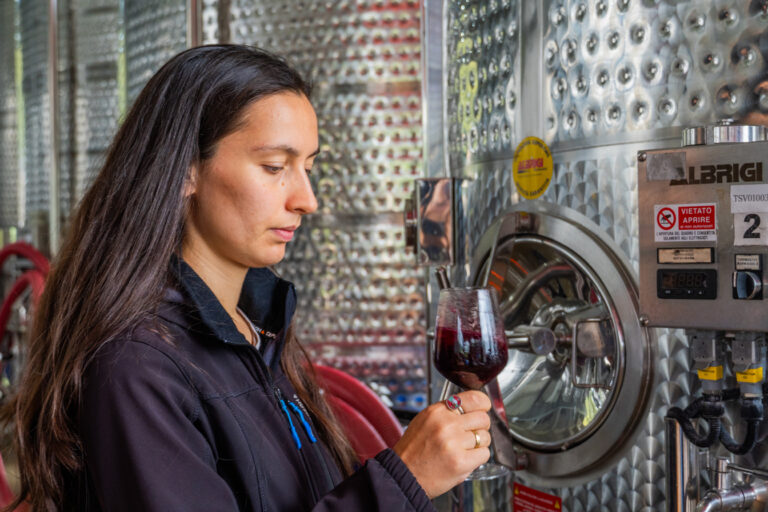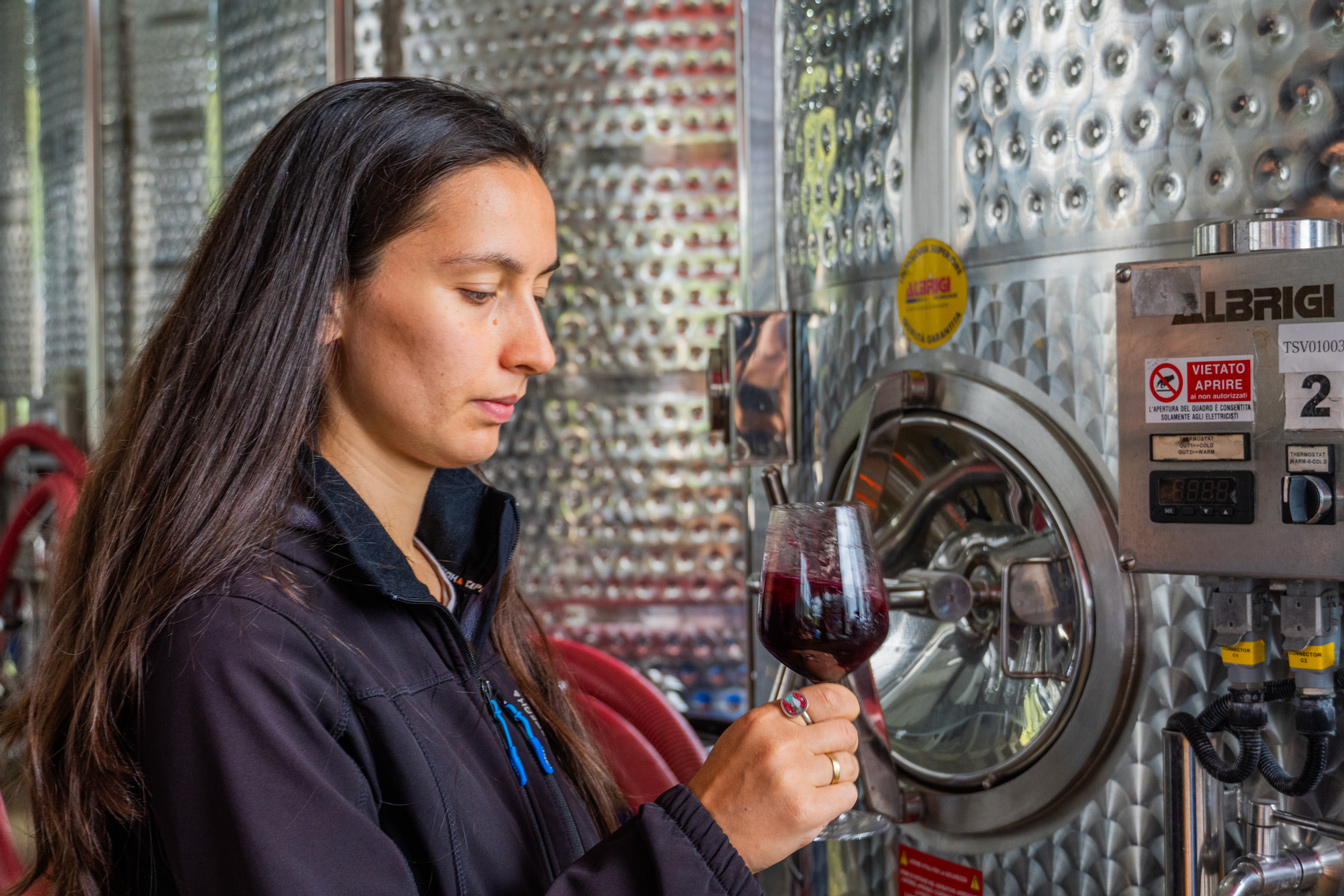
With an academic background in chemistry and biology, Sophio decided to combine her love of science and nature and go into winemaking. ©FAO/Guram Saqvarelidze
A Young Winemaker’s Scientific Path to Better Grapes
In the storied wine region of Kakheti, the agricultural heart of Georgia, Sophio Khutitdze grew up surrounded by vineyards, yet once imagined a future in medicine. From her school years, she gravitated toward the sciences, with chemistry and biology as her strongest subjects, and even sat for the national medical entrance examination. Over time, however, she realised that medicine did not truly align with her calling.
Seeking a path that could unite scientific curiosity with a deep connection to nature, she enrolled at the Agricultural University. When the moment came to choose a specialisation—agronomy, chemistry, biology or winemaking—she selected viticulture and oenology, a decision that reshaped her life.
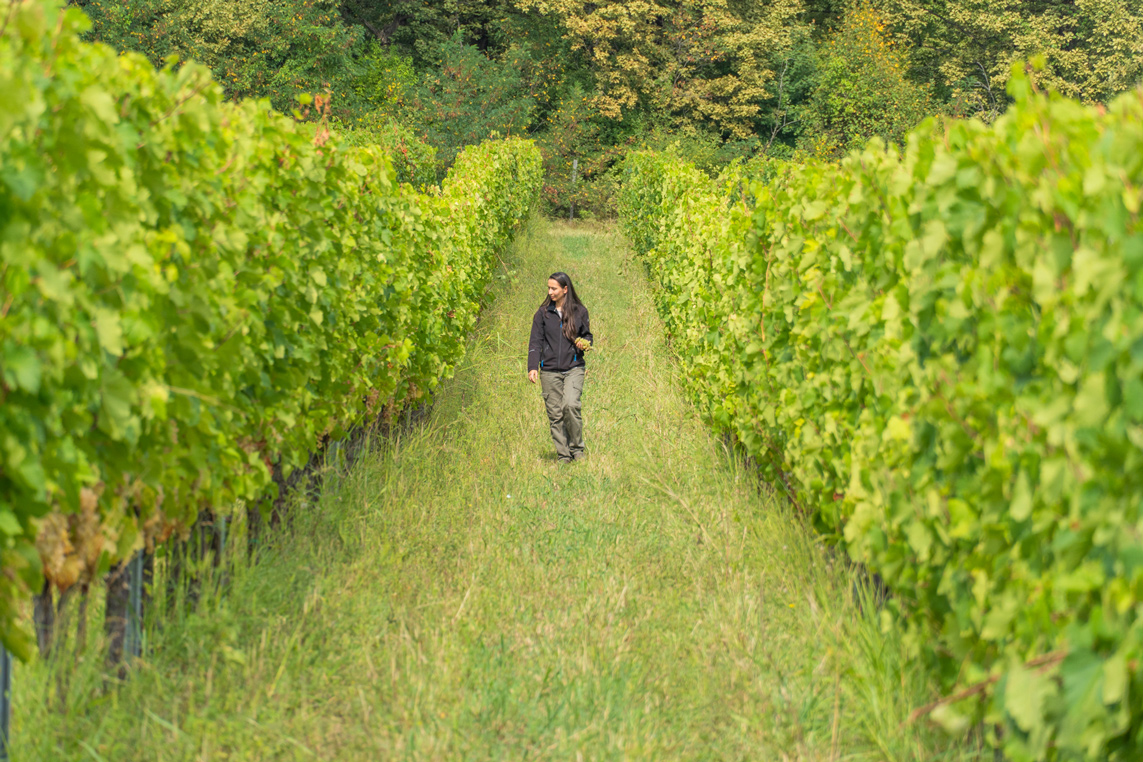
Today, at 25, Sophio works as both a viticulturalist and a winemaker for a private wine company in Kakheti, overseeing 40 hectares of vineyards. To her, wine is not simply a craft but a biological creation, shaped by yeast, living processes and carefully coordinated vineyard management. “Wine is a living product — shaped by yeast, biological processes and carefully coordinated vineyard management practices,” she explains. That belief brings her back to the beginning of every bottle: the grape itself. “To make quality wine, you need quality grapes. That starts in the vineyard.”
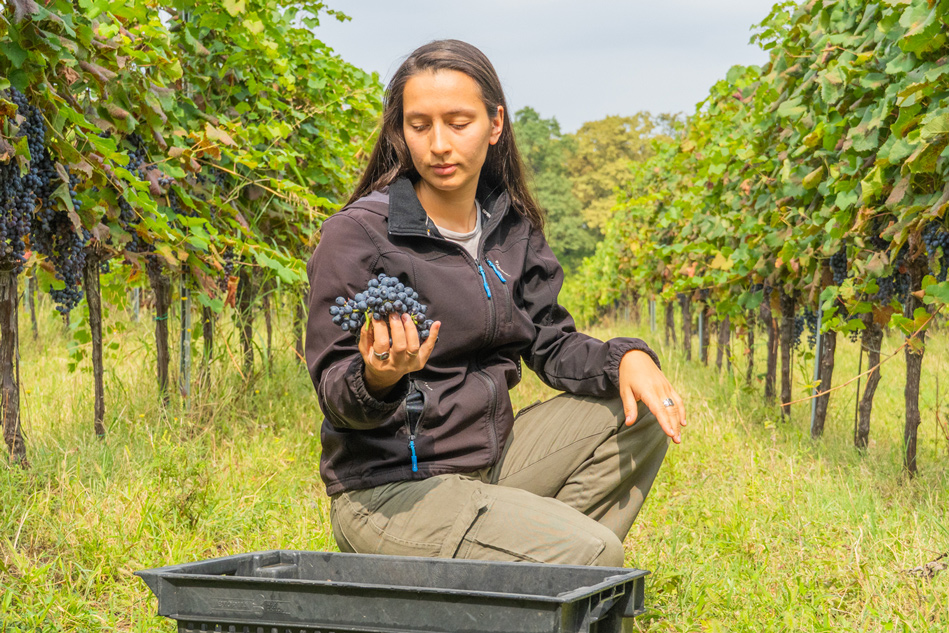
She approaches winemaking with the same scientific discipline she once applied in the classroom. Learning and experimentation guide her daily routine. “I focus on learning every day and applying new approaches in both the vineyard and the cellar,” she says. Her responsibilities evolve with the seasons—monitoring vine growth and disease control in spring, managing pests in summer, supervising harvest and fermentation in autumn, and preparing vineyards for winter care.
Six hectares under her management are already organic, and she plans to convert the remaining 34 hectares within the next three years. She stresses the inseparable relationship between viticulture and winemaking. “A winemaker must know their raw material. High-quality grapes are the foundation that leads to good wine,” she says.
Science becomes most visible in the struggle against vineyard pests. Georgian winegrowers have long faced the European grapevine moth, Lobesia botrana, whose larvae feed on grapes and create wounds that invite secondary fungal infections such as grey mould. These infestations reduce yields, damage grape quality, and increase risks to food safety.
Determined to move beyond dependence on chemical pesticides, Sophio joined a project in 2023 implemented by the Food and Agriculture Organization of the United Nations (FAO). Funded by the European Union and Sweden under the European Neighbourhood Programme for Agriculture and Rural Development (ENPARD IV), the initiative relies on a mating disruption approach. Synthetic pheromone diffusers are placed throughout vineyards to prevent moths from reproducing, sharply reducing their numbers and the damage they cause without broad chemical use.
“We have been implementing it for two years. This has minimised moth presence in our vineyards,” Sophio explains. “Most importantly, we eliminated the use of chemical pesticides. The Mating Disruption Programme fits perfectly with our plan to transition to organic production.”
Hands-on learning has been central to this transformation. Training covered everything from correct pheromone application to precise pruning techniques. FAO expanded this effort through Training of Trainers sessions addressing all aspects of integrated vineyard management.
“We learned directly in the vineyard,” Sophio recalls. Now, one of the new trainers herself, she has begun passing this knowledge to colleagues. “I have further shared this knowledge with my colleagues, and we are now bringing it to practice — young vines responded well, and over time, results will be visible even in older vines.”
Alongside vineyard management, FAO regularly organises additional training for Georgia’s wine sector on export strategies and market development. Through the ENPARD programme, more than 700 representatives from the wine industry have participated in these sessions.
The results are increasingly visible. Sophio and fellow Georgian winemakers are reducing pesticide use, improving grape and wine quality, and promoting environmentally responsible practices. The combination of pheromone-based pest control and sustainable vineyard management is helping ensure vineyards remain healthy, productive and economically viable.
“It’s the continuous experimentation and application of knowledge that will help me improve our wines and vineyard management practices,” Sophio reflects.
She speaks with quiet satisfaction about her profession. “I’m quite happy with that decision. I like my profession. It’s diverse, I’m constantly in contact with nature, and nature is balance. Every organism is connected to one another, creating harmony.”
Across Georgia, 23 wineries covering 875 hectares in four regions have adopted integrated pest management methods through FAO’s programme. Eighty-six per cent of participants report improvements in grape quality and food safety, while nine out of ten companies say they intend to continue using pheromones independently.
Science, passion and youth have come together like a carefully blended bouquet, offering fresh promise not only for Georgia’s wine industry but for its agriculture as a whole.
Source: The FAO News And Media Office, Rome
– global bihari bureau