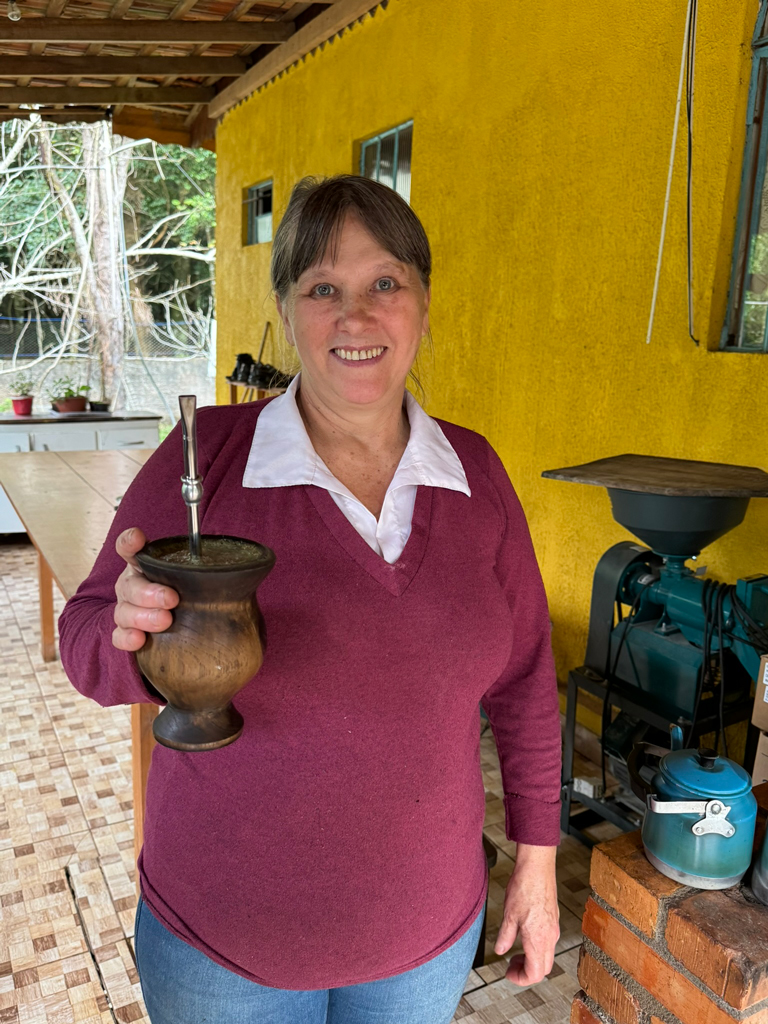
In Brazil’s Araucaria Forest, the Rio d’Areia Indigenous Peoples, with Antonio Lima as their leader, manage forests and shade-grown erva-mate together on their land. ©FAO/Luiza Olmedo
Why Paraná’s Forest Farming Matters to the World
In southern Brazil, a drink is never just a drink. A cuia—the traditional gourd used for sharing chimarrão, the erva-mate infusion—circulates quietly from hand to hand, opening conversation and anchoring people to place. What it carries is more than warmth. It holds the memory of the forest and a lived understanding of how to exist alongside it.
In Brazil’s south-central state of Paraná, erva-mate (Ilex paraguariensis) is not grown on cleared land. Instead, it is cultivated beneath native forest canopies, in landscapes where agriculture depends on the forest rather than replacing it. This way of producing food has sustained family livelihoods for generations, shaping an agricultural system rooted as much in ecology as in culture. Its importance also extends beyond the region. Alongside Argentina and Paraguay, Brazil ranks among the world’s leading producers and exporters of erva-mate, supplying both regional and international markets.

What distinguishes the traditional shade-grown erva-mate system is its ability to hold together agricultural production, biodiversity conservation and social organisation under sustained environmental pressure. The Araucaria Forest—part of the Atlantic Forest biome—is among the most threatened ecosystems on the planet. Decades of deforestation and land-use change have reduced it to a small fraction of its original extent. Against this backdrop, the survival of traditional agroforestry systems is not accidental. It is the outcome of daily choices, accumulated knowledge and collective care, carried forward across generations.
These systems have kept the remaining forest areas ecologically functional, economically productive and socially governed. In doing so, they have built resilience—supporting rural livelihoods while ensuring that ecological knowledge continues to be transmitted rather than lost.
“This is not just a farming system; it is a way of being with the forest,” says Evelyn Nimmo, Adjunct Professor at the State University of Ponta Grossa. “Production happens within the forest, guided by agroecological principles and ancestral knowledge. Communities manage canopy cover, regeneration and diversity in ways that allow the forest to remain standing while sustaining livelihoods.”
That philosophy translates directly into practice. “For a long time now, we have understood that it is necessary to preserve the Araucaria Forest, protect water sources and avoid the use of agrochemicals,” says João Carlos Andrianchyk, a small-scale erva-mate producer. “We are passing this understanding on to younger people because the world will need this work if we want to continue the good life we have here.”
That “good life” rests on continuity—the capacity to live from the land without exhausting it. In communities such as Pontilhão and Paço do Meio, more than 130 families depend directly on erva-mate, which often accounts for around 70 per cent of household income.
The forests these communities manage are neither untouched nor neglected. They are actively cared for through selective pruning and natural regeneration. Erva-mate grows alongside native fruit trees, medicinal plants and other forest species, forming a layered environment that supports biodiversity, protects soils and helps regulate water cycles.
Unlike industrial monocultures, where pests are suppressed through chemical inputs, these forest-based systems rely on ecological balance. “There is a caterpillar that damages erva-mate,” explains producer João Negir e Silva. “But we have gone ten to eleven years without outbreaks here. They reach neighbouring areas, but they do not come here because of the biological diversity we maintain.”
Here, biodiversity functions as a form of protection rather than an abstract goal. Interactions between birds, insects and plants reduce vulnerability and allow production to continue without degrading the forest itself.
Work follows the rhythms of the ecosystem. Erva-mate leaves are harvested only once every three years, allowing plants time to recover. Fruit is collected without shaking trees. Many producers propagate their own seedlings, maintaining native species such as araucaria, imbuia and canela guaicá—key components of the Araucaria Forest—and gradually reinforcing forest structure.
“We survive from agriculture and from the erva-mate we grow,” says rural producer Olga Wenglarek. “Everything is used, from firewood for cooking to food from our gardens. There is care involved in surviving and in making sure that those who come after us will also find a place.”
The significance of this system is sharpened by a biological constraint. The Araucaria tree (Araucaria angustifolia), the forest’s keystone species, cannot be effectively conserved through conventional seed banks. Its seeds are highly perishable and depend on living, connected landscapes to persist. As a result, the long-term survival of the Araucaria Forest depends directly on communities that keep it standing, productive and continuous.
That responsibility predates commercial production. Long before erva-mate entered formal markets, it was central to Indigenous life. Known as ka’a by the Guarani, the plant has long been used in ceremonies, rituals and everyday consumption.
“Erva-mate has always been part of our collective life,” says cacique Antonio Lima of the Rio d’Areia Indigenous land. “It is not only about consumption. It is community work, with shared rules on forest care, when to harvest and how to do it. This organisation is what has allowed the forest to remain standing and the community to remain united.”
Within this context, the designation of the traditional shade-grown erva-mate system as a Globally Important Agricultural Heritage System by the Food and Agriculture Organization of the United Nations (FAO) carries particular weight. Recognised in May 2025, it became Brazil’s second such system, alongside the Espinhaço Range Sempre-Vivas system.
“This recognition is much more than a title,” says Jorge Meza, FAO Representative in Brazil. “It shows how local communities have managed forests sustainably for centuries—protecting biodiversity, generating income and maintaining strong cultural identities.”
In Paraná, agriculture does not stand apart from nature. It stands with it. The forest endures not because it has been left alone, but because it has been worked, cared for and shared—building resilience for both people and ecosystems.
Source: The FAO News And Media Office, Rome
– global bihari bureau