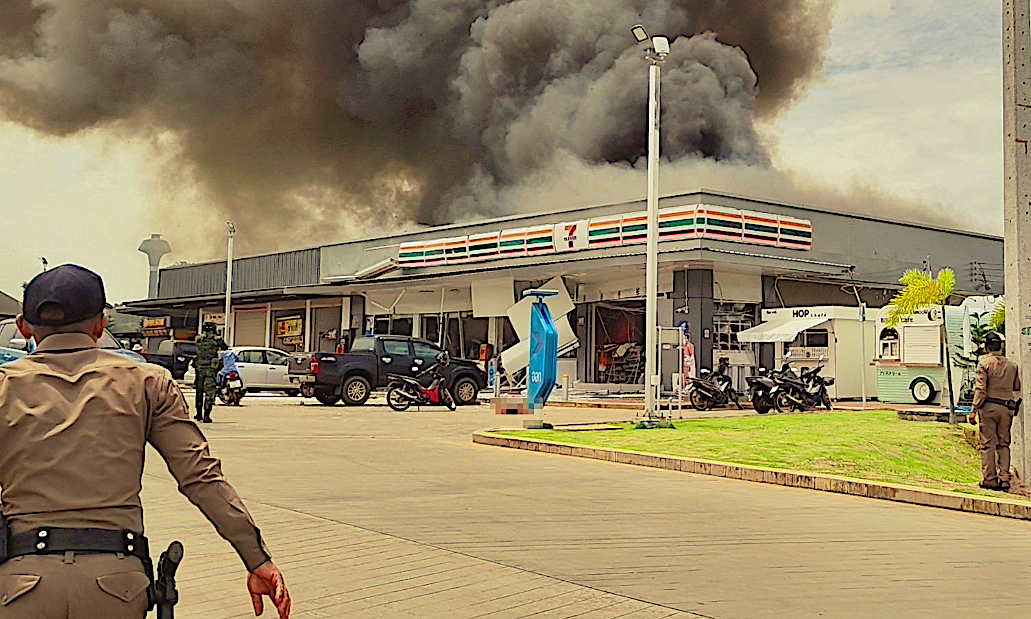
A Cambodia attack on gas station and military base in Thailand. Photo source: @Killercool63|X
China, U.S. Push Ceasefire as Border Fighting Intensifies
Civilian Toll Rises in Renewed Clash
Bangkok/Phnom Penh/Washington/Beijing: The border between Thailand and Cambodia has witnessed one of the most severe escalations of violence in recent decades, with renewed clashes continuing for more than ten days. Heavy artillery exchanges, drone strikes, rockets, and air attacks have punctuated the 817-kilometre frontier, with fighting reported near Poipet, a major commercial hub in Cambodia, and in villages in Thailand’s Si Sa Ket and Surin provinces. Both Thai and Cambodian forces have deployed fighter jets and heavy artillery, reflecting a significant escalation in scale and technological sophistication. Independent reports indicate dozens of fatalities among military personnel and civilians, while hundreds of thousands of residents have fled combat zones, creating a humanitarian crisis. Essential services such as water, electricity, healthcare, and education have been disrupted, and markets and roads in the border provinces have been damaged. Travel advisories warn against venturing within 50 kilometres of the border due to active hostilities.
The humanitarian fallout has been dramatic. Authorities in Cambodia report that nearly half a million people — primarily women and children — have fled their homes in multiple provinces, while in Thailand, more than 400,000 residents have evacuated to safe shelters, including schools, community centres, and temporary camps. Families describe explosions and long treks to safety, and hospitals are overwhelmed with wounded civilians. Schools have been closed, and economic activity has slowed sharply in affected districts. Relief agencies are coordinating with local authorities to provide shelter, food, and medical care, but access remains difficult due to damaged roads and ongoing bombardments.
Displaced civilians speak of fear and trauma amid the chaos. In O’smach, a town near the Cambodian frontier, residents recounted how an airstrike killed a neighbour while families sheltered together. In Thai border villages, children winced at the sound of distant explosions while parents guided them to temporary shelters. Hospitals and clinics have been forced to treat trauma cases under extreme conditions, with staff working around the clock to care for both civilians and injured personnel.
Diplomatic efforts have intensified in parallel with the fighting. China has emerged as a central mediator in the crisis, dispatching its Special Envoy for Asian Affairs on a shuttle-diplomacy mission between Bangkok and Phnom Penh. Speaking at the December 19 press conference, Chinese Foreign Ministry Spokesperson Guo Jiakun emphasised that China is “deeply saddened by the civilian casualties” and reaffirmed Beijing’s commitment to promoting peace and rebuilding trust. Foreign Minister Wang Yi also spoke with the Cambodian and Thai foreign ministers to encourage dialogue, and China continues to offer platforms for negotiation while urging both sides to “bear in mind peace and stability along the border as well as the interests of the two peoples.”
This mediation effort comes amidst sensitive developments. Thailand’s recent discovery of Chinese-made weapons in Cambodia raised questions over Beijing’s impartiality in the peace process. Guo dismissed the controversy, noting that both China and Thailand had clarified the issue and reaffirmed China’s constructive role in fostering a ceasefire.
The United States has also stepped up engagement. Secretary of State Marco Rubio spoke with Thailand’s Foreign Minister, Sihasak Phuangketkeow, today, emphasising Washington’s concern over ongoing violence and urging Thailand to implement previously agreed ceasefire terms as per the Kuala Lumpur Peace Accords. The United States called for concrete steps to reduce tensions along the border and stressed the broader regional implications of the conflict, warning that prolonged fighting could destabilise Southeast Asia.
Southeast Asian regional diplomacy has been active as well. Ahead of a special ASEAN ministerial meeting scheduled for December 22, 2025, in Malaysia, efforts to mediate a ceasefire continue. Thailand has set clear conditions ahead of the meeting, insisting that Cambodia must first formally declare a ceasefire, that the truce be real, continuous, and verifiable on the ground, and that both sides cooperate on joint demining operations along the border. Bangkok has emphasised that these conditions are prerequisites for any meaningful engagement at the ASEAN forum, framing them as confidence-building measures to ensure stability, protect civilians, and demonstrate Cambodia’s commitment to de-escalation. ASEAN officials have sounded cautiously optimistic about progress, and both China and the United States have signalled that dialogue remains the most viable path to ending hostilities, but achieving alignment between the conflicting parties has proven challenging.
The conflict is rooted in long-standing territorial disputes tracing back to colonial-era demarcations. Previous ceasefire agreements, including accords signed last year, have repeatedly collapsed amid violations and mutual distrust. Observers monitoring compliance have faced difficulty accessing frontline zones safely, illustrating the fragility of enforcement mechanisms. Minor clashes earlier in 2025 had hinted at rising tensions, but the current flare-up is one of the most sustained and destructive, with military and civilian targets alike affected.
The humanitarian dimension continues to grow. Tens of thousands of residents have fled frontline villages, seeking refuge in neighbouring towns or across the border. Food, water, and medical supplies are urgently needed, and families face overcrowding and inadequate shelter. Children are especially vulnerable, with schooling interrupted and many facing the psychological effects of displacement and exposure to conflict. Local health authorities report treating multiple cases of trauma, malnutrition, and injury caused by artillery and airstrikes.
Public services have come under severe strain. Hospitals, community clinics, and other essential facilities struggle to maintain operations amid mass evacuations. Damaged roads and infrastructure have hindered the delivery of humanitarian aid, while water systems and power lines in affected districts have been disrupted, creating further urgency for relief efforts.
Not all ceasefire attempts have succeeded. Efforts to announce temporary truces have been undermined by continued skirmishes in multiple sectors of the border. While both governments publicly reaffirm their commitment to peace and negotiations, the persistence of violence underscores the difficulty of achieving lasting stability in the region.
Cultural heritage sites near the frontier have also been placed at risk. Iconic temples and monuments lie within reach of artillery and rocket fire, raising international concern over the preservation of irreplaceable historical sites. Though no major destruction has been reported, the proximity of fighting threatens both the structures and the surrounding communities that rely on tourism and cultural activity.
The economic impact of the fighting has been significant. Cross-border trade has slowed sharply as checkpoints were closed and transport routes disrupted, halting large portions of bilateral commerce previously valued at several billion dollars annually. Local businesses dependent on border trade report severe losses, while agricultural communities along the frontier worry about lost harvests, displaced livestock, and long-term economic damage. Preliminary government estimates suggest that direct physical damage, emergency relief, and reconstruction in Thailand could already exceed USD 300–770 million, with prolonged conflict potentially increasing combined economic losses for Thailand and Cambodia into the billions of dollars, when factoring in trade stoppages, tourism collapse, and disruptions to labour and remittances. The economic burden on local communities and regional governments is mounting, compounding the humanitarian crisis.
The pattern of escalation in 2025 illustrates a gradual buildup. Minor clashes and artillery exchanges in August and September were followed by heavier exchanges in early December, culminating in sustained bombardments and airstrikes. Evacuations began almost immediately, and international attention intensified as the scale of the humanitarian crisis became clear. Diplomatic efforts by China, the United States, and ASEAN have aimed to restore a ceasefire, but a formal agreement has yet to be reached.
Looking ahead, the situation remains fragile. Both Bangkok and Phnom Penh continue to maintain strong military positions, and civilian welfare is still at risk. The convergence of humanitarian needs, regional stability, and international diplomatic engagement underscores the urgency of a lasting resolution. The ability of both countries to adhere to agreements, protect civilians, and cooperate with mediators will determine whether peace can be restored or whether the violence will continue to escalate.
The Thailand–Cambodia border crisis remains one of Southeast Asia’s most pressing security and humanitarian challenges. With ongoing fighting, mass displacement, critical infrastructure under threat, mounting economic costs, and clear conditions ahead of ASEAN engagement, the coming days will be decisive in shaping the future of the border region and the lives of the hundreds of thousands affected.
– global bihari bureau