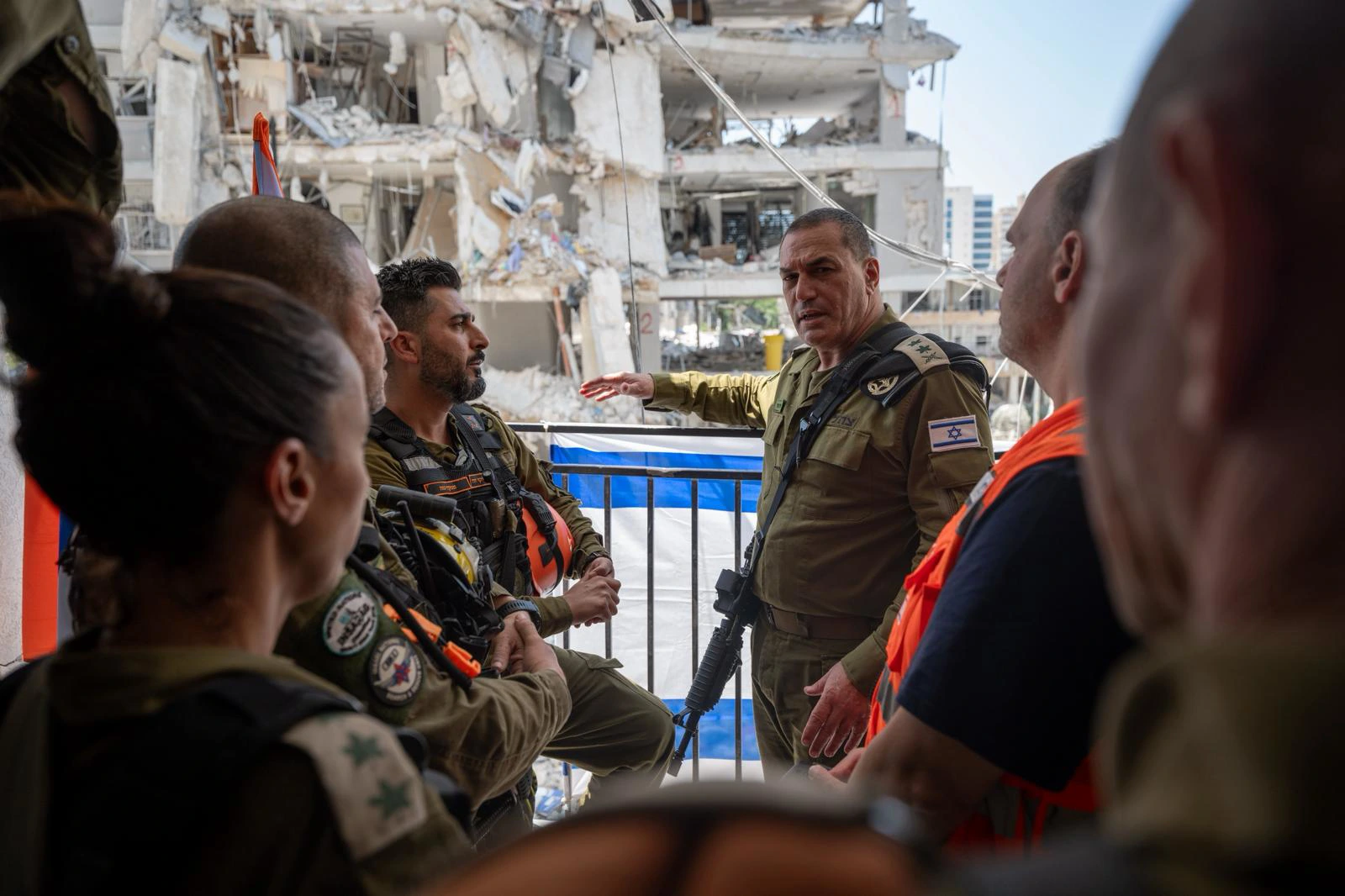
Israel's Chief of the General Staff, LTG Eyal Zamir, at the impact site of an Iranian missile in the Israeli city of Bat Yam on June 17, 2025.
Trump’s Tough Talk Fuels Iran-Israel Firestorm
Tehran/Tel Aviv/Washington/New York: The Iran-Israel conflict, now in its sixth day as of June 18, 2025, continues to escalate with intense military exchanges, raising global fears of a broader regional war. Israel’s Operation Rising Lion, launched on June 12, targeted Iran’s nuclear facilities, missile bases, and military leadership, with the Israeli Defense Forces (IDF) striking missile batteries.
The IDF claims these strikes, guided by its Intelligence Directorate, have crippled Iran’s nuclear enrichment capabilities and command structure, killing key figures like Major General Ali Shadmani, the wartime chief of staff, and Mohammad Kazemi, intelligence chief of the Islamic Revolutionary Guard Corps (IRGC). Iran retaliated with “Operation True Promise III”, firing over 440 ballistic missiles and hundreds of drones at Israel, targeting cities like Tel Aviv and Haifa. The IRGC reported downing three Israeli jets, a claim the IDF denies, asserting no air force casualties.
Also read: Skies Ablaze as Middle East Teeters on Edge
Official casualty figures reflect the conflict’s heavy toll. In Iran, the Ministry of Health reports 585 deaths and 1,326 hospitalisations, with over 90% of casualties being civilians, including those killed in strikes on residential areas and energy infrastructure like a fuel depot near Tehran. In Israel, the Magen David Adom (MDA) emergency service confirms 24 deaths, including 19 civilians and two soldiers, with over 1,300 injuries, 87 of which occurred in central Israel from strikes on Petah Tikva and Bnei Brak. Specific incidents include four deaths in Petah Tikva, one in Bnei Brak, and eight in Haifa and Tel Aviv combined, with a missile strike on a Herzliya bus terminal causing no fatalities but significant damage. Both sides report extensive property damage, with nine buildings destroyed in Ramat Gan and Tehran’s Grand Bazaar shuttered amid civilian evacuations.
The United States, under President Donald Trump, has taken a firm stance, demanding Iran’s “unconditional surrender” while denying direct involvement in Israel’s strikes. The U.S. has bolstered Israel’s air defences, intercepting Iranian missiles, and established a 24/7 Middle East Task Force to support American citizens. Trump’s rhetoric, including claims of controlling Iran’s skies and knowing the location of Supreme Leader Ayatollah Ali Khamenei, has heightened tensions. Iran’s President Masoud Pezeshkian condemned Israel’s attack on the IRINN state television headquarters, calling it a violation of international law, and vowed a proportional response. Diplomatic efforts falter as Iran cancelled nuclear talks scheduled for June 15, 2025, in Oman, citing ongoing Israeli attacks. The United Nations, through Deputy Spokesperson Farhan Haq, urges de-escalation, with the Secretary-General pushing for a ceasefire at the G7 summit. The International Atomic Energy Agency (IAEA) confirmed damage to Iran’s Natanz enrichment facility, raising concerns about radiological risks, though external radiation levels remain normal.
Regional dynamics complicate the crisis. Iranian-backed groups like Kata’ib Hezbollah have threatened U.S. interests, while Yemen’s Houthis launched missiles at Israel. Israel’s evacuation warnings to Tehran’s District 18 and other areas have sparked mass displacement, with residents sheltering in metro stations and mosques. India and China are evacuating citizens, and Israel’s El Al airline extended flight suspensions through June 23, stranding 150,000 Israelis abroad. G7 leaders, meeting in Canada, prioritise de-escalation, with German Chancellor Friedrich Merz and the European Union’s Ursula von der Leyen advocating diplomacy to prevent Iran’s nuclear weaponisation.
The conflict’s trajectory hinges on military restraint and diplomatic breakthroughs. Israel’s targeted strikes aim to neutralise Iran’s nuclear and military capabilities but risk inflaming civilian sentiment, as seen in Tehran’s rallying around the flag. Iran’s missile barrages, while causing significant damage, have been less effective due to Israel’s advanced defences, yet its threats of further retaliation signal resolve.
The Middle East teeters on the edge of a devastating war as the Iran-Israel conflict erupts into a perilous new chapter, with Israel’s relentless airstrikes and Iran’s defiant pledge of retaliation threatening to engulf the region in chaos. The absence of nuclear talks and rising civilian casualties underscore the urgent need for a ceasefire to prevent a wider war. The United Nations Secretary General’s deputy Special Envoy for Syria, Najat Rochdi, on June 17, 2025, warned the United Nations Security Council members that the escalation between Israel and Iran risks the progress toward peace and recovery in Syria.
On June 17, 2025, the IDF launched a sweeping offensive involving dozens of fighter jets that struck over 70 Iranian air defence missile batteries across Iran, and a centrifuge production site in Tehran using more than 50 warplanes. Guided by the IDF’s Intelligence Directorate, these strikes targeted advanced missile launchers and detection radars, many concealed within civilian infrastructure to counter Israeli air operations. An Israeli Air Force (IAF) commander described the mission as a historic turning point, capable of reshaping the conflict by establishing aerial superiority and clearing paths to Tehran and other critical targets. Remotely piloted aircraft complemented the operation, identifying and neutralising additional launchers and radars on the ground, significantly weakening Iran’s defensive capabilities.
This campaign follows Iran’s missile attack on the Israeli city of Bat Yam, where the IDF’s Chief of the General Staff, LTG Eyal Zamir, visited the impact site alongside Home Front Command Commander MG Rafi Milo, Dan District Commander COL Shani Gershi, and Bat Yam Mayor Tzvika Brot. Zamir conducted a situational assessment, emphasising the critical role of civilian resilience in sustaining Israel’s operations. He highlighted the extraordinary scope of the war, with Israeli forces hunting surface-to-surface missiles 1,500 kilometres away while Home Front Command troops manage search and rescue, treat the injured, and address fatalities in Bat Yam, reinforcing the importance of adherence to protective measures and Home Front Command guidelines.
In Tehran, Iran’s President Masoud Pezeshkian condemned an Israeli airstrike on the Islamic Republic of Iran News Network (IRINN) headquarters during a live broadcast, denouncing it as a barbaric act that exposes Israel’s unrestrained savagery and blatant disregard for international law. He lauded the courage of IRINN journalist Sahar Emami, whose composure under fire symbolised Iran’s unyielding resistance against aggression.
Pezeshkian warned that Israel’s actions, supported by Western powers, are destabilising the region and undermining any hope for lasting peace. In a June 17 phone call with the United Arab Emirates (UAE) President Mohammed bin Zayed Al Nahyan, he accused Israel of sabotaging diplomatic efforts, citing the assassination of Hamas political leader Esmaeil Haniyeh early in his administration as a deliberate provocation. He reaffirmed Iran’s commitment to negotiation and regional cooperation, viewing neighbouring countries as brothers, but lamented Israel’s persistent obstruction. The UAE leader expressed solidarity with Iran, noting shared interests and ongoing consultations to reduce tensions and restore stability. In a June 16 call with Turkish President Recep Tayyip Erdogan, Pezeshkian asserted that Iran did not start the conflict but would respond proportionately to Israeli attacks, vowing to defend its territory in a manner that would make Israel regret its actions. He highlighted Iran’s pursuit of peace through nuclear negotiations with the United States, but claimed a U.S. representative told Iran’s Foreign Minister Abbas Araghchi that Israel’s attacks required U.S. approval, implying American complicity. Erdogan urged Israel to cease its assaults to facilitate renewed nuclear talks, offering Turkey as a host, while Pezeshkian thanked him for his peace efforts and expressed gratitude for Turkey’s solidarity.
The United States, led by President Donald Trump, plays a central role in navigating this volatile crisis. At a June 17, 2025, Department of State briefing, spokesperson Tammy Bruce underscored Trump’s resolute stance—reiterated over 40 times since 2011 and at least a dozen times since taking office—that Iran must not possess a nuclear weapon. This commitment drives the Trump administration’s priority to ensure the safety and security of American citizens at home and abroad. To manage the crisis, the State Department established a 24/7 Middle East Task Force to coordinate support for U.S. citizens, diplomatic missions, and personnel. The task force has issued over 30 security alerts and updated travel advisories, urging Americans to avoid Israel, Iraq, and Iran and to enrol in the Smart Traveler Enrollment Program (STEP) at travel.state.gov for timely updates. Bruce provided a contact number (+1-202-501-4444) and directed the citizens to the website’s red box for embassy assistance, praising the dedication of U.S. government teams, particularly in Israel and Ukraine, where personnel sheltered in bunkers amid attacks. She highlighted the unsung efforts of thousands of American citizens working anonymously in embassies and consulates worldwide to facilitate diplomacy and support Americans, emphasising that their safety is the priority of Secretary of State Marco Rubio and the entire department.
The U.S. posture has evolved dramatically. Initially maintaining distance from the Israel-Iran conflict, Trump has adopted a more assertive tone, claiming control over the skies and knowledge of the Iranian supreme leader’s location, though stating no intent to target him “for now.” His demand for Iran’s “unconditional surrender” and warnings against attacks on civilians or American soldiers—posted on Truth Social, where he declared, “We don’t want missiles shot at civilians, or American soldiers. Our patience is wearing thin. Thank you for your attention to this matter!”—signal a hardening stance. Bruce clarified that the U.S. did not initiate or participate in Israel’s attacks on Iran, a position echoed by Rubio, but deflected questions about U.S. support for regime change or strikes on Iran’s nuclear facilities, such as Fordow, stating that Trump is the “singular guiding hand” for such decisions. She declined to confirm whether diplomacy with Iran remains open, noting that Trump alone decides, and could not verify Iranian interest in continued talks. When pressed on intelligence assessments—specifically whether Iran’s nuclear program has progressed since a March 26, 2025, U.S. assessment that Iran was not pursuing a nuclear bomb—Bruce deferred to the White House and National Security Council, citing Trump’s access to critical information. Questions about the 60-day timeline for Iran’s nuclear talks, compared to the 18 months given to the Taliban in Trump’s first term, or the administration’s shift from optimism about negotiations to near-war footing, went unanswered, reflecting a cautious approach to strategic details.
International concern is mounting. The United Nations, through Deputy Spokesperson Farhan Haq, voiced alarm over the military escalation, urging Israel and Iran to adhere to international law and protect civilians and infrastructure. The UN Secretary-General, attending the G7 summit and meeting with leaders, including Iran’s Foreign Minister Araghchi, is advocating for de-escalation and an immediate ceasefire. Haq noted that the Security Council is deliberating, and while the Secretary-General has the authority under Article 99 of the UN Charter to call for a meeting, he has not yet exercised it. The UN has relocated some international staff and dependents from the region, though specific numbers are unavailable. Haq condemned escalatory rhetoric, including Israeli Defence Minister Katz’s threat to Iran’s supreme leader, likening him to Saddam Hussein, and Trump’s tweet about knowing the leader’s location, urging all parties to avoid actions or statements that could inflame tensions. He dismissed as rhetorical the Israeli Ambassador’s claim that many UN Permanent Representatives are grateful for Israel’s actions against Iran’s “terror regime,” reiterating that diplomacy is the best path to address regional security and Iran’s nuclear program. Haq acknowledged that conflicts eventually reach a point where parties are willing to negotiate, but this stage remains elusive.
Regional dynamics add complexity. Iranian-backed Kata’ib Hizballah threatened to target U.S. interests if America intervenes, prompting questions about U.S. coordination with Iraq to prevent Israeli overflights in Iraqi airspace. Bruce redirected such inquiries to the Department of Defense and the White House, citing Trump’s Truth Social posts as the clearest expression of U.S. policy. Trump’s recent Middle East trip, described as successful, involved discussions with leaders like Saudi Arabia’s Mohammed bin Salman, Qatar, and the UAE, who align with U.S. goals for peace. Bruce referred to Trump’s posts for details, emphasising his dealmaking expertise. The lack of a U.S. special envoy for Iran and confirmed ambassadors in key Middle Eastern posts raised concerns about the State Department’s readiness for a post-conflict scenario, but Bruce insisted that 24/7 operations, led by Rubio and guided by Trump, ensure preparedness, driven by personnel with deep diplomatic experience. She noted that the State Department operates like the military, anticipating and addressing issues before, during, and after crises, even if such efforts are not publicly visible.
India responded by establishing a 24/7 control room in its Ministry of External Affairs on June 17, offering contact numbers (+91-11-23012113, +91-11-23014104, +91-11-23017905, +91-9968291988) and an email (situationroom@mea.gov.in) for citizens. The Indian Embassy in Tehran and consulates in Bandar Abbas and Zahedan activated emergency helplines (+98-9128109115, +98-9128109109, +98-9010144557, +98-9015993320, +91-8086871709, +98-9177699036, +98-9396356649) to assist Indian nationals.
In Israel, Prime Minister Benjamin Netanyahu met with President Isaac Herzog and opposition leader Yair Lapid on June 17 for security updates, reflecting a unified response. The IDF’s Intelligence Directorate, led by Major General Shlomi Binder, was pivotal in enabling strikes on Iran’s General Staff, while maintaining vigilance over Gaza hostages and threats to Israeli soldiers and civilians. Binder praised his team’s ability to break boundaries and deliver timely warnings, calling them Israel’s “eyes” and urging humility and focus amid extraordinary challenges.
The human toll is staggering. In Bat Yam, Home Front Command troops prioritise search and rescue, treating the injured and managing fatalities, with Zamir stressing civilian resilience as a pillar of Israel’s strength. In Tehran, Pezeshkian lauded Iran’s defence forces and media for their diligence, framing the IRINN attack as a rallying cry for national unity. The targeting of civilian infrastructure, like IRINN, sparked debate, with Haq questioning its legitimacy as a military target, though Bruce deferred to Israel for justification, stating, “You’d have to ask Israel about their decisions.” Unconfirmed reports of former Iranian President Mahmoud Ahmadinejad’s death in Tehran remain unaddressed, with Bruce unable to comment. Trump’s broader peace efforts, including an offer to mediate the Kashmir issue—rebuffed by India’s Modi government—highlight his willingness to intervene globally, though Bruce respected India’s sovereignty, noting that Trump’s offers are generous but depend on acceptance.
Analytically, the conflict reveals a precarious balance between military aggression and diplomatic restraint. Israel’s strikes, while tactically precise, risk international condemnation by targeting civilian sites, bolstering Iran’s narrative of victimhood and rallying its populace. Iran’s vow of proportional retaliation, while calculated to avoid all-out war, signals unwavering resolve, and its claims of U.S. complicity could draw Washington into the conflict, especially if Kata’ib Hizballah acts on its threats. Trump’s rhetoric—blending threats, intelligence boasts, and mediation offers—creates a volatile dynamic: it may coerce Iran into concessions or provoke further escalation, particularly given the unclear intelligence on Iran’s nuclear progress and the abbreviated timeline for talks. The involvement of regional powers, evidenced by Trump’s Middle East trip and Pezeshkian’s dialogues with the UAE and Turkey, suggests mediation potential, but their alignment with U.S. and Israeli interests remains uncertain. The UN’s principled calls for restraint lack enforcement power, leaving major powers to avert a wider war. Israel’s hints at regime change, as seen in Katz’s rhetoric and strikes on Iran’s General Staff, contrast with its initial focus on nuclear capabilities, raising questions about strategic objectives. The human cost—missile strikes in Bat Yam, attacks on Tehran’s media, and civilian displacement—underscores the urgency of de-escalation.
As the NATO summit looms in The Hague, the crisis’s trajectory remains unpredictable. Israel’s campaign to dismantle Iran’s defences and nuclear capabilities, Iran’s defensive posture, and the U.S.’s delicate balancing act define a region on the brink. With global leaders converging and the UN advocating for peace, the coming days will test whether diplomacy can silence the drums of war or if the Middle East will descend into further chaos.
– global bihari bureau