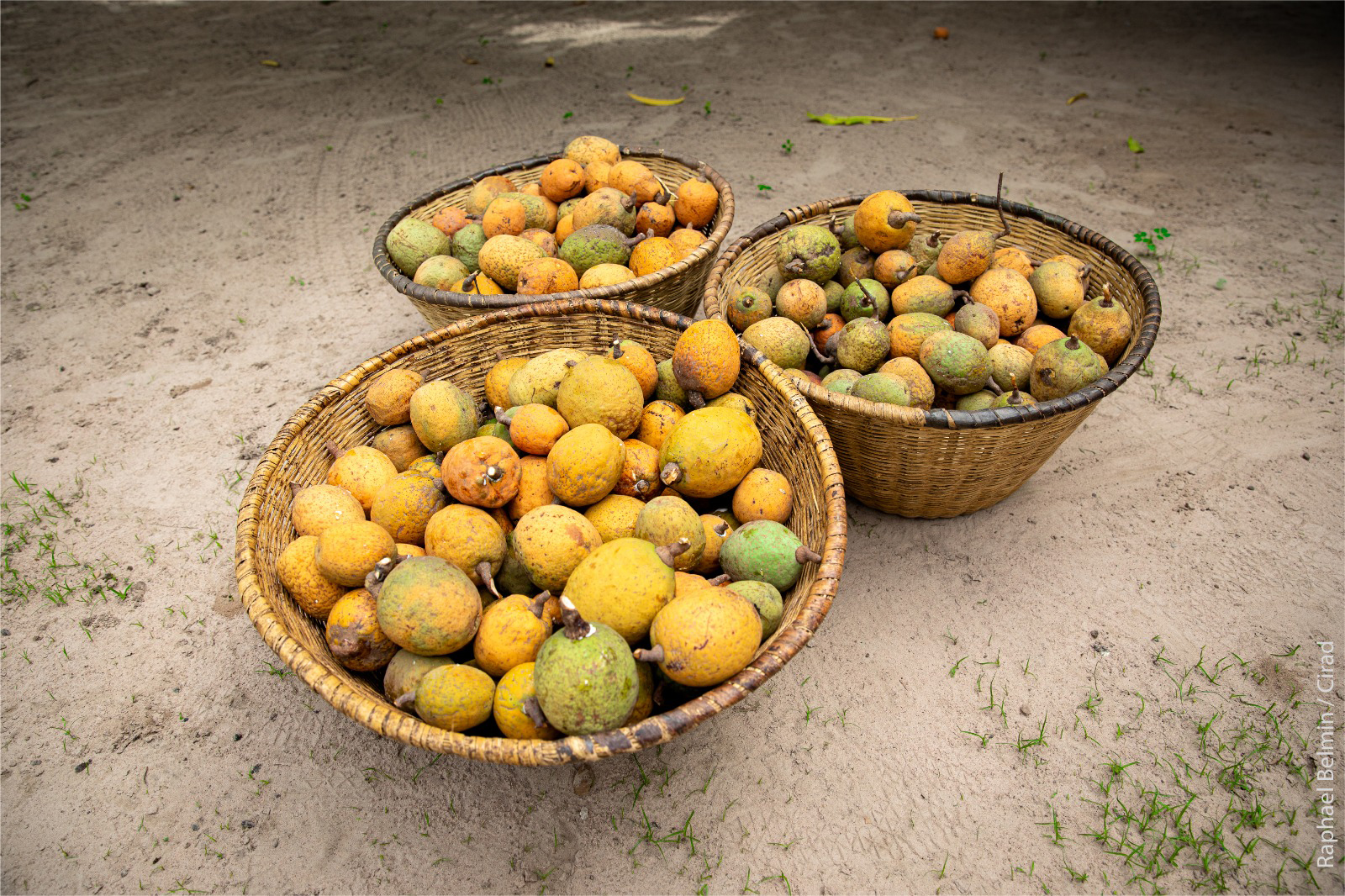
Madd fruits (Saba senegalensis) grow wild across West Africa, but the ones from the Casamance region possess unique characteristics that have been recognised with a geographical indication. ©CIRAD/Raphael Belmin
Ziguinchor, Senegal: In the lush Casamance region of southern Senegal, the Madd fruit has long been a staple of local life, gathered from towering forest vines that stretch over 40 meters high. For generations, communities have relied on this wild harvest, with youth climbing the vines using ropes or poles in the summer months, a dangerous task requiring balance and skill honed through years of practice. The fruits, reaching up to 10 centimetres in length, are packed with vitamins A and C and antioxidants, mostly consumed fresh, though only around two per cent is processed into juices, sweet, or savoury preserves. Deeply embedded in the culture of lower Casamance, madd grows in the Sacred Woods, a traditional worship site that ties spiritual traditions to forest management, preserving both heritage and ecosystem.
The Madd of Casamance stands apart from its West African counterparts, its unique characteristics shaped by the region’s rich ecosystem, referred to as the “green lung of Senegal,” along with specific ripening conditions and the traditional know-how of local communities. Youth handle the harvest, while women in cooperatives process and market the products, but producers once had little control over pricing and faced threats from unsustainable practices, over-exploitation, and forest fires that endangered vines and forests alike.

Mamadou Baldé, a licensed picker since 2020, recalls, “I was mainly selling to the traders from Dakar who imposed their price on us.” This changed on June 25, 2024, when Madd became Senegal’s first product officially registered as a Geographical Indication (GI) by the African Organization of Intellectual Property, a milestone that protects its name and origin.
The GI designation ensures only fruit from the Casamance region, processed under strict specifications, can be called “Madd de Casamance.” These rules prohibit cutting vines, picking unripe fruit, or using artificial ripening methods, and mandate processing within 200 kilometres of harvest areas, keeping income and jobs local and vital for rural youth who might otherwise turn to illegal migration or illicit trade. The eight-year effort to secure the GI involved training hundreds of producers, setting quality standards, and building oversight structures. Partnering with the Centre for International Cooperation in Agronomic Research for Development (CIRAD) and the World Intellectual Property Organization (WIPO), the Food and Agriculture Organization of the United Nations (FAO) guided the process from feasibility studies to certification, providing funding, technical expertise, and organisational support. Local non-profit Économie Territoire et Développement Services (ETDS) implemented the project with communities and the Association for the Protection and Promotion of the Geographical Indication Madd de Casamance (APPIGMAC), a body of producers trained by FAO in governance, post-harvest handling, and forest stewardship. They defined the specifications that all members must follow, guaranteeing consistent and distinctive quality for consumers.
Pape Tahirou Kanouté, ETDS Executive Director, explains, “The registration of the madd de Casamance as a geographical indication has allowed this wild fruit and its value chain to be more recognised by the public authorities as a sector that brings about sustainable local growth.” With GI guarantees of origin, quality, and traceability, customers are willing to pay more, leading to an average 20 per cent price increase in some markets. Baldé adds, “The GI has allowed me to expand my professional network in the sector, particularly the processors to whom I deliver fresh GI Madd. This has increased my marketing volumes of madd… Thanks to this work, I am very well-known, and I was able to buy a hectare to set up an orchard. I am very proud of that.”
Environmental protection is central to the GI. The specifications include safeguards to prevent over-exploitation, making conservation profitable. The Senegalese Forestry Office, with local village committees, manages the resource by mapping production areas, ensuring forest fire management, and launching reforestation and assisted natural reforestation efforts. Community agreements with rural populations facilitate forest management, preserving the Sacred Woods. Moustapha Diassy, a harvester, says, “The job of a picker, and especially of GI madd picker, is a noble profession that allows me today to earn a living, provide for my family and save money… That’s why I’m very committed to the defence of forests. I am even a member of a local association that defends the environment and especially the preservation of the Madd. It’s a fight for me because the Madd gave me everything. I became what I am thanks to the madd.”
Globally, there are nearly 9,500 registered Geographical Indications across all continents. In Africa, there are more than 200 GIs, including Penja pepper in Cameroon and “Attiéké des Lagunes,” a fermented cassava couscous, in Côte d’Ivoire. For rural communities in Casamance and beyond, geographical indications offer a path to greater value from traditional knowledge and resources, preserving environmental and cultural systems that sustain them.
Source: The FAO News And Media Office, Rome
– global bihari bureau