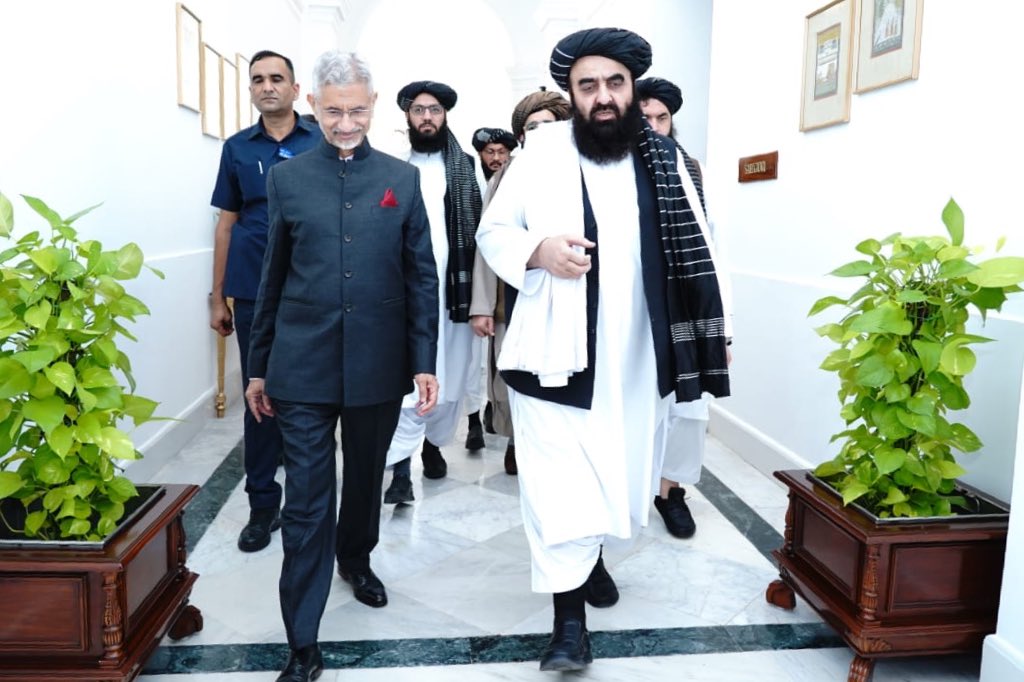
India’s External Affairs Minister S. Jaishankar with Mawlawi Amir Khan Muttaqi, Foreign Minister of the Taliban’s Islamic Emirate of Afghanistan, in New Delhi on October 10, 2025.
 By Deepak Parvatiyar*
Kabul in Delhi: Trade Soars, Access Stumbles
New Delhi: On October 10, 2025, India’s External Affairs Minister Dr. S. Jaishankar welcomed Mawlawi Amir Khan Muttaqi, Foreign Minister of the Taliban’s Islamic Emirate of Afghanistan, to New Delhi, extending aid and trade to a regime that only Russia has moved to normalise relations with since July 2025, while Western powers withhold formal recognition over human rights violations. The India-Afghanistan Joint Statement unveiled ambulances, scholarships, and a new trade corridor, with India upgrading its Kabul mission to a full embassy, aiming to counter Pakistan and China’s regional sway while managing refugee flows.
Yet, when women journalists were barred from Muttaqi’s Afghan Embassy press conference, the Journalists’ Unions and opposition leaders decried it as a reflection of Kabul’s gender curbs, which have slashed female media workers from several thousand before 2021 to roughly 600–800 currently, per estimates from the Afghanistan Journalists Centre (AFJC) and Reporters Without Borders (RSF). With the Press Emblem Campaign (PEC) noting Afghanistan’s 175th ranking out of 180 in the 2025 RSF World Press Freedom Index (up from 178th in 2024, score 17.88/100), India’s diplomatic outreach to a four-year “interim” Taliban government—lacking a constitution or elections—treads a fine line between strategic leverage and democratic principles.
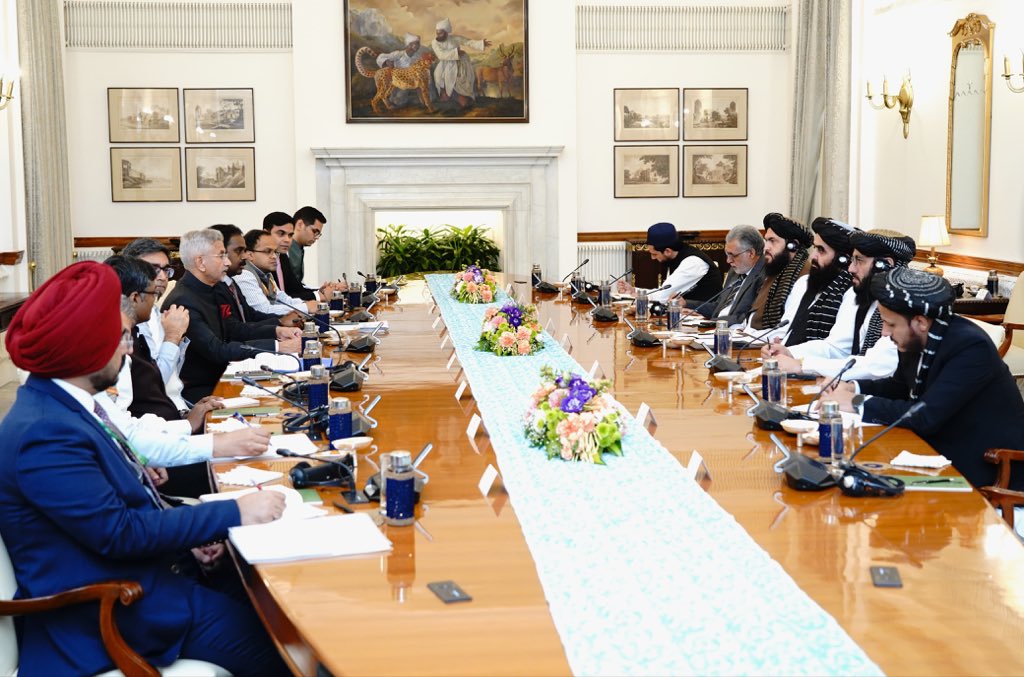
The Hyderabad House talks, part of Muttaqi’s October 9-16 visit, were built on India’s $3 billion historical aid to Afghanistan. Jaishankar thanked Kabul for condemning the April 22, 2025, Pahalgam attack in Jammu and Kashmir (26 killed), while Muttaqi assured Afghan soil would not host anti-India groups like Lashkar-e-Taiba, stressing mutual respect for sovereignty. India committed to 20 ambulances (symbolically handed over), a Thalassemia Centre, a Modern Diagnostic Centre, upgrades to Kabul’s Indira Gandhi Institute of Child Health, a 30-bed hospital in Bagrami, Oncology and Trauma Centres, and five Maternity Clinics in Paktika, Khost, and Paktia. India fitted 75 prosthetic limbs, offers medical care, and expands scholarships under the electronic-Indian Council for Cultural Relations (e-ICCR) scheme, with more university slots planned. Humanitarian aid—food grains, school supplies, pesticides, and relief for Nangarhar and Kunar earthquake victims—includes housing for 80,000 repatriated refugees from Pakistan’s 2025 “Illegal Foreigners Repatriation Plan.” The India-Afghanistan Air Freight Corridor boosts trade, alongside invitations for Indian firms to tap Afghanistan’s $1 billion mining sector and Salma Dam cooperation for hydroelectric and agricultural needs. Cricket exchanges and regular dialogue aim to deepen ties.
India’s embassy upgrade aligns with approximately 18 countries maintaining missions in Kabul as of June 2025: China, Russia, Iran, Pakistan, Turkey, Saudi Arabia (reopened December 2024), United Arab Emirates (UAE), Qatar, Oman (September 2024), Indonesia, Japan, Kazakhstan, Kyrgyzstan, Tajikistan, Turkmenistan, Uzbekistan, Bangladesh, and Egypt. These prioritise trade and security—China’s Belt and Road Initiative (BRI) extended in 2024 with $1 billion mining deals and August 2025 China-Pakistan Economic Corridor (CPEC) talks—over formal recognition.
Western nations, including the United States (US), United Kingdom (UK), and European Union (EU), withhold recognition, freezing over $7 billion in Afghan central bank assets under the US International Emergency Economic Powers Act (IEEPA) via a 2022 executive order, with subsequent Treasury and court actions shaping access, alongside sanctions on Taliban leaders under US Executive Order (EO) 13224 and EU Regulation 753/2011.
The United Nations (UN) General Assembly Resolution A/79/L.100 (July 2025) and UN Security Council (UNSC) Resolution 2593 (2021) demand inclusivity, unmet by a Pashtun-heavy cabinet excluding Tajiks, Hazaras, and women.
The International Criminal Court’s (ICC) July 2025 warrants for Supreme Leader Haibatullah Akhundzada and Chief Justice Abdul Hakim Haqqani for gender-based crimes, including banning girls’ education beyond grade six, underscore Kabul’s isolation, as echoed by Amnesty International’s Agnes Callamard: “No government can claim legitimacy while oppressing half its population” (September 2025).
The press conference exclusion, enforced by Taliban officials despite Delhi Police requests, sparked a domestic firestorm that highlights the risks of India’s engagement. The DUJ’s October 11 statement, signed by President Sujata Madhok, Vice President S.K. Pande, and General Secretary Jigeesh A.M., called it a “troubling echo” of Kabul’s policies, where media face over 200 violations in 2025 (Freedom Network Pakistan), including 256 arrests and 130 torture cases in 2024 (United Nations Assistance Mission in Afghanistan [UNAMA]), with 40% of outlets closed (RSF). The Ministry of External Affairs noted Mumbai’s Afghan Consul General managed invitations. Opposition voices amplified the critique: the Leader of the Oppositon in Lok Sabha, Rahul Gandhi, tweeted, “Mr. Modi, when women journalists are excluded, it signals weakness to every Indian woman.” His sister and Congress parliamentarian Priyanka Gandhi Vadra asked, “If women’s rights aren’t just posturing, how was this insult allowed?” Their senior party colleague P. Chidambaram urged solidarity, Trinamul Congress MP Mahua Moitra decried a blow to equality, and Communist Party of India General Secretary D. Raja flagged misogyny’s reach.
This backlash reflects the challenge of engaging a regime whose August 2024 Morality Law enforces dress codes and media censorship, stalling a 2022 Constitution committee and deepening instability, per the EU Agency for Asylum’s 2024 “underspecified” Sharia system assessment.
These domestic tensions mirror the regional frictions India leverages to bolster its strategic position, as Pakistan’s October 11 protest over the joint statement’s Kashmir reference and Muttaqi’s remarks blaming Islamabad for Tehrik-i-Taliban Pakistan (TTP) attacks—disputed claims of 317 civilian deaths in 2025 (Armed Conflict Location & Event Data Project [ACLED])—exposed Pakistan’s vulnerabilities. October clashes in Kunar, Helmand, and Khost, where Taliban forces seized three Pakistani posts, saw contested casualties: 58 soldiers dead, 30 wounded (Inter-Services Public Relations [ISPR]) versus 9 Taliban losses (Taliban claims), with 600+ TTP attacks reported (Pakistan Institute for Conflict and Security Studies [PICSS]).
Pakistan’s summoning of Kabul’s envoy, pressing for 4 million Afghan refugees’ return amid “Fitna-e-Khawarij” threats, weakens Islamabad’s regional influence, benefiting India. This friction validates India’s counterterrorism assurances from the Taliban (e.g., against Lashkar-e-Taiba) and strengthens its soft power through aid, contrasting with Pakistan’s strained Kabul ties.
Yet, India maintains distance from Taliban legitimacy, mindful of domestic criticism over gender curbs and global sanctions, to avoid endorsing a regime isolated for its human rights record.
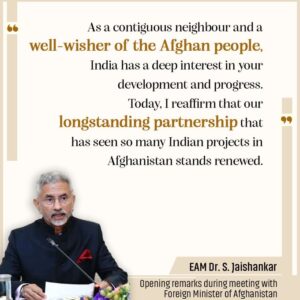
India’s $25 million 2023-2025 budget aid and 1,000 annual Indian Council for Cultural Relations (ICCR) scholarships manage 60,000+ Afghan refugees, countering China’s $323 million 2024 trade and BRI sway—despite Islamic State-Khorasan Province (ISKP) attacks on Chinese workers. Afghanistan’s economy, reliant on $3.6 billion in UN aid (2024-2025) for 22.9 million in need, suffers from Taliban skimming, per the Special Inspector General for Afghanistan Reconstruction (SIGAR), and a bottom-tier GDP per capita. The Taliban’s interim rule, set in September 2021 under Acting Prime Minister Mullah Hassan Akhund and Haibatullah Akhundzada, meets Montevideo Convention control criteria but fails on international relations capacity, relying on ad hoc clerical rulings. Russia’s normalisation, citing $323 million trade and gas pipeline talks, contrasts with UN calls for a coordinator (A/79/L.100).
India’s calculated outreach—leveraging Pakistan’s TTP woes and refugee repatriation tensions while offering substantial aid—positions it as a stabilising force in a volatile region, outpacing China’s economic inroads and Pakistan’s faltering influence. Yet, the press conference controversy and global condemnation of the Taliban’s gender policies, as seen in the ICC warrants and UN demands, underscore the risk: if India’s democratic values appear sidelined, domestic and international backlash could undermine its diplomatic gains, leaving New Delhi to navigate this high-stakes tightrope with utmost caution.
*Senior journalist