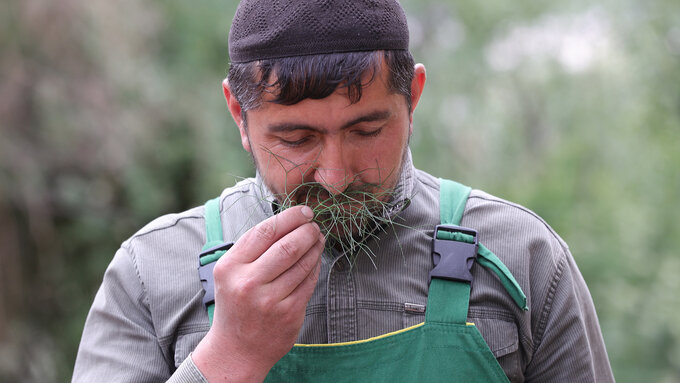
Across Tajikistan, traditional healing is closely tied to the country’s agrobiodiversity. Local healers use their knowledge of herbs, roots and extracts to treat common conditions. ©FAO/Didor Sadulloev
Gulrez Healer Saves Mountain Herbs and Knowledge
In the small village of Gulrez, tucked in the mountains of eastern Tajikistan, Dzhamolov Mahmadali, a 39-year-old healer, offers remedies crafted from the region’s wild plants, a trusted alternative to distant medical clinics hours away over rough roads. “I prepare medicine from what grows near us,” Mahmadali says. “People come to me because they trust these remedies. They’ve known them since childhood.” Inside a small room in his home, he sorts dried herbs into open wooden compartments, each carefully labelled. The scent of mountain thyme, seabuckthorn, and wild carnation, locally known as Mahalaska, fills the air. A grinding machine and oil extractor sit nearby, modern tools that have transformed his work.
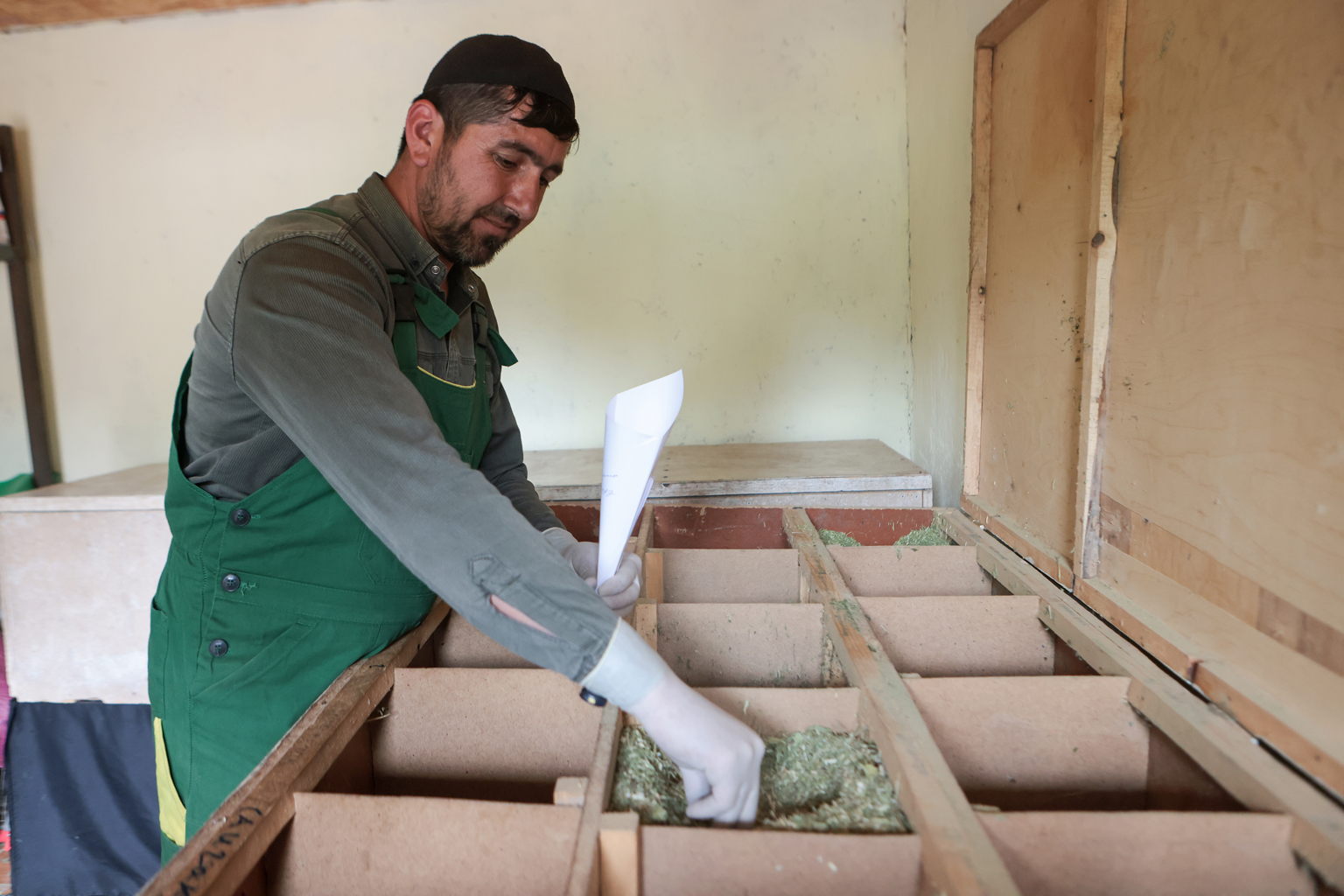
Mahmadali’s remedies, like his sought-after seabuckthorn oil and blends of wild carnation and Chi boy—a plant he says cleanses the blood—draw 10 to 15 patients weekly from Gulrez, nearby villages, and other districts. Born in Gulrez, he learned from his father, who was trained by a renowned local healer. “I grew up next to my father, watching him mix oils, grind leaves, and give advice to neighbours,” he recalls. In 2015, he completed a six-month course in traditional medicine at a Dushanbe medical training centre, earning a license from the Ministry of Health. But manual preparation was a hurdle. “All the preparation was done by hand,” he says. “Cutting, drying, and grinding took too long. I couldn’t always help people quickly enough. Sometimes I had to send them away.”
Tajikistan’s rich agrobiodiversity, with native medicinal plants like ferula, liquorice, and seabuckthorn, has long been woven into household remedies, local diets, and generational knowledge. Yet, climate change, overharvesting, overgrazing, and land-use changes threaten these species, some growing scarce or disappearing. Younger generations, increasingly disconnected from this heritage, risk losing this knowledge. “We were losing not only the plants, but the knowledge,” Mahmadali says. “And once it’s lost, it’s hard to bring back.”
The Food and Agriculture Organization (FAO), with support from the Global Environment Facility, is helping communities like Gulrez protect this agrobiodiversity through training and awareness of its value for food, health, and income. In 2023, Mahmadali received FAO training on safe harvesting, drying, and storage methods, along with equipment: a herb grinder, oil extractor, manual seeder, and sprayer. “We collect herbs during the season, after September,” he says. “Then we dry, clean and prepare them. With the new tools, I can do in hours what used to take days.” His workspace, with a drying area protected from direct sunlight, ensures consistent, tailored remedies for each patient.
FAO also promotes diverse, locally grown, nutritious plants to support rural diets and livelihoods, giving communities practical reasons to conserve healing plants and pass on knowledge. This strengthens food security, health, identity, and resilience. “Tajikistan is the homeland of valuable crop varieties and their wild relatives,” says FAO Agricultural Officer Carolina Starr. “By reconnecting with these naturally growing species and the knowledge tied to them, communities like Mahmadali’s are helping conserve this diversity and strengthen nutrition and resilience.”
Concerned about fading interest among youth, Mahmadali teaches his five children, one of whom eagerly watches and asks questions. The FAO support has eased his workload, boosted his income, and freed time for his family. Proud to carry his father’s legacy, he sees healing as a way to nurture both people and the environment. “If we protect these plants and pass on the knowledge, our communities can stay healthy for generations,” he says. “This isn’t just my work. It’s part of who we are.”
Source: The FAO News And Media Office, Rome
– global bihari bureau