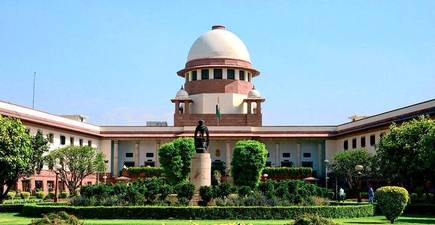
The Supreme Court of India
Aravalli Definition Case: Supreme Court Admits Intervenor
Court Allows Intervention in Ongoing Aravalli Proceedings
New Delhi: The Supreme Court of India has admitted an application seeking intervention in its ongoing suo motu proceedings on the definition and protection of the Aravalli hills, a case that has acquired renewed Constitutional and environmental significance amid concerns over regulatory fragmentation and ecological degradation.
The intervention application has been filed by Rajendra Singh, a veteran environmentalist and convenor of the non-governmental organisation Tarun Bharat Sangh, in Suo Motu Writ Petition (Civil) No. 10 of 2025, titled In Re: Issue Relating to Definition of Aravali Hills and Ranges and Ancillary Issues. The matter is being heard under the Court’s original jurisdiction and follows an order passed on 29 December 2025, in which the bench flagged unresolved questions surrounding the definition of the Aravalli range and the institutional processes required to address them.
According to the application, Singh seeks permission to intervene in order to assist the court on what he describes as threshold Constitutional questions that arise before any administrative or technical exercise to delineate or classify the Aravalli landscape is undertaken. The application states that Singh was associated with earlier litigation before the Supreme Court on mining in the Aravalli region, notably Tarun Bharat Sangh, Alwar v. Union of India (Writ Petition (Civil) No. 509 of 1991), in which the court examined the legality of mining activities and laid down governing principles on environmental protection and the role of the state.
The intervention plea emphasises that the present proceedings are not confined to individual development projects but concern the broader Constitutional treatment of ecological systems that operate as integrated and continuous wholes. It argues that definitional exercises—such as drawing boundaries or classifying terrain—carry legal consequences that may result in the exclusion of certain areas from Constitutional protection, thereby exposing them to alteration or degradation through downstream regulatory or private action.
A central feature of the application is an annexed note titled “Definitional Choice as a Constitutional Determination of Ecological Dispensability”, which contends that the question of whether any part of the Aravalli landscape can be regarded as “ecologically dispensable” is a non-delegable Constitutional issue under Articles 21 and 48A of the Constitution. The note argues that such a determination cannot be left to cartographic exercises, environmental impact assessments, or expert committees without the court first fixing Constitutional limits on what may or may not be exposed to ecological disintegration.
The annexure further submits that any definition endorsed by the court operates as a judicial act with foreseeable consequences, because exclusion from protection follows necessarily from the act of definition itself. It maintains that ecological indispensability is to be assessed by function, continuity, and structural role rather than by spatial enclosure or administrative convenience, and that environmental impact assessment mechanisms can operate only after exposure is treated as constitutionally permissible in principle.
Referring to the Supreme Court’s earlier environmental jurisprudence, the application recalls observations made by the court in its 14 May 1992 order in the Tarun Bharat Sangh case, where it held that environmental issues “far transcend the trivialities and inhibitions of an adversarial litigation” and require the highest level of judicial attention. It also cites records of a court-appointed committee from those proceedings, including a dissenting note warning that narrowly focusing on boundary lines could defeat environmental objectives by fragmenting ecologically contiguous terrain.
The application urges the court to ensure that the sequencing of its inquiry remains anchored in Constitutional principle, with definitional and classificatory exercises treated as consequential rather than preliminary steps. It submits that questions raised by the court in paragraph 9 of its December 2025 order—relating to ecological continuity, systemic consequences, and regulatory coherence—must be addressed before any institutional or technical assistance contemplated in paragraph 10 is undertaken.
Filed on January 19, 2026, through advocate-on-record Maulshree Pathak, the intervention plea seeks leave for Singh to address the court in the ongoing suo motu proceedings and to place on record material that, according to the applicant, reflects the continuity of principles already settled in the Supreme Court’s Aravalli-related jurisprudence.
The Supreme Court’s decision to admit the intervention brings an additional Constitutional dimension to a case that is being closely watched by environmental regulators, state governments, and industry stakeholders, given the Aravalli range’s ecological role across several northern Indian states and its long history of contested development and conservation policies.
– global bihari bureau