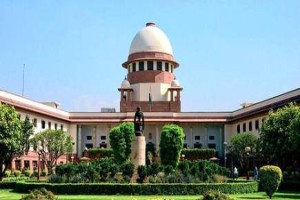
Supreme Court of India
 By G. Krishna Mohan Rao*
New Delhi: After 10 MLAs in Telangana defected to the Congress party from the Bharat Rashtra Samithi (BRS) after it formed a government in the state following the November 2023 assembly elections, where the Speaker is yet to take a final call on the defectors, the Supreme Court last week said that to protect the foundations of democracy, Parliament must take a call on the effectiveness of the anti-defection law mechanism.
Noting that this mechanism has been virtually blunted due to the widely perceived partisanship of Speakers, leading to delays in deciding disqualification petitions against the political turncoats, Supreme Court Chief Justice BR Gavai and Justice AG Masih on July 31, 2025, directed the Telangana Assembly Speaker to decide within three months the disqualification petitions filed against 10 BRS MLAs who defected to Congress
Significantly, the verdict marks a departure from the restraint that courts have shown in setting deadlines for Speakers and could well be a precedent in settling defection-related cases in the future. The chief justice-led bench was critical of the way the Speaker issued notice on the disqualification petitions seven months after they were filed, and said such a delay breached the trust Parliament reposed in presiding officers to adjudicate defection cases fearlessly and expeditiously.
In the 2023 elections to the 119-member assembly, the Congress party had won 64 seats, the BRS 39, the Bharatiya Janata Party (BJP) 8, the All India Majlis-e-Ittehadul Muslimeen (AIMIM) 7 and the Communist Party of India (CPI), one. However, the Congress numbers rose after the defection of the 10 BRS MLAs.
Writing the 74 page judgement recording numerous instances of Speakers’ deliberate inaction in speedy adjudication of disqualification petitions against MLAs, Chief Justice Gavai said, “It is for Parliament to consider whether the mechanism of entrusting speakers to important task of deciding the issue of disqualification on the ground of defection is serving the purpose of effectively combating political defections or not?” He said, “If the foundations of our democracy and the principles that sustain it are to be safeguarded, it will have to be examined whether the present mechanism is sufficient or not… it is for Parliament to take a call on it”.
The Supreme Court reiterated the settled law that Speakers/Chairmen of Assemblies, Lok Sabha, Rajya Sabha, function as tribunals, while deciding disqualification petitions under the anti-defection law, and that their decisions can be scrutinised by the High Courts and the Apex Court.
Chief Justice Gavai examined the purpose behind the enactment of the anti-defection law in 1985 through a Constitutional amendment and said the only purpose of entrusting the work of adjudicating the disqualification petitions to the Speaker/Chairman was to avoid dilly-dallying and resultant delay in the courts of law or the Election Commission’s office.
Referring to a chain of cases under the anti-defection law marred by inordinate delay in adjudication by Speakers across the states, already frowned upon by the Supreme Court in as many cases, the bench said, “We need not answer this question, since the facts of the various cases themselves provide an answer.”
It may be recalled that with a view to regulating political defections, the anti-defection law was brought under the 10th Schedule. In 1985. With the experience of over 30 years of working of the 10th Schedule to the Constitution, the question arises as to whether the trust which Parliament entrusted in high office of the Speaker or the Chairman of avoiding delays in deciding the issue with regard to disqualification has been adhered to by the incumbents in the high office of Speaker and the Chairman or not?
Legal luminaries have pointed out that over the years, certain lacunae of the anti-defection law have come to the forefront. One such major defect concerned clause 4 of the original anti-defection law pertaining to the provisions relating to a “split”, which was rampantly misused by those in power, and led to the unethical practice of “horse trading”.
It was against this backdrop that the provision relating to “splits” was deleted from the 10th Schedule through the 91st Constitutional amendment in 2003.
However, there are still some grey areas which need to be addressed. A major drawback of the anti-defection law is the lack of a precise definition of defection itself. Similarly, terms like ‘voluntarily giving up party membership’ and ‘political party’ have not been defined.
The anti-defection law itself does not expressly take into account the activities of legislators outside the legislature. Both the presiding officers and the courts have given their rulings and pronouncements on the basis of creative interpretation of the law. As regards the issuance of the party ‘whip’, it may be mentioned that the Law Commission, under the chairmanship of Justice B P Jeevan Reddy, in its 170th report, among other things observed, “whip may be issued only when the voting in the House affects the continuance of the Government and not on each and every occasion. Such a course would safeguard both the discipline and the freedom of speech and expression of the members”.
It has been pointed out that yet another major lacuna in the law is that it doesn’t provide a timeframe for the decision by the Presiding Officers. It is against this backdrop that in a 2024 judgment, the Supreme Court, responding to an application moved by a faction of the ruling Shiv Sena in Maharashtra, observed that disqualification proceedings pending before the State Assembly could not be delayed indefinitely and the Speaker has to abide by the Court’s order. It asked the Speaker to hear the matter in “no later than a week”.
In the light of the recent observations of the Supreme Court, it is worth a while to mention that in a report entitled “A review of Anti-defection Law”, under the chairmanship of late Speaker of West Bengal Assembly Abdul Halim, which was adopted by the presiding officers conference, it was observed that a time frame may be laid down for a decision by the Election Commission in anti-defection cases.
*Senior journalist