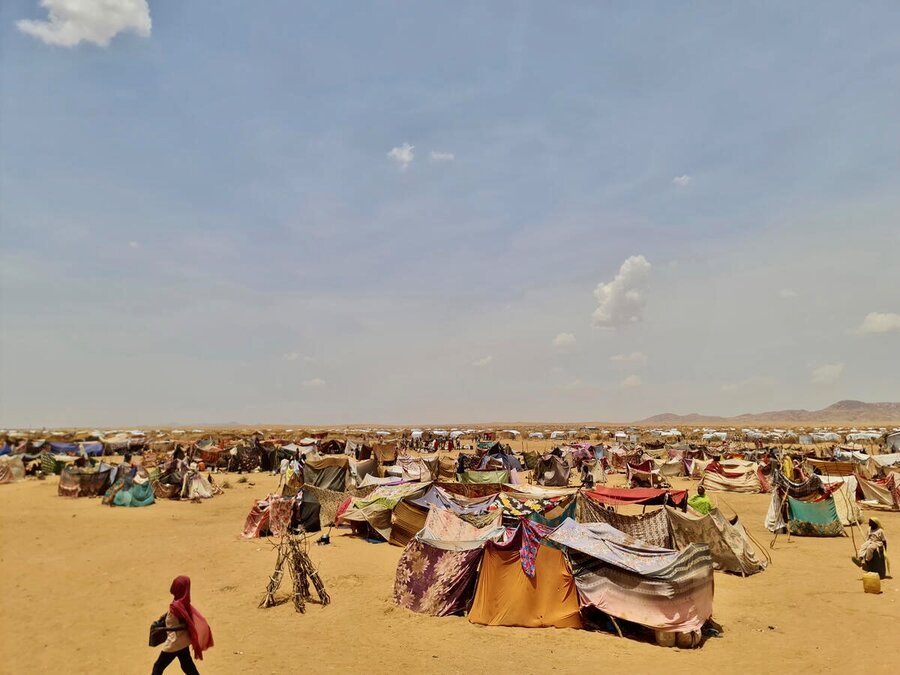
File photo of Tawila displacement camp in Sudan's North Darfur State. Photo: WFP/Mohamed Galal
UN Nears Access to Besieged Sudan City El Fasher After 18 Months
Breakthrough Looms in Darfur as UN Teams Prepare
Geneva: After months of silence from inside El Fasher, a small opening has appeared for humanitarian agencies struggling to reach the tens of thousands still trapped in the city. United Nations (UN) officials said today that a breakthrough may be close in gaining access to El Fasher, the capital of North Darfur in Sudan, where tens of thousands of civilians remain trapped after an 18-month siege and the October 2025 takeover by the Rapid Support Forces (RSF) paramilitary group. Humanitarian teams from the UN have secured an agreement in principle to enter the city for the first time since the blockade tightened, raising cautious hopes after months of near-total silence from inside.
Ross Smith, Director of Emergency Preparedness and Response at the World Food Programme (WFP), said the fragments of information reaching aid agencies point to conditions “beyond horrific”. Because communication networks have collapsed, agencies are relying on satellite imagery and testimonies from survivors who recently escaped along roads they describe as littered with landmines and unexploded ordnance. WFP estimates that between 70,000 and 100,000 people may still be inside El Fasher, though precise figures remain impossible to verify.
Those who fled spoke of a city gutted by hunger and violence. During the final weeks of the siege, the Office of the United Nations High Commissioner for Human Rights reported that civilians had resorted to eating peanut shells and animal feed. Satellite analysis showed what appeared to be bloodstains at suspected execution sites, with patterns consistent with mass killings and ethnically targeted violence.
Smith said discussions with the RSF yesterday resulted in preliminary agreement on minimum conditions for allowing an initial UN assessment and reconnaissance mission into El Fasher. He warned, however, that after more than a year and a half under siege, essential supplies and infrastructure needed for relief operations have been “completely obliterated.”
Many of those displaced from the city have moved toward Tawila, a small desert settlement now transformed into an enormous makeshift camp sheltering more than 650,000 people—an expansion so vast that aid workers describe its population as comparable to that of Luxembourg. Others have headed farther north toward Ad Dabbah. United Nations and partner convoys supported by the World Food Programme are currently en route to Tawila with food assistance intended to cover 700,000 people for a month. Aid workers say families there have endured months of extreme hunger and now face widespread disease outbreaks, including cholera, while living beneath straw and grass structures that offer little real shelter.
Sudan’s conflict, which began on April 15, 2023, between the RSF and the Sudanese Armed Forces (SAF), has pushed more than 12 million people from their homes, now the largest displacement crisis in the world. The violence has continued to spread beyond Darfur. The United Nations Refugee Agency (UNHCR) reported on Friday that fighting intensified in West Kordofan earlier this month after the RSF seized a Sudanese Armed Forces base in the town of Babanusa. In South Kordofan, civilians remain trapped in besieged cities such as Kadugli and Dilling. UNHCR said women, children and older people have begun fleeing, but men and youth often stay behind due to a heightened risk of detention or violence along escape routes by groups suspecting them of loyalty to the opposing side. More than 40,000 people have been displaced from North Kordofan since November 18, according to UNHCR. The agency warned that access to these populations is becoming increasingly difficult and that available resources remain critically low.
International pressure on armed actors in Sudan increased this week following a United States government announcement of new sanctions. On Tuesday, December 9, 2025, the U.S. Department of State said Washington had designated four individuals and four entities linked to a transnational network—largely involving Colombian nationals and companies—accused of recruiting former Colombian military personnel to fight for the RSF and of providing training to RSF combatants, including children. The measures were taken under Executive Order 14098, which permits sanctions related to the conflict in Sudan. The U.S. government said the actions were intended to disrupt a major external source of tactical and technical expertise that has strengthened RSF operations, including the group’s capture of El Fasher on 26 October.
The sanctions follow remarks made on November 19 by President Donald Trump, who publicly described the atrocities taking place in Sudan. According to the State Department, the U.S. measures align with the Joint Statement on Restoring Peace and Security in Sudan issued on 12 September, which calls for a three-month humanitarian truce, a permanent ceasefire and a transition to an independent, civilian-led government. Washington urged external actors to stop supplying weapons or financing to either side and said it was working with regional governments to prevent further destabilisation. Additional details were provided in a separate release from the U.S. Department of the Treasury.
For humanitarian agencies, the immediate focus remains on obtaining safe access to El Fasher. The tentative understanding reached with the RSF marks the first substantive opening in months. United Nations teams hope to begin assessments soon, though they warn that conditions inside the city have deteriorated rapidly after prolonged isolation. Until entry is confirmed, the fate of the thousands still inside El Fasher will remain largely unknown—another void in a conflict marked by mass displacement, civilian suffering and limited visibility into some of its hardest-hit areas.
– global bihari bureau