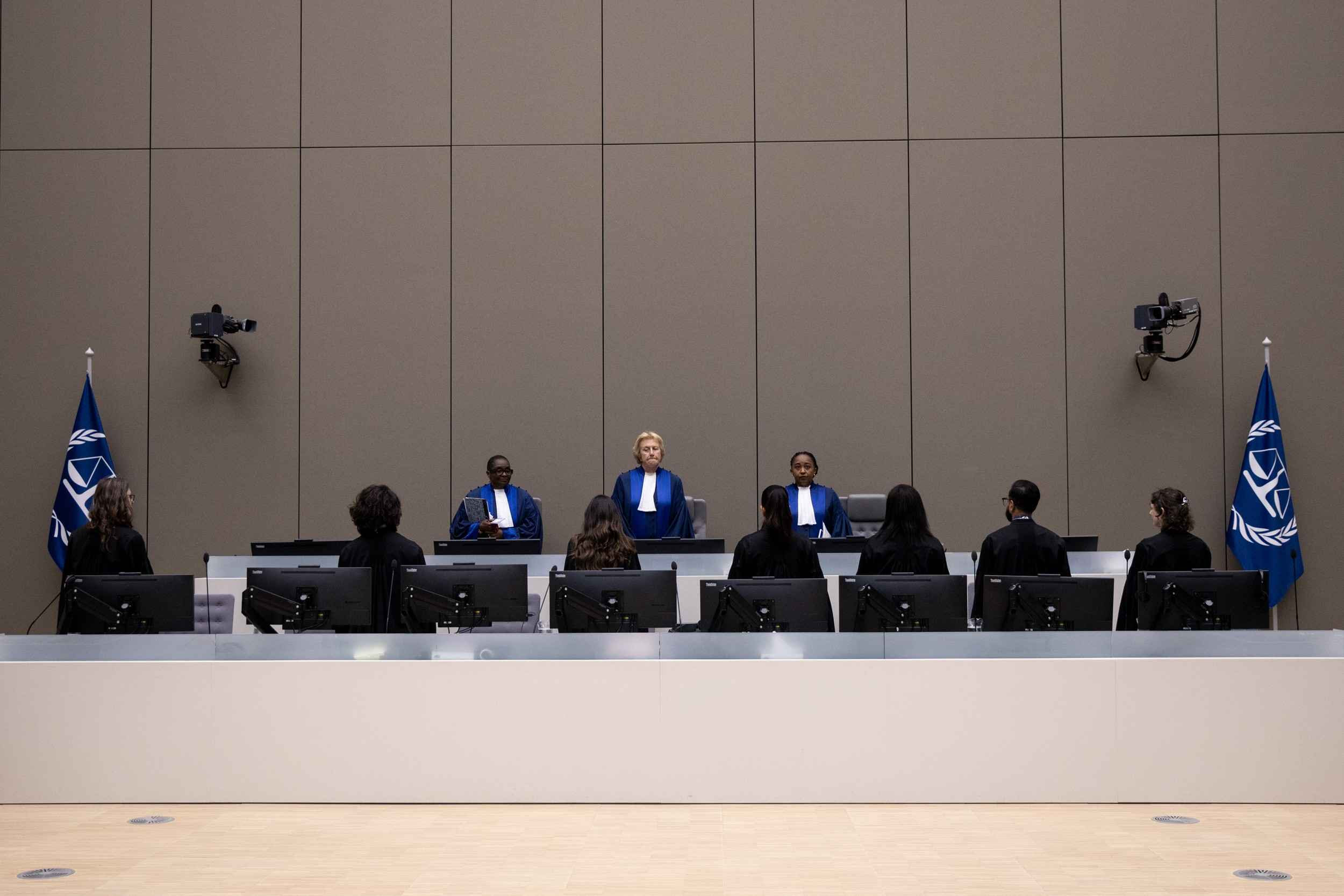
Trial Chamber I of the International Criminal Court during the hearing held today. Photo credit: ICC-CPI
Janjaweed Leader Ali Kushayb Convicted on 27 Counts for Darfur Acts by ICC
The Hague: The Trial Chamber I of the International Criminal Court (ICC) today convicted Ali Muhammad Ali Abd-Al-Rahman, a former pro-government Janjaweed militia leader, on 27 of 31 counts of war crimes and crimes against humanity for acts committed in Darfur, Sudan, between August 2003 and April 2004.
Based on evidence presented by the Office of the Prosecutor of the International Criminal Court, the judges of Trial Chamber I unanimously found Mr Abd-Al-Rahman guilty beyond reasonable doubt for crimes that occurred in the widespread and systematic attack by the Janjaweed militia and Government of Sudan forces against the civilian population in West Darfur, Sudan in the context of an armed conflict between the Government of Sudan and rebel armed groups between at least August 2003 and March 2004.
“The conviction of Mr Abd-Al-Rahman is a crucial step towards closing the impunity gap in Darfur. It sends a resounding message to perpetrators of atrocities in Sudan, both past and present, that justice will prevail, and that they will be held accountable for inflicting unspeakable suffering on Darfuri civilians, men, women and children,” said Deputy Prosecutor Nazhat Shameem Khan.
The verdict, the first ICC trial stemming from the UN Security Council’s 2005 referral of the Darfur situation via Resolution 1593, addresses the experiences of thousands of victims, primarily from the Fur tribe, who testified to incidents of murder, torture, rape, and displacement during a campaign led by Sudan’s government and its allied militia.
The 27 counts include murder, attempted murder, torture, rape, persecution, pillaging, forcible transfer, outrages upon personal dignity, and property destruction. The four counts not resulting in convictions—two for other inhumane acts and two for cruel treatment—were dismissed as their underlying acts, such as beatings and detention conditions, were covered by the 27 counts, avoiding redundancy in the judgment. Abd-Al-Rahman, detained in ICC custody since June 9, 2020, awaits sentencing, with the Chamber’s decision today setting a timeline for sentencing proceedings and initiating a reparations phase for victims to address losses sustained in Darfur.
The impact of this conviction reverberates far beyond the courtroom’s walls, resonating as a clarion call for justice in a region scarred by violence. For survivors like P-1073, a 15-year-old girl raped multiple times in Bindisi, the verdict is a lifeline, validating her courage in sharing a trauma that left enduring physical, social, and psychological scars. It offers a measure of closure to communities like the Fur, Zaghawa, and Masalit, who bore the brunt of a campaign designed to eradicate their presence. The ruling challenges the culture of impunity that has long shielded perpetrators in Darfur, setting a precedent that even high-ranking militia leaders can be held accountable. It sends a stark warning to those who perpetrate atrocities worldwide: justice, though delayed, is inevitable. The reparations phase, now underway, holds the promise of financial compensation, community rebuilding, and acknowledgement of the suffering endured, offering a path toward healing for survivors who have carried the weight of loss for over two decades. This verdict, rooted in the resilience of victims who found their voice through the ICC, reaffirms the court’s role as a bulwark against human rights abuses, illuminating a path toward a world where such horrors are neither forgotten nor repeated.
“Today we have shown what we can achieve when we work together, with victims, national authorities and based on the mandate and support of the UN Security Council. This moment also represents a vindication of the decision of the Council to refer this matter for action to our Office. And we are working to ensure that the trial of Mr Abd-Al-Rahman will be the first of a number in relation to the Situation in Darfur at the International Criminal Court. Our collective resolve, this partnership for accountability between survivors and the international community, will continue to be indispensable as we seek to end the cycle of violence and impunity that continues to afflict the Darfuri people,” Deputy Prosecutor Khan said.

Ali Muhammad Ali Abd-Al-Rahman, born in 1949 in Rahad Al-Berdi, South Darfur, was a member of the Ta’aisha tribe, recognised as an Arab tribe in Sudan. A former warrant officer in the Sudanese Armed Forces’ Medical Corps, he retired in the mid-1990s after qualifying as a medical assistant in 1984. He settled in Garsila, West Darfur, operating a pharmacy and serving as a community leader in the Wadi Salih region. Known as “Ali Kushayb,” a name he acknowledged in a 2020 video but denied in court, he became a Janjaweed commander during the Darfur conflict. The ICC issued arrest warrants on April 27, 2007, and June 11, 2020, leading to his surrender in the Central African Republic on June 9, 2020. Transferred to The Hague, he has been detained at the ICC’s detention centre for 1,582 days as of the verdict, with an initial appearance on June 15, 2020. A confirmation of charges hearing occurred from May 24 to 26, 2021, and on July 9, 2021, Pre-Trial Chamber II committed him to trial on 31 counts, covering murder, attempted murder, torture, rape, persecution, pillaging, forcible transfer, outrages upon personal dignity, other inhumane acts, cruel treatment, and property destruction in Kodoom, Bindisi, Mukjar, and Deleig.
The trial, conducted by Judges Joanna Korner, Reine Alapini-Gansou, and Althea Violet Alexis-Windsor, began on April 5, 2022, and concluded with closing statements from December 11 to 13, 2024. It involved 74 witnesses—54 from the prosecution, 17 from the defence, 2 from the Chamber, and 1 from victims’ legal representatives—and 1,861 pieces of evidence, including survivor accounts, documents, and physical items, analysed to establish guilt beyond a reasonable doubt. The participation of 1,591 victims, through a legal team, included an opening statement on June 5, 2023, and testimony on June 5-7 and October 16-17, 2023. Witness P-1073 described her experience in Bindisi, while P-0878 recalled a statement by Minister Harun in Mukjar, indicating intent to target the Fur, reflecting the ethnic focus of the campaign.
The Darfur conflict began in 2003, following an April 25, 2003, attack by the Sudan Liberation Movement/Army (SLM/A) on Al Fasher airport. Sudan’s National Security Council issued a confidential Emergency Plan on December 18, 2003, to address the rebellion and control non-Arab tribes—Fur, Zaghawa, and Masalit—viewed as rebel supporters. The plan authorised arming semi-regular forces like the Janjaweed, drawn from Arab tribes, with government weapons, training, and support from air and fire assets, including Land Cruisers and trucks with DShK guns. It included measures to eliminate community leaders and officials, without distinguishing between combatants and civilians. Abd-Al-Rahman, connected to Minister Harun and Lt. Hamdi, led Janjaweed operations in the Wadi Salih region, identified in a government report as “Commander of the Al-Fursan.”
In August 2003, Abd-Al-Rahman commanded over 1,000 Janjaweed fighters in attacks on Kodoom and Bindisi, Fur-majority villages without rebel presence. He ordered the destruction of homes, looting of livestock, and killing of at least 46 civilians, including Abdullah Hassan, Bakhit Ibrahim, Muslim Mohammed Ibrahim, Hasan Muhammad Hasan, Faqih Umar Ya’qub (imam of Kodoom Tineh mosque), Halima Isa, Kony Harun, Mohammed Khamiss, Hussein (“Jourgi”), and Adam Suleiman. Witness P-0012 described Bindisi as reduced to ashes, with 90% of homes burned and bodies scattered. Women and girls were subjected to rape, some in public, with clothing used to silence them. P-1073 reported being taken to a deserted residence, whipped, beaten, and raped multiple times, with ongoing effects. The attacks displaced 1,600 families from Kodoom and 1,800 from Bindisi, many moving to Mukjar.
From February to March 2004, Mukjar, with 1,800 households, grew to over 4,100 as displaced villagers arrived from areas like Arada and Nyerli. Abd-Al-Rahman, working with government forces, managed checkpoints and house searches targeting Fur men, labelled “tora bora” or “criminals.” Over 400 were arrested, including umdahs Yahya Ahmad Zarruq and Issa Harun Noor, and held in overcrowded, unsanitary cells at Mukjar’s police station, without food, water, or sanitation. Abd-Al-Rahman used an axe and whip on detainees, injuring Zarruq’s shoulder and using terms like “slaves.” On March 1, 2004, Minister Harun visited, parading detainees and labelling them “rebels.” On March 2, after a meeting with officials, Abd-Al-Rahman ordered the execution of at least 50 detainees, taken to Khor Talaba and Nyerli, shot for 20 minutes, and left unburied. Victims included Mohammed Abdelkarim, Abdu Mini, Hassan Abdalla, Ibrahim Muhammad Ali Ballut, Adel Bady, Yusuf Muhajer, Adam Mohamed Babay, and the two umdahs.
In Deleig, from March 5 to 7, 2004, with over 16,000 displaced persons, Abd-Al-Rahman led the arrest of over 100 Fur men and boys, including those as young as 12. Detained outside the police station without food or water, they faced beatings. He killed Adam Adam Abd-Al-Rahman (Jenif) and Sheikh Motor with axe blows, with Jenif dying within 10 minutes and Sheikh Motor after being placed in a vehicle. Over 70 detainees were executed near Fere and Koska, shot while lying prone, with bodies left unburied. Victims included Issa Harun, his 13- or 14-year-old son, Abu Bakar Suleiman Abakar, Zakaria Abdelmawla Abakar, Umdah Jiddo Khamis Abd-Al-Karim, Umdah Mohamed Suleiman Abdulshafa, Umdah Adam Adam Degges Ahmed Abdulshafa, and Sheikh Ismail Abdulaziz. Three survivors—one uninjured, two injured—testified, noting fighters checking for survivors. Additional detainees were killed near Fere on March 7.
The court convicted Abd-Al-Rahman on 27 counts for his roles as direct perpetrator, co-perpetrator, and commander. He was found guilty of murder, torture, outrages upon personal dignity, and persecution in Mukjar and Deleig for actions like killing Jenif and Sheikh Motor. He was convicted for murder, attempted murder, torture, outrages upon personal dignity, and persecution involving 200 captives in Mukjar and Deleig, committed with Janjaweed and government forces. He was held responsible for ordering murder, rape, pillaging, property destruction, forcible transfer, persecution, and other inhumane acts in Kodoom and Bindisi. The four dismissed counts—other inhumane acts (Counts 14 and 24) and cruel treatment (Counts 15 and 25)—were covered by other convictions, such as torture and outrages upon personal dignity. The defence’s claim that he was not “Ali Kushayb” was rejected, based on his 2020 admission and witness testimonies from associates and locals. His role was supported by ties to Minister Harun, authority over Janjaweed deputies, and a government report. Detained for over five years, Abd-Al-Rahman awaits sentencing and reparations proceedings, addressing the experiences of Darfur’s victims.
– global bihari bureau