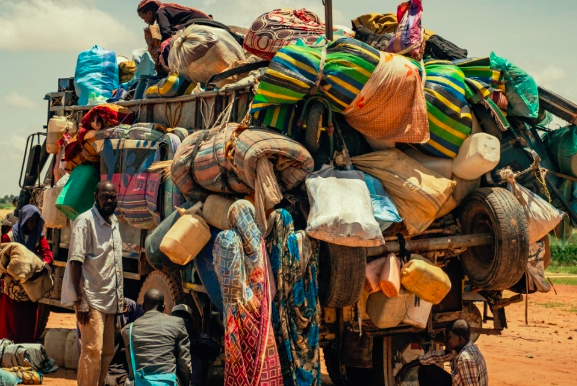
Photo source: UN Migration
Displacement, Hospital Attacks Deepen Sudan’s Crisis
Aid Cuts and Attacks Push Sudan Crisis Toward Collapse
Port Sudan/Cairo/ Geneva: Violence across Sudan is accelerating and spreading in ways that mirror earlier phases of the war, driving mass displacement, dismantling health care and eroding the ability of humanitarian agencies to operate, United Nations officials warned on Friday as fighting intensified around the Kordofan states and beyond.
The International Organization for Migration (IOM) said more than 50,000 people have been uprooted in the Kordofan regions since late October alone, a figure that reflects fear-driven flight rather than voluntary movement. Speaking from Port Sudan to journalists in Geneva, the agency’s Chief of Mission in Sudan, Mohamed Refaat, said civilians were running simply to survive as shelling, urban encirclement and insecurity close in on major towns.
Kordofan on Brink as Sudan Violence Escalates
United Nations reports indicate that residential areas in Dilling, in South Kordofan, were shelled over the past 48 hours by the Rapid Support Forces and allied fighters from the Sudan People’s Liberation Movement–North. The Rapid Support Forces (RSF) have been at war with the Sudanese army since April 2023, after the collapse of Sudan’s transition to civilian rule, and their tactics increasingly resemble those used earlier in Darfur: prolonged sieges, bombardment of civilian areas and the systematic degradation of basic services.
The capture of El Fasher, the capital of North Darfur, on 26 October after a siege lasting more than 500 days marked a turning point. Its fall triggered mass displacement and left behind civilians who survived on animal feed and peanut shells as food supplies collapsed. Displacement tracking shows that more than 109,000 people have fled El Fasher and surrounding villages since late October, but many remain trapped in neighbouring areas, unable to move further because of insecurity and the breakdown of logistics. Aid agencies warn that essentials for survival in these areas have been almost completely destroyed.
The same pattern is now threatening Kordofan. People are fleeing from Babanusa, Kadugli and El-Obeid, the capitals of South and North Kordofan, as fighting edges closer to urban centres. Humanitarian officials say arrivals in White Nile and Gedaref states increasingly consist only of women and children, underlining acute protection risks. In Kadugli alone, the United Nations estimates that between 90,000 and 100,000 people could be displaced if hostilities continue and if escape routes remain open. El-Obeid, a strategic city in North Kordofan, is being described as only a step or two away from becoming the next major target, with more than half a million people already affected by the conflict there.
The security environment deteriorated further last weekend when six Bangladeshi peacekeepers were killed in drone attacks on a logistics base in Kadugli used by the United Nations force deployed in Abyei, the disputed border region between Sudan and South Sudan. The attack has raised alarm not only about civilian safety but about the shrinking operational space for the United Nations itself, signalling that even internationally protected missions are no longer insulated from the violence.
Alongside displacement, the collapse of health care has reached what the World Health Organization (WHO)describes as an unprecedented level. Since the conflict began in April 2023, the agency has verified 201 attacks on health care in Sudan, resulting in 1,858 deaths and 490 injuries. In 2025 alone, 65 attacks have been confirmed, causing more than 1,620 deaths and 276 injuries. These figures mean Sudan now accounts for more than 80 per cent of all deaths globally from attacks on health care in complex humanitarian emergencies this year, making it the deadliest setting in the world for medical workers and patients.
The most recent attack occurred on 14 December, when a hospital in Dalanj, a key administrative and health hub in South Kordofan, was struck, killing nine health workers and injuring 17 others. Earlier in the month, a kindergarten and the Kalogi Rural Hospital were hit, killing 114 people, including at least 60 children, while health staff were treating casualties. In Darfur, repeated assaults on medical facilities have continued, including attacks on maternity and referral hospitals in El Fasher in October that killed hundreds of patients and civilians, and the detention or abduction of health workers in Nyala and surrounding areas.
WHO officials say these attacks are not isolated incidents but part of a broader erosion of access to care, with health workers operating under constant threat of bombardment or detention. The agency has called for an immediate halt to attacks on civilians, health facilities and humanitarian operations, warning that continued violations of international humanitarian law are pushing the system beyond recovery.
The crisis is being compounded by severe funding cuts that are forcing aid agencies into explicit triage. The International Organization for Migration says it has lost 83 million dollars in funding this year, dramatically reducing its footprint across Sudan. As a result, humanitarian teams are now passing through areas where needs are extreme but are unable to assist, prioritising only those judged to be at immediate risk of death. Officials say this shift marks a grim transition from overstretched response to systemic abandonment.
With fighting spreading from Darfur into Kordofan and key cities edging closer to siege conditions, United Nations agencies warn that appeals alone have failed to restrain the violence. Without protection for civilians, health workers and peacekeepers, and without restored humanitarian access and funding, they caution that the humanitarian catastrophe in Sudan is set to deepen further, even as prospects for peace remain distant.
– global bihari bureau