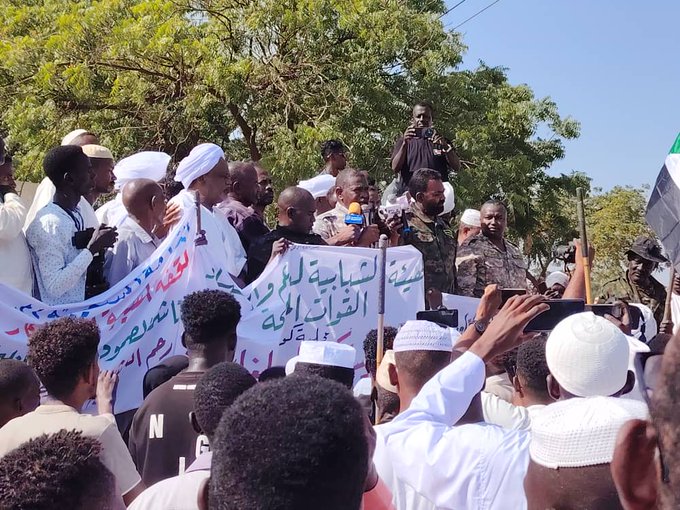
People march to support armed forces and to express solidarity with the citizens of El-Fasher, march in Kosti in march in Kosti, Sudan. today. Photo source @SUNA_AGENCY|X
About 36,000 Flee El Fasher Amid Atrocities
El Fasher Death Toll May Hit Hundreds, UN Warns
Geneva: The United Nations warned today that the civilian death toll in El Fasher, Sudan, “could amount to hundreds” after the Rapid Support Forces (RSF) captured the North Darfur capital on October 23, 2025, with fresh survivor accounts of summary executions, gang rapes, and killings of wounded patients in hospitals emerging despite severed telecommunications and blocked humanitarian access.
More than 36,000 civilians have fled on foot to Tawila, 70 kilometres west, since October 26, according to the International Organization for Migration (IOM). The three-to-four-day journey on foot added to Tawila’s existing burden of over 652,000 displaced people.
“More details continue to emerge about atrocities committed during and after the fall of El Fasher to the Rapid Support Forces (RSF) in Sudan on 23 October,” OHCHR spokesperson Seif Magango, briefing from Nairobi to journalists in Geneva, said. He disclosed that the United Nations Office of the High Commissioner for Human Rights (OHCHR) received “horrendous accounts of summary executions, mass killings, rapes, attacks against humanitarian workers, looting, abductions and forced displacement” during and after the Rapid Support Forces’ incursion last week. Survivors who fled El Fasher, terrified and survived the threatening journey to Tawila provided the testimonies.
Magango reported that at least 25 women were gang-raped when Rapid Support Forces forces entered a shelter for displaced people near El Fasher University. Witnesses confirmed RSF personnel selected women and girls and raped them at gunpoint, forcing the remaining approximately 100 families to flee amid gunfire and intimidation directed at elderly residents.
Three doctors are being held by the RSF, and at least two local humanitarian responders were killed inside the paramilitary-controlled city on October 27 and 29, 2025. The United Nations Office of the High Commissioner for Human Rights has recorded at least four incidents in which humanitarian personnel and local volunteers were assaulted.
The World Health Organization (WHO) corroborated reports of attacks on health facilities and personnel, deploring the abduction of six health workers—four doctors, a nurse, and a pharmacist. The Saudi Maternity Hospital has been attacked five times in October alone. Following the capture of El Fasher, there is no longer any humanitarian health presence in the city, and access remains blocked. Dr Teresa Zakaria, head of the WHO’s Humanitarian Operations Unit, said the agency is “unable to assist those who have been impacted, the injuries that have occurred from the multiple attacks against civilians.”
WHO confirmed that 189 attacks have been verified in Sudan this year, resulting in at least 1,670 deaths and 419 injuries. “Eighty-six per cent of all these attack-related deaths have occurred this year alone, and this indicates that attacks are getting deadlier,” Dr Zakaria said.
Distressing reports indicate the killing of sick and wounded individuals inside the Saudi Maternity Hospital and in buildings in the Dara Jawila and Al-Matar neighbourhoods, which were being used as temporary medical centres. “These extremely grave allegations raise urgent questions as to the circumstances of these killings in what should be places of safety for anyone in need of medical help,” Magango said. He emphasised that an investigation into the atrocities must be carried out in an independent, transparent, and prompt manner to ensure justice.
The RSF, a paramilitary group, has been locked in a brutal conflict with the Sudanese Armed Forces (SAF) since April 2023. The group seized control of El Fasher, the capital of North Darfur state, after forcing Sudan’s army to withdraw from its last stronghold in the western Darfur region. With the capture of El Fasher, the RSF’s territorial control now extends across Darfur and parts of Sudan’s south, while the Sudanese Armed Forces control the capital, Khartoum, and much of the country’s north and centre.
Sudan, a gold- and oil-rich nation, has become the site of the world’s largest humanitarian and displacement crisis on record, with about 14 million people displaced out of a population of 51 million. Famine is widespread, and outbreaks of cholera and other deadly diseases are increasing.
Fewer than half of health facilities across Sudan are providing their full range of services, according to the WHO. Twelve per cent are only partially functional, while 40 per cent are completely nonfunctional. In the Kordofan and Darfur states, the situation is significantly worse.
“The Sudan Humanitarian Response Plan to date is only 27.4 per cent funded—a very, very big gap,” Dr Zakaria added. “For the health sector itself, funding stands at 37 per cent, so we are struggling very much with resources. That’s why we are calling on the international community not to abandon the people of Sudan, because the main actors are our Sudanese organisations, who continue to be present and deliver assistance.”
Magango echoed UN High Commissioner for Human Rights Volker Türk’s appeal for “states with influence over the parties in the conflict to act urgently to end the violence, halt the flow of arms fueling violations, and ensure meaningful protection of civilians.”
– global bihari bureau