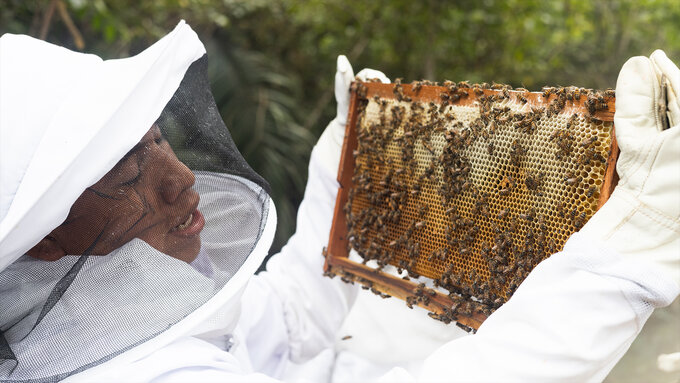
Beekeeping helps farmers boost biodiversity and production in Belize. ©FAO/Ya’axche Conservation Trust
In the verdant heart of southern Belize, where the Maya Golden Landscape weaves a tapestry of ancient forests and vibrant farmlands, Eventir Cal, a 57-year-old farmer, has found an unexpected partner in his quest to sustain his family of nine: bees. For decades, Eventir tilled the soil using the time-honoured milpa system, a traditional Mayan practice of intercropping maize, beans, squash, and vegetables. This method, deeply rooted in the cultural and ecological fabric of the Maya people, thrives in the lush mosaic of protected forests and wildlife sanctuaries that define this region. But life took a sharp turn when a farm accident impaired his mobility, making the trek to the communal milpa fields a daunting challenge. Determined to provide for his family, Eventir shifted his focus to a smaller plot near his home, seeking ways to maximise food production while honouring the land that has sustained his people for generations.
Years earlier, Eventir had learned agroforestry techniques from the Ya’axché Conservation Trust, a local Mayan organisation dedicated to preserving the region’s rich biodiversity. He adopted shade-grown cocoa to enrich the soil and protect the forest, but it was a new venture, supported by the Food and Agriculture Organization of the United Nations (FAO) and the Global Environment Facility (GEF), that truly transformed his livelihood: beekeeping. In the Mesoamerican Biological Corridor, a biodiversity hotspot stretching from Mexico to Panama, bees are unsung heroes. Nearly 90 per cent of wild flowering plants and 75 per cent of global food crops rely on pollinators like bees to thrive. In Belize, where the Maya Golden Landscape forms the last vital link between mountain rainforests and Caribbean coastal ecosystems, these industrious insects are essential to maintaining the delicate web of life that supports endangered species and nourishes communities.
Eventir joined 35 other producers in the Maya Golden Landscape for beekeeping workshops, learning to select sites, capture bees, and master production techniques for honey and other bee products. With this knowledge, he set up hives near his home, carefully monitoring his bees’ health as he prepared for his first harvest. The bees became more than a source of income; they were a lifeline, allowing him to farm sustainably while prioritising his well-being and the health of the forest. Within two years, his hives were buzzing with activity, and Eventir was as busy as his tiny partners. The pollination from his bees boosted the yield and quality of his fruit and vegetable crops, a testament to the power of biodiversity when harnessed thoughtfully. By providing habitats for pollinators, Eventir not only sustained his farm but also contributed to the resilience of the surrounding ecosystem.
Among his hives, Eventir tends to a species of stingless bees native to Belize, prized by the Maya for their honey’s medicinal properties. Though these bees produce less honey than their stinging counterparts, their product is a local treasure, with jars selling out within a day at markets. Eventir anticipates his first commercial harvest this year, a milestone in his journey. Yet, his path has not been without hardship. The Mesoamerican Biological Corridor faces increasing droughts, and in 2024, wildfires ravaged southern Belize, scorching over 20,000 hectares of forest and farmland. Eventir lost a season’s harvest and two bee colonies to the flames and smoke, a blow that could have broken his spirit. Instead, it fueled his determination to protect his bees and promote climate-resilient agriculture.
With support from the FAO and GEF, Eventir rebuilt his apiaries and began restoring his bee colonies. He also took on a new role as a community educator, teaching others about the vital role of pollinators. When wild bee colonies are found in homes, he relocates them to his farm, a practice that has replaced the old habit of burning them out of fear or ignorance. “Now they call me, and I take them to a safe place,” he says, his voice carrying the quiet pride of a man who has become a steward of both nature and tradition. By blending centuries-old Mayan knowledge with modern beekeeping techniques, Eventir has emerged as a role model in his community. His bees not only pollinate crops, increasing yields without the need to clear more forest, but also produce honey that sustains his family and strengthens local markets. In this delicate dance between farmer and bee, Eventir is helping to build a more resilient, sustainable future for his community and the biodiverse landscape they call home.
Source: The FAO News And Media Office, Rome
– global bihari bureau