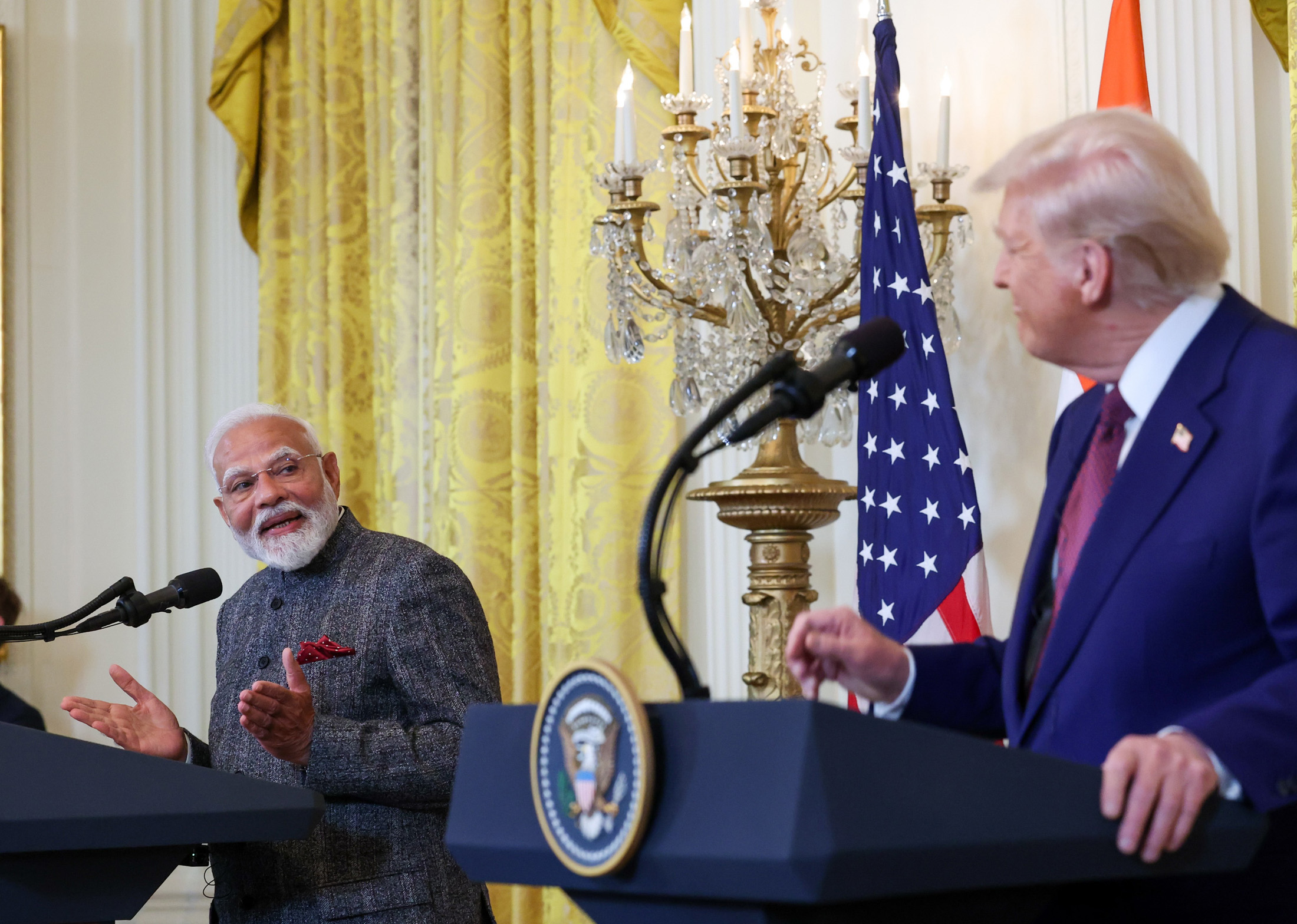
File photo of Prime Minister Narendra Mod with the US President Donald Trump at Joint Press Conference at White House in Washington DC, USA on February 13, 2025.
Steady Words in a Turbulent Year for India–US Ties
A Call Meant to Reassure More Than Reveal
New Delhi: Prime Minister Narendra Modi’s telephone conversation with United States President Donald Trump today provides clarity on a bilateral relationship that has navigated a turbulent and unpredictable year. The call reaffirmed that despite tariff frictions, shifts in the Indo-Pacific balance, and domestic political pressures in both countries, the India–United States partnership continues to operate on a strategically anchored trajectory. The engagement promptly signals confidence in the relationship’s stability at a moment when the global diplomatic environment remains fluid.
The tone of the Indian readout issued by the Prime Minister’s Office is deliberately measured and understated, characteristic of carefully managed leader-level communications intended to highlight continuity rather than negotiate specifics. It emphasises warmth, mutual intent, and shared commitment to global peace, stability, and prosperity. Notably, the readout does not reference contentious issues that have intermittently surfaced during the year, including Trump’s tariff hikes on Indian steel and aluminium, procedural anxieties affecting Indian professionals in the United States, or delays in technology transfers such as the GE F414 engine deal. Their omission reflects standard diplomatic practice: unresolved matters are left out unless both sides wish to signal a resolution.
Modi and Trump have previously established a rhythm of alternating public spectacle and careful diplomacy. Verified interactions include the “Howdy, Modi!” event in Houston in September 2019, which highlighted personal rapport as part of a strategic narrative, and Trump’s visit to Ahmedabad in February 2020, marked by large public gatherings and symbolic gestures. Beyond these headline events, the relationship also accommodated moments of tension over trade, tariffs, and other transactional issues, all of which were managed without derailing the broader partnership. Today’s telephone call aligns with this pattern, opting for a low-key, leader-level exchange rather than a high-visibility event.
The timing of the call adds strategic significance. It came shortly after Russian President Vladimir Putin visited New Delhi and after the conclusion of India–United States consultations on counterterrorism and regional security on December 3, 2025. In this context, the conversation consolidates outcomes from the recently concluded security discussions and signals India’s ability to manage relations with multiple major powers simultaneously. Publicising the call underscores this strategic positioning, conveying confidence and continuity in India’s diplomacy while projecting the message that India can engage Washington robustly even as it maintains high-level ties with Moscow.
The readout’s reference to regional and global developments, though conventional in phrasing, remains meaningful. The Indo-Pacific continues to form the strategic backdrop of India–US engagement, encompassing shared interests in maritime security, counterterrorism, and a rules-based regional order. By framing the conversation within these parameters, the call continues a decade-long trajectory of structured cooperation that has expanded from defence and technology initiatives to broader regional and global considerations. This continuity, observable across official statements, ministerial dialogues, and public remarks by senior officials, demonstrates that even in the absence of headline-grabbing announcements, leader-level diplomacy preserves the structural foundations of the partnership.
Routine procedural details remain undisclosed, as is standard practice. The readout does not specify which side initiated the conversation, its duration, or any private follow-up arrangements. These omissions reflect the nature of leader-level communications, which often convey intent, reassurance, and alignment more than operational detail.
At the same time, the strategic durability of the partnership cannot be taken for granted. US domestic political pressures, including the potential impact of upcoming electoral cycles and Trump’s “America First” posture, could test India’s leverage in trade, defence, and technology negotiations. Tariff disputes, visa concerns, and delays in technology transfers remain potential friction points. The 11 December call consolidates continuity and confidence, but the partnership’s smooth functioning will depend on how both sides manage these underlying challenges in 2026.
Taken together, the conversation represents a carefully calibrated reaffirmation of India–US ties. It does not announce new initiatives nor resolve outstanding issues, but it consolidates strategic confidence and signals steadiness at a moment of geopolitical flux. By situating the call within the broader rhythm of past interactions, recent high-level engagements, and concurrent geopolitical developments, the exchange underscores the durability of one of India’s most consequential bilateral relationships, while also highlighting that continuity will need active management amid evolving regional and domestic pressures.
– global bihari bureau