File photo
CAQM Tightens Curbs as Delhi-NCR Air Slips to Severe+
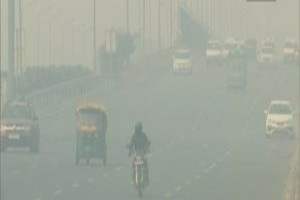
New Delhi: The Commission for Air Quality Management (CAQM) in the National Capital Region and Adjoining Areas, today evening, invoked Stage-IV of the extant Graded Response Action Plan (GRAP) across the entire Delhi–National Capital Region with immediate effect, citing a sharp deterioration in air quality driven by unfavourable meteorological conditions. The decision followed an urgent meeting of the Sub-Committee on Graded Response Action Plan as Delhi’s air quality index continued to worsen through the day.
According to the Central Pollution Control Board’s Daily Air Quality Index Bulletin, Delhi’s daily average air quality index stood at 400 at 4 pm today and rose further to 428 by 8 pm. The Commission attributed the rapid decline in air quality to the influence of a Western Disturbance, calm wind conditions and highly unfavourable weather patterns that have restricted dispersion of pollutants across the region.
In view of the rising trend and to prevent further deterioration, the Sub-Committee on Graded Response Action Plan (GRAP) has decided to proactively implement all actions envisaged under Stage IV of the existing Graded Response Action Plan, classified as “Severe Plus” air quality conditions. The Commission clarified that the Stage-IV measures are being enforced in addition to the restrictions and preventive actions already in force under Stage-I, Stage-II and Stage-III of the plan.
The Commission directed all implementing agencies, including the Pollution Control Boards of the National Capital Region states and the Delhi Pollution Control Committee, to ensure strict and uniform enforcement of the Stage-IV measures across the region. A five-point action plan under Stage-IV has accordingly come into effect throughout the National Capital Region.
Under the new restrictions, the entry of Bharat Stage-IV trucks into Delhi has been stopped with immediate effect, except for vehicles carrying essential commodities or providing essential services. Trucks powered by liquefied natural gas, compressed natural gas or electricity, as well as Bharat Stage-VI diesel trucks, will continue to be permitted to enter the city. In addition, the plying of Delhi-registered diesel-operated heavy goods vehicles of Bharat Stage-IV and below has been banned within Delhi, except for those engaged in essential services.
Construction and demolition activities have been prohibited in line with Stage-III provisions, with the ban extended to linear public infrastructure projects such as highways, roads, flyovers, overbridges, power transmission lines, pipelines and telecommunication works. The measure is aimed at curbing dust and particulate emissions during the period of severe air pollution.
The Commission has also directed state governments in the National Capital Region and the Government of the National Capital Territory of Delhi to mandatorily conduct school classes for children, including higher classes from Class VI to IX and Class XI, in a hybrid mode combining physical and online instruction wherever online facilities are available. This directive applies to the National Capital Territory of Delhi and the districts of Gurugram, Faridabad, Ghaziabad and Gautam Buddha Nagar, while other National Capital Region states have been advised to consider adopting similar arrangements. The Commission clarified that the choice of attending classes online, where available, will rest with students and their guardians.
In addition, National Capital Region state governments have been advised to consider further emergency measures, including closure of colleges and other educational institutions, suspension of non-emergency commercial activities, and regulation of vehicular movement through schemes such as odd-even restrictions, depending on local conditions.
The Commission for Air Quality Management also appealed to residents of the National Capital Region to comply with the Citizen Charter prescribed under the Graded Response Action Plan and support effective implementation of pollution control measures. In addition to advisories already issued under earlier stages, the Commission advised children, the elderly and individuals suffering from respiratory, cardiovascular, cerebrovascular or other chronic ailments to avoid outdoor activities and remain indoors as far as possible. Those who need to venture outdoors have been advised to wear masks as a precautionary measure.
The Commission said the situation would continue to be closely monitored and further decisions would be taken based on air quality trends and prevailing meteorological conditions.
– global bihari bureau