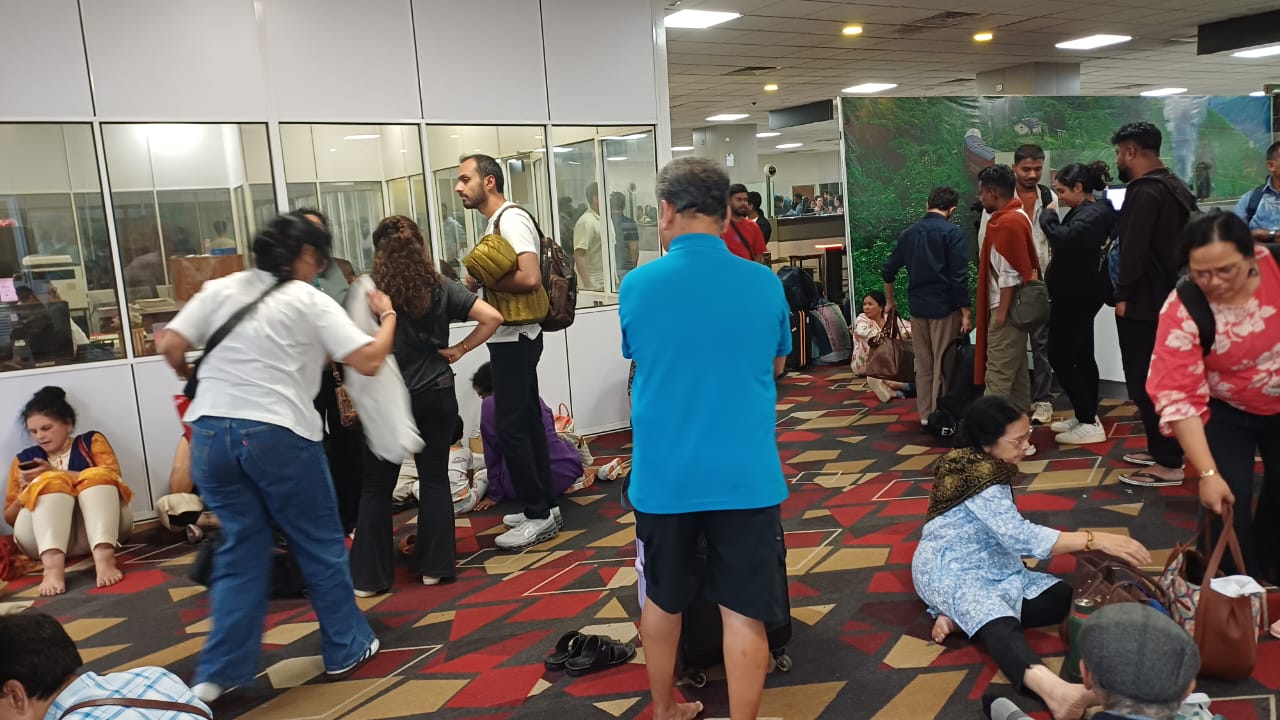
Travellers stranded at Colombo's Bandarnaike International Airport as Cyclone Ditwah delayed flights. Photo by Prof Ambrish Saxena.
Cyclone Ditwah devastates Sri Lanka; India rushes aid
Colombo/New Delhi: Cyclone Ditwah has left Sri Lanka facing one of its most destructive weather emergencies in recent years, with the Disaster Management Centre (DMC) confirming significant loss of life, widespread displacement and massive infrastructural damage. The DMC’s initial bulletin reported 46 deaths and 23 missing persons as floods and landslides swept through multiple provinces; a subsequent update raised the official death toll, while noting that further revisions remain possible as rescue teams reach currently inaccessible areas.
More than 44,000 people have been displaced across the island, according to government figures, with schools and public buildings functioning as temporary shelters in over a dozen districts. The storm delivered more than 300 mm of rainfall in parts of the east and central highlands over a 24-hour period — sufficient to trigger landslides, hill collapses, mudflows and flash flooding in densely populated settlements. Roads, bridges and railway tracks suffered extensive damage, cutting off entire communities and delaying rescue deployment to areas where communications failed.
Urban disruption was felt nationwide. Government offices and rail services were suspended. Fallen trees and floods blocked arterial highways and suburban links. Low-lying neighbourhoods around the capital experienced deep inundation as water outflow systems failed under the surge. The international airport was forced to divert multiple flights, and key commercial activities were paused to prioritise emergency operations and public safety. At 10 pm (IST) on Friday, a Colombo resident described conditions as “still having strong winds but reduced,” even as the overall weather remained unsafe.

Airport delays intensified through the evening as storm conditions worsened. Professor Ambrish Saxena of South Asian University was among hundreds stranded at Bandaranaike International Airport. “At the airport. Worst weather conditions here. Flight is delayed,” he said. He later added that the situation in the country was “alarming,” citing “unprecedented rains for the last one week” and explaining that landslides and flooding on November 27 forced the government to close schools, colleges, universities and public offices on November 28 and issue a red alert advising people to stay off roads. “All incoming and outgoing flights are delayed. The airport is full of passengers, and the crowd is unmanageable,” he reported.
The weather emergency also disrupted scheduled international events. A two-day Social Emotional and Media Literacy Workshop at the Swami Vivekananda Cultural Centre, organised under the aegis of the Indian High Commission in Colombo, could not resume on its second day due to extreme weather. The workshop — a collaboration of South Asian University and UNESCO Mahatma Gandhi Institute of Education for Peace and Sustainable Development (MGIEP) — was inaugurated on November 27 but suspended on November 28. It featured Dr Rich Bansal of UNESCO MGIEP and Professor Saxena as resource persons and was hosted by Professor Ankuran Dutta, Director of the Centre.
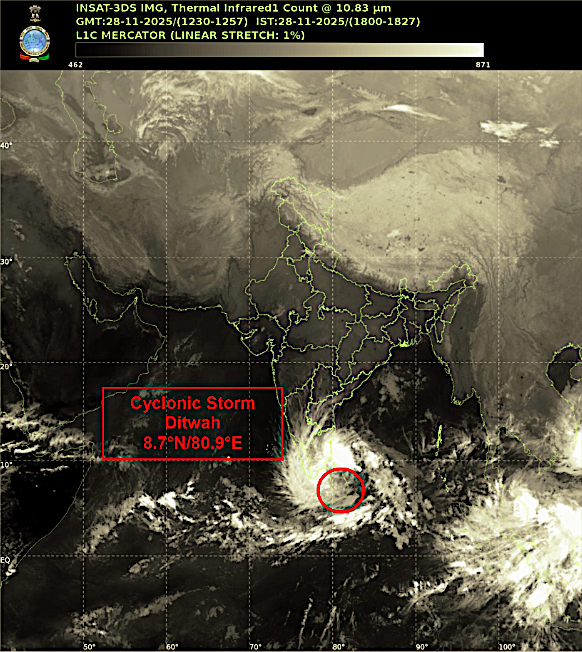
According to meteorological authorities, Ditwah formed over the southwest Bay of Bengal on 26 November as a low-pressure disturbance and rapidly intensified into a cyclonic storm before striking Sri Lanka on 27 November. As of the early hours of 28 November, the circulation lay near the eastern coast of the island and was moving north-northwest across coastal Sri Lanka toward the adjoining Bay of Bengal. Projections indicate that the system is likely to approach the coasts of northern Tamil Nadu, Puducherry and southern Andhra Pradesh by 30 November, with warnings of heavy rainfall, high wind speeds and rough sea conditions in Indian coastal districts.
Search and rescue efforts in Sri Lanka remain intensive. Military, police and civil-defence forces are engaged in evacuations, relief distribution and retrieval operations in flood and landslide-hit zones. Authorities have cautioned that figures on casualties and displacement may continue to evolve as teams penetrate remote high-risk areas cut off by collapsed roads and debris. Medical supplies, dry rations and temporary shelter material are being transported to relief centres, though accessibility remains a persistent challenge.
In India, the cyclonic impact across Sri Lanka triggered an immediate humanitarian response. Prime Minister Narendra Modi conveyed condolences to the people of Sri Lanka, expressing sympathy for families who have lost loved ones and praying for the safety and swift recovery of those affected. The Government of India has dispatched emergency relief and Humanitarian Assistance and Disaster Relief (HADR) support under Operation Sagar Bandhu, and stated that additional support will be provided as the situation evolves. The Prime Minister underscored that India’s response is guided by the Neighbourhood First policy and Vision MAHASAGAR, reaffirming solidarity with Sri Lanka in its hour of need.
As the cyclone continues to shift slowly away from Sri Lanka, authorities stress that the danger is not yet over. Many regions remain waterlogged, the risk of further landslides persists in saturated highlands, and several river basins remain above danger level. The next 48 to 72 hours are expected to be critical both for Sri Lanka’s disaster-relief operations and for Indian coastal states preparing for severe weather conditions as Ditwah tracks northwest over the Bay of Bengal.
– global bihari bureau