48 Medals, Infinite Stories
Manama: India’s teenage athletes have delivered the nation’s finest showing at the Asian Youth Games 2025, returning from Manama, Bahrain, with a record 48 medals—13 gold, 18 silver, and 17 bronze. The tricolour flew highest under the Gulf night sky on October 31, and the momentum is already reshaping youth sport at home. Sports academies report surging enrollments, federations are fielding sponsorship inquiries, and state governments are fast-tracking new training and talent-development programs. Ten days of competition in the third edition of the Asian Youth Games have transcended the medal table, establishing India as a credible mid-tier power in continental youth athletics and team sport.
The closing ceremony at Khalifa Sports City Stadium unfolded under dazzling floodlights, with over 5,000 athletes from 45 nations assembled for the farewell parade. Bahrain hosted the event with precision and poise, blending advanced infrastructure—AI-assisted timing systems, solar-powered cooling, and zero-waste initiatives—with cultural showcases rooted in its pearl-diving heritage. The Games’ seamless organisation, blending tradition and innovation, earned global praise. For India’s contingent, aged between 14 and 18, the event marked a coming-of-age moment: the young athletes outperformed all previous delegations, earning medals across athletics, swimming, kabaddi, judo, boxing, wrestling, badminton, and several team disciplines.
Organised every four years by the Olympic Council of Asia (OCA), the Asian Youth Games are designed as a developmental bridge to senior continental and Olympic competition. Nanjing 2013 introduced 2,000 athletes across 12 sports, Doha 2017 expanded to 15 sports and debuted esports trials, and Manama 2025 scaled further to 24–26 disciplines with full gender parity and a comprehensive sustainability mandate. Demonstration sports such as camel racing, breaking, and Muay Thai were introduced to reflect Asia’s diversity and test future inclusion under the OCA banner.
Medal-by-sport table for India at Manama 2025
| Sport | Gold | Silver | Bronze | Total |
|---|---|---|---|---|
| Athletics | 3 | 5 | 4 | 12 |
| Swimming | 2 | 3 | 2 | 7 |
| Kabaddi | 2 | – | – | 2 |
| Boxing | 1 | 2 | 2 | 5 |
| Judo | 1 | 2 | 1 | 4 |
| Wrestling | 1 | 1 | 2 | 4 |
| Badminton | 1 | 1 | 1 | 3 |
| Table Tennis | – | 1 | 1 | 2 |
| Shooting | 1 | 1 | 2 | 4 |
| Others (Muay Thai, Breaking, etc.) | 1 | 2 | 2 | 5 |
| Total | 13 | 18 | 17 | 48 |
India’s 48 medals mark not just statistical success but a structural leap forward. Earlier editions relied heavily on isolated strengths; this time, breadth and balance defined the performance. The girls’ kabaddi team captured the nation’s attention with a dominant run, crushing Iran 75–21 in the final, their precision and agility redefining India’s prowess in traditional sport. In athletics, Edwina Jason earned silver in the 400 metres (55.43s), while Oshin hurled her discus to 43.38 metres, taking another silver and setting a new personal best. Boxing rings echoed with the cheers for Khushi Chand, Ahaana Sharma, and Bhoreshi Pujari, who each brought home gold medals, while Sani Subhash Fulmali, Anjali, and Arjun Ruhil dominated the beach wrestling categories. Swimmers recorded new national youth records, while judokas and wrestlers secured hard-fought podiums against seasoned East Asian rivals. Racquet events and hurdles added to the tally, showcasing a new generation of athletes comfortable across both traditional and contemporary disciplines.
Prime Minister Narendra Modi hailed the contingent’s achievement, posting on X soon after the closing ceremony: “Our young athletes have scripted history at the Asian Youth Games 2025 with their best-ever performance, winning an impressive 48 medals. Congrats to the contingent. Their passion, determination and hard work are clearly visible. My best wishes for their future endeavours.”
The message, which swiftly crossed half a million shares, echoed nationwide pride and spurred immediate dialogue among policymakers about expanding India’s youth sports infrastructure, scholarships, and grassroots programs.
Historical data validates India’s rise. About 70% of Asian Youth Games medalists have historically advanced to senior-level international events. Neeraj Chopra, for instance, won silver in javelin at Nanjing 2013 before securing Olympic gold in Tokyo. Swimmers from Doha 2017 now anchor India’s senior relay squads. The Manama 2025 cohort is already under observation for the 2026 Youth Olympics in Dakar and the 2029 Asian Youth Games in Aichi-Nagoya.
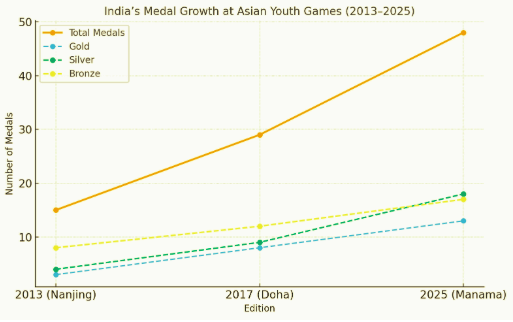
| Edition | Host City | Total Medals | Gold | Silver | Bronze | Rank |
|---|---|---|---|---|---|---|
| 2013 | Nanjing, China | 15 | 3 | 4 | 8 | 9th |
| 2017 | Doha, Qatar | 29 | 8 | 9 | 12 | 6th |
| 2025 | Manama, Bahrain | 48 | 13 | 18 | 17 | 4th |
While China, Japan, and South Korea continued to occupy the top three positions in the medal tally, India’s mid-table surge signalled an important evolution. The distribution of medals across diverse sports, rather than concentration in a few, demonstrates the success of a more inclusive and sustained training ecosystem. Bahrain’s flawless hosting—with AI-refereed contests, efficient crowd management, and eco-friendly facilities—earned widespread appreciation, reflecting how regional collaboration can drive innovation in sport.
The ripple effect of India’s success is already evident. State sports departments have sought increased allocations for infrastructure and coaching. Private academies are reporting record enrollments in kabaddi, boxing, and combat sports. Corporate houses have announced talent identification programs, aiming to harness youthful promise early. Across small towns and cities, parents and local councils are renewing interest in grassroots tournaments that were once on the verge of neglect.
As the young athletes return home—some back to classrooms, others directly to winter training camps—the nation’s gaze follows them. The 48 medals are not an endpoint but a starting line, a symbol of what coordinated policy, opportunity, and perseverance can achieve. With continued investment and vision, these teenagers will mature into the champions of Nagoya 2029, Los Angeles 2032, and beyond.
Manama 2025 has shown that India’s sporting story is no longer written in isolated triumphs but in collective momentum. The starting gun has fired—and India’s youth, determined and fearless, are running to claim the decade ahead.
– global bihari bureau