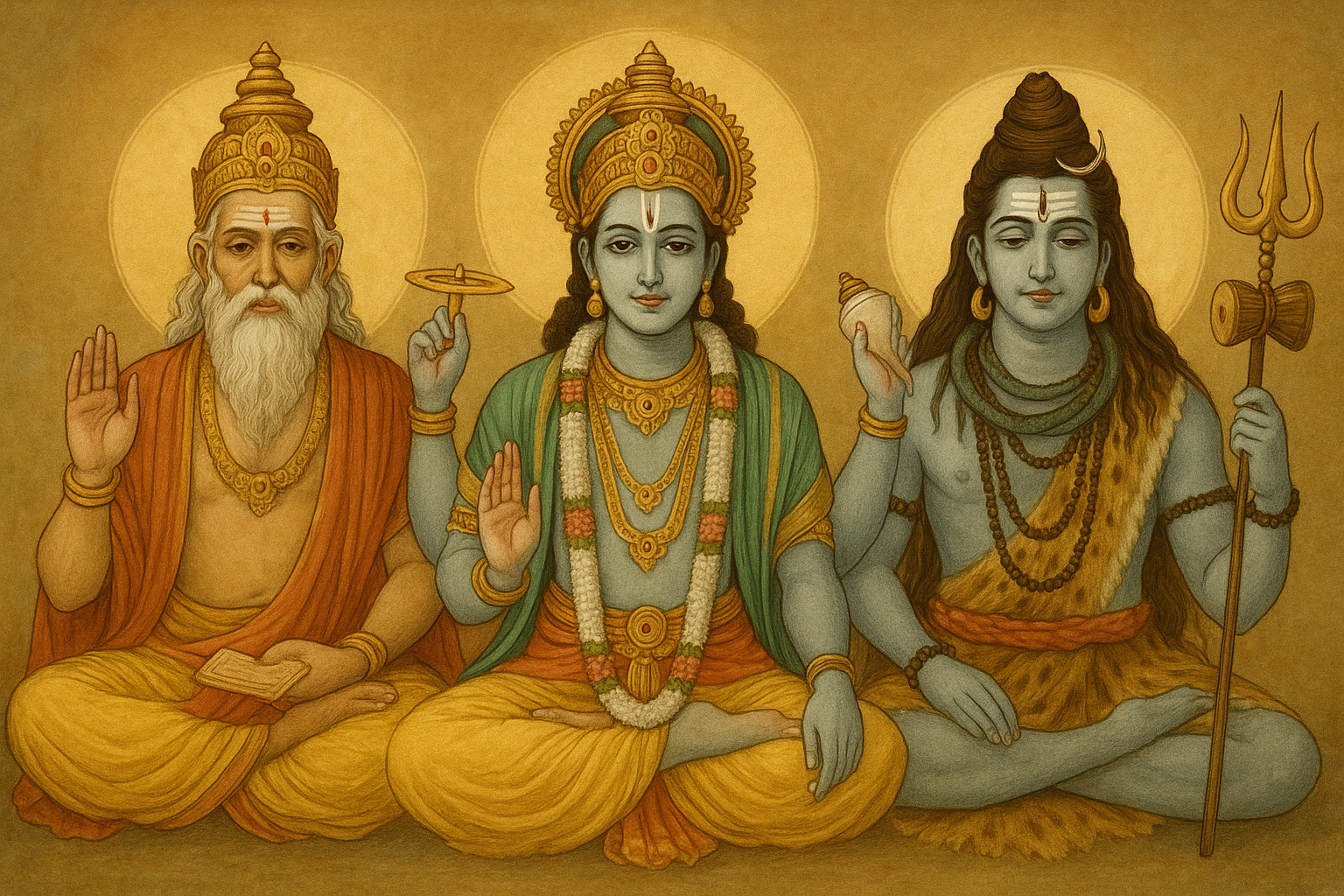
Trinity
Spirituality: Trinity is One Reality
One God, Many Forms
Q : Where does the Hindu trinity of gods – Brahma, Vishnu and Rudra come in relation to Ishvara?
Ishvara is one without a second, and he alone is. His true nature is beyond all roles and limitations, and in His relative nature, he is possessed of all attributes also. Therefore, everything is a manifestation of Ishvara. He can be invoked in many forms and names, because every name and form is his. Just as an actor assumes different roles and is called by different names, so also when Ishvara assumes the role of a creator, he is called Brahma; as sustainer, Vishnu; as dissolver, Rudra or Shiva. These three principles are constantly manifested in the universe. Creation cannot take place unless the previous stage is destroyed.
The concepts of creation, sustenance, and dissolution are indicated by the names Brahma, Vishnu and Rudra. The word Brahma means that which is vast and growing; Vishnu means that which pervades everything, and Rudra means that which destroys. It is important to understand that they are not three. In the example of the actor, even though the beggar, the minister and the king may appear to be three, they are but one.
Since we see the creation in front of us, there is a need to understand the creator. Creation, sustenance and destruction are taking place according to an intelligent scheme that has been brought to manifestation in this universe. God is satchit ananda – existence, awareness/intelligence and wholeness. It is the wholeness that manifests as the universe in an intelligent manner. When Ishvara is said to be the creator, the sustainer and the dissolver, then the attributes of omniscience, omnipotence, etc., also go along because in order to create, sustain and destroy, certain powers are required. The pot maker must have the knowledge, the skill and the ability to make the pot. In the same way, the creator of the universe must have knowledge of the universe. The one who has created the whole must be all-knowing. He must have all the power and the skill also. Therefore, God is omniscient and omnipotent. He is both ordainer and controller.
As we explore the idea of Ishvara, we see that there is fairness and justice in the universe. The scheme may appear unfair and unjust with reference to a given event, but when we look at an event from the larger perspective of the vastness of time and space, it becomes clear that every incident is insignificant from the standpoint of the whole, and everything falls into place. A big painting, when seen close-up, appears to be mere spots with no connection with one another. But when you step back and observe the relation between the different parts of the painting, the harmony becomes clear.
As saguna brahma, God with attributes, Ishvara is the ruler of the universe. We find that everything in the universe is controlled. The Sun rises and sets at the appointed time, and so does the Moon. The Earth revolves around the Sun in a given manner. Every element in the universe functions in an appointed manner. Nothing transgresses its nature. This cannot be unless there is someone who ordains them to be so. Wind, fire, water, earth, sun, etc., are all powerful forces.
But they still follow an order. Ishvara must have the power to ordain. So he is said to be all-powerful, all-mighty. He must have knowledge to create, preserve/rule and dissolve. Knowledge alone manifests as the universe, and therefore, he must be all-knowing. Being the material cause, he is omnipresent also. He must be where the effect is. Therefore, he is all-pervasive, immanent. Omniscient, omnipotent, omnipresent — this is Ishvara. Therefore, Brahma, Vishnu and Rudra are manifestations of Ishvara.
A woman is perceived in different ways by different people as a mother by her child, wife by her spouse, daughter by her parents, etc. She is in fact all of them, and also she transcends them all, because she is a person by herself. Similarly, different aspects of one Ishvara are given different names. In the Gita, Lord Krishna says, “I am the father, mother, grandfather of this universe. I am everything.” We may look upon ourselves as his children.
We look at the Goddess as a mother. She has two forms: benign and ferocious. She is benign to her children and ferocious in protecting them. All these are nothing but different ways of looking at God, relating to him and worshipping him.
Q: In this context, what does it mean when goddess Lakshmi is addressed as the consort of Vishnu? Is it just a concept?
A: Everything in this creation, including you and I, is a combination of two principles: Person and personality. We find the play of these principles wherever we look in the relative universe. A glowing bulb is the result of the union of its filament and electricity, neither of which can illuminate a hall on its own. Light is only possible when these two factors combine. Electricity manifests as light through the bulb.
The universe is also a creation of the union of Person and personality, known as purusha and prakriti in Sanskrit. Person is the consciousness, and personality is the matter. Consciousness manifesting through matter becomes creation, life. Consciousness and matter are relative manifestations of Brahman. The Person, consciousness, is usually looked upon as the male principle and personality, matter, is looked upon as the female principle. The union of these two results in creation.
Hence, gods also have consorts. Nothing can be accomplished without the involvement of the two principles. Even as I speak now, the Person, consciousness, is functioning through the organ of speech. Action can also take place only when there is a union of a Person and personality. Brahmä, the creator, is the puruna aspect as far as the creation is concerned. Functioning through his consort Sarasvati, he creates. Lord Vishnu functioning through Lakshmi sustains, and Rudra/Shiva functioning through Parvati/Shakti/Durga dissolves or destroys. Of course, there are no strict compartments because these names of gods are also ultimately relative.
Lord Vishnu can also be looked upon as the ultimate truth. In one form, such as Vishnu, we can invoke saguna-brahman as well as nirguna-brahman. When we invoke the saguna aspect, brahman with attributes, then we call him protector, and as nirguna, He is satchidananda, beyond all attributes, names and forms. It is the same with Lord Shiva. In the corresponding puranas, we find that respective Gods are presented as creator, sustainer and dissolver/destroyer. So there are no hard-set rules. Generally, however, Brahma is looked upon as creator, Vishnu as preserver and Shiva /Rudra as destroyer.
The idea of consort is that without Shakti, prakriti, the female principle, the male principle cannot accomplish anything. Action or creation can only take place when both principles are involved. Therefore, there is a consort associated with every god, and the nature of the consort will correspond with the function to be performed. For Brahma to create, knowledge is required. Sarasvati is the goddess of knowledge. So they are associated with each other. For preserving and maintaining, resources are required. Lakshmi, the goddess of wealth and prosperity, is the consort of Lord Vishnu. Power is required for dissolution. Parvati/Durga is the goddess of power with which Lord Rudra/Shiva destroys.
Q: In the same context, in some literature, the form of Kali is equated with that of a demon. Does it mean that worshipping Kali is worshipping a demon? What is the meaning of the worship of Kali in that form?
A: Mother Goddess and all gods have two forms — benign and ferocious. Rudra is the ferocious form of Lord Shiva, and Dakshinamurti is the benign form. Whenever there is a danger to the universe, the Lord manifests in a ferocious form to destroy the demonic forces and protect his devotees, dharma and the universe.
Mother Goddess appears as Kali to destroy the demons. She is not a demon. A mother becomes ferocious to protect her children when they are in danger. Worshipping Kali is worshipping a mother and not a demon. We have the need to be protected. Devotees often feel they are being attacked by many evil forces. From a spiritual standpoint, one also finds evil forces attacking oneself from within. The demons of lust, greed and anger very often take over the mind. The Lord is the refuge from them. Kali is the one who destroys them. Kali is one who transcends Kala, time. She destroys all the relative existence to take us to the absolute.
Q: Can you tell us about the gods in the Hindu culture? Is Hinduism a polytheistic culture or is it a pantheistic culture? Do Hindus worship one God or do they worship several gods?
A: Hindus worship one God in many forms. The Vedas explain that there is one God and all there is is God. He is said to be both the creator and the manifestation of the universe. He is both the efficient and the material cause – the maker, and the material. For example, in the case of a clock, the clock-maker is the intelligent or the efficient cause. The matter from which the various parts are made is the material cause.
The universe, whatever it is, however it is, is never apart from God, godliness and divinity. The wholeness and completeness that is God is all-pervasive, and since wholeness, completeness and truth can only be one, and if God is all this, he cannot be many. He has to be one and non-dual. This is what the Vedas, particularly the upaniñads, teach us. It can therefore be said that Hindus do not believe in many gods, or even one God. They believe in only God. Ask any child in India where God is, and he will say, “Everywhere.” This may be just a statement, for it is true that an ordinary person does not see God everywhere. But, they accept that God is everywhere, and that divinity, beauty and harmony are everywhere.
Q. If Hindus believe in one God, then why are there so many devatas?
God is omniscient, omnipotent and omnipresent. He is the creator, the sustainer, the dissolver and the ordainer. Since this means he is everything, any one of his aspects can be worshipped as being predominant. If worshipped predominantly as the creator, we call him Brahmä; predominantly as preserver, we call him Vishnu; predominantly as destroyer, we call him Rudra.
Now, since the entire universe is the manifestation of God, all natural forces — wind, fire, earth, Sun, Moon, etc – also become manifestations of God. The Vedas worship these forces as devatäs, and address them by different names. But like the famous statement “The truth is one, the wise people call it by different names,” all these names, such as Agni, god of fire; Väyu, god of wind, etc., are but different manifestations of the one Truth, God.
Just as you can reach me by touching any part of my body, one can reach God, no matter which aspect of his – Agni, Väyu, Sürya, or the creator, sustainer, dissolver – one worships. The various names and forms are a way of helping devotees relate to one God in their own personal way. It is, but the worship of the only God through these different manifestations.
Therefore, Hinduism is not polytheistic or pantheistic. Hinduism believes that there is only one God.
…to be continued
*Swami Viditatmananda Saraswati has been teaching Vedānta Prasthānatrayī and Prakaraṇagranthas for the last 40 years in Ahmedabad, Gujarat. Throughout the year, he conducts daily Vedānta discourses, accompanied by retreats and Jñāna Yajñas on Vedānta in different cities in India and foreign countries.