Spirituality: Five Elements, One Consciousness
When Nature Becomes Divine
The Sacred Science of Elements
Q: Will you please explain the concept of the five elements and their worship?
A: Pancha-mahabhutas means the five great elements. The Vedas and the Upanishads in particular describe creation as made of Pancha-mahabhutas, or five elements. It is a model.
The five elements are space, air, fire, water, and earth. The air evolves from the space, the fire from the air, the water from the fire and the earth from the water. Since the quality of the cause is reflected in the effect, each element not only has a specific quality of its own, but that of the preceding ones also. In the progressive degree of their grossness, space is the subtlest; it can be experienced only by one organ of perception. The air, the fire, and the water are grosser, more perceptible. The earth is the grossest element because all five organs of perception can experience it.
Every element is associated with a quality. Sound travels in space and can be called its quality. Touch is the specific quality of the air, and it also inherits the quality of sound from the space. Therefore, the air can be heard and felt. Colour or form is the specific quality of the fire. It can be seen. It also has the qualities of sound and touch, which are the qualities of the air. Taste is the specific quality of the water, which also inherits from the qualities of sound, touch and sight from fire. Smell is the specific quality of earth, and has the other four qualities — sound, touch, sight and taste.
Thus, the universe is made up of these five elements. It has five-fold objects — of sound, touch, sight, taste and smell.
There are five corresponding organs of perception — hearing, touch, sight, taste, and smell, with which the five objects, in that order, are experienced. The five organs of action—of speech, hands, legs, excretion and generation — have corresponding associations with the elements. The speech produces sound, which is the quality of space. Hands are said to be produced from the air, legs from the fire, the organ of excretion from the earth and the organ of generation from the water.
Thus, the universe, made of the five organs of perception, the five organs of action, the five-fold objects of the world and the five elements, is called prapancha.
It is not that all the elements are distinct from one another. We say the air is evolved from the space, the fire from the air and so on. Ultimately, they are reduced to the space, and the space will also be reduced to consciousness.
These great elements are both in the subtle state and the gross state. The space, the first element, and the air, the fire, the water, and the earth are in a subtle state when they first become manifest. Then they combine to become gross when the perceivable world, including our gross body, is created. The subtle body — sense organs, mind and vital air — is the product of five elements in their subtle state.
God is also worshipped through the worship of these five elements. Each element is looked upon as a deity, because it is a manifestation of the Lord, and is therefore sacred. For Hindus, followers of Vedic culture, everything in nature is the manifestation of God, and hence, nature is to be worshipped. The world is not to be exploited. It is not looked upon as something from which the maximum should be extracted. We only take what is needed and leave the rest for others to maintain the balance and harmony. Vedas teach a life of harmony with nature, and hence, there is a worship of nature as made of the five elements.
Each of the elements has an important place in our lives. It is responsible for our sustenance, growth, and action. The earth supports and provides food; the water cleanses and quenches thirst; the fire provides warmth and helps cook the food; the air sustains life through breath, and the space provides accommodation. There should be awareness, gratitude and a sense of worship for these privileges. Hence, all the elements are worshipped as devatas.
It is possible to worship the earth, the water and the fire because they are tangible; the air and the space are not tangible so there is no specific worship for them. In a typical act of worship, the different steps followed help us make our contribution to the five elements. In day-to-day living, the elements are polluted by us and are sanctified by worship. The sacred sound produced by reciting the hymns, ringing the bells, and blowing a conch purifies the space. The incense burnt during worship purifies the air. Lighting and waving the lamp is our contribution to the fire. Milk used for bathing the deity is our offering to the water. Sandal-paste is said to represent the earth. Thus, all five elements are represented in our act of worship. The recognition of their role in our life, and offerings during worship create a harmonious relationship between humans and the rest of the world.
In South India, there are temples dedicated to the Lord in the form of these elements. In Chidambaram, Tamil Nadu, the main sanctum has a Shiva linga, but on the side is another sanctum where the Lord Shiva is worshipped as space. Here, there is no murti, but just a mirror on which sits a garland of golden bilva leaves as though hanging in space, signifying the Lord in the form of the space.
In Kälahasti, Andhra Pradesh, the Lord is worshipped in the form of the air. There is a lamp in the sanctum along with the Shiva linga, and the construction is such that there is a constant, gentle stream of air, which makes the light flicker.
In Arunachalam, Tamil Nadu, the Lord is worshipped as Fire. It is said that the Lord appeared here as a column of fire. In November every year, a huge flame, visible for many miles, is lit on the peak of the mountain.
In Kanchipuram, Tamil Nadu, the Lord is worshipped as the earth and in Jambukeshwara as the Water.
This form of worship is symbolic. Some may scoff at this idea of worshipping stones, water, etc., but it is a matter of one’s sensitivity. Just because divinity is not experienced or felt does not mean it is not present. To quote an example, there is music in this room. It cannot be heard because it is in the form of electronic waves. In order to receive those waves, a radio receiver is needed. When tuned to the right wavelength and frequency, music can be heard. The receiver is an extension of the ears. In the same way, just because God is not visible or felt in the elements, worshipping them cannot be ridiculed. It is not that God is not present. There is not enough sensitivity to help us feel his presence. Spiritual life is meant to cultivate sensitivity so God can be experienced. Begin with faith, and in the course of time, it becomes an experience.
…to continue
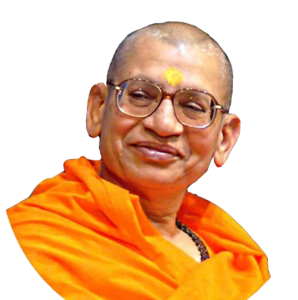
*Swami Viditatmananda Saraswati has been teaching Vedānta Prasthānatrayī and Prakaraṇagranthas for the last 40 years in Ahmedabad, Gujarat. Throughout the year, he conducts daily Vedānta discourses, accompanied by retreats and Jñāna Yajñas on Vedānta in different cities in India and foreign countries.