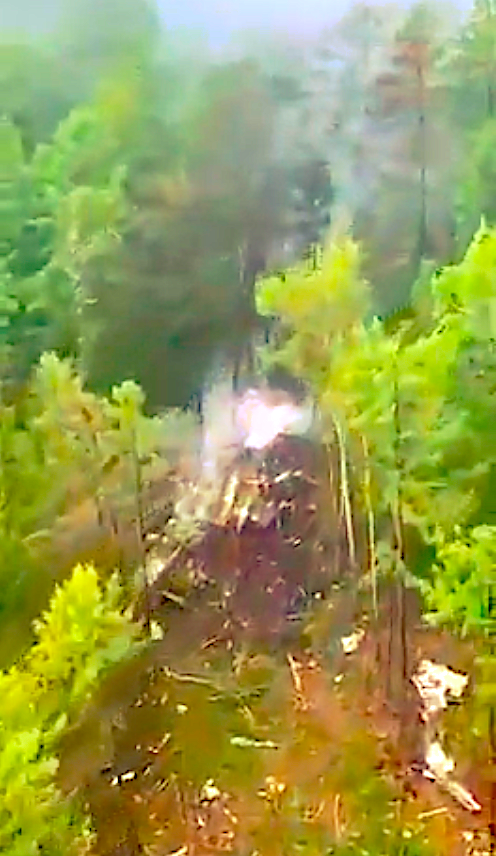
Photo source: X
Moscow: A Soviet-era Antonov An-24 passenger plane operated by Angara Airlines crashed near Tynda in Russia’s Amur region today, killing all 48 people on board, including 42 passengers—five of whom were children—and six crew members. Russian authorities, including the Far Eastern Transport Prosecutor’s Office and Amur Regional Governor Vasily Orlov, confirmed the tragedy, which occurred as the plane attempted a second landing in poor visibility. The crash, one of the deadliest aviation incidents in Russia since 2021, prompted global condolences, with Indian Prime Minister Narendra Modi expressing solidarity: “Deeply saddened at the loss of lives in the tragic plane crash in Russia. Extend our deepest condolences to the families of the victims. We stand in solidarity with Russia and its people.”
The plane, built in 1976 and operated by Siberia-based Angara Airlines, was en route from Blagoveshchensk to Tynda, a key railway junction in the Amur region near the Russia-China border, after departing from Khabarovsk. It disappeared from radar at approximately 1:05 p.m. local time (0405 GMT) during a second landing attempt at Tynda Airport, with no distress signals sent, according to the Russian Ministry of Emergency Situations (EMERCOM). A Rosaviatsiya Mi-8 helicopter located the burning fuselage on a mountainside 9-10 miles (15-16 kilometres) south of the airport, in a dense, swampy forest with no road access. Over 100 rescuers, using heavy machinery, navigated the rugged terrain to reach the site, where thick smoke and scattered debris confirmed no survivors, as stated by Governor Orlov: “I regret to inform you that, according to preliminary data, there are no survivors of the An-24 plane crash in the Tynda District. Rescuers have reached the crash site.”
Preliminary investigations suggest crew error during landing in poor visibility or a technical malfunction as possible causes. However, the Russian Investigative Committee has launched a criminal probe under Article 263, Part 3, of Russia’s Criminal Code for violations of air traffic safety rules resulting in multiple deaths. Both flight data and cockpit voice recorders are being analysed, according to the Interstate Aviation Committee (MAK). The aircraft, despite its age, held an airworthiness certificate valid until 2036, though it had experienced at least four incidents since 2018, including a nose gear collapse in Kirensk in May 2025.
The Antonov An-24, a twin-turboprop designed in the 1950s for rugged conditions, is a staple for regional routes in Russia’s remote areas. Angara Airlines, based in Irkutsk, operates 10 An-24s, all of which were built between 1972 and 1976. Western sanctions since Russia’s 2022 invasion of Ukraine have restricted spare parts, increasing maintenance costs and complicating fleet modernisation. In 2023, Angara and another Siberian airline requested extensions for the An-24’s service life due to a lack of alternatives, as Russia produced only five new domestic planes by early 2025 against a goal of 1,000 by 2030.
The crash, the first fatal passenger aviation incident in Russia since a 2021 An-26 crash in Kamchatka that killed 28, has reignited concerns about the safety of ageing Soviet-era aircraft. At least one Chinese citizen was among the passengers, prompting condolences from Chinese President Xi Jinping to Russian President Vladimir Putin. A government commission was formed to manage the aftermath, and a hotline was established for affected families. Governor Orlov declared three days of mourning in the Amur region, calling it a “terrible tragedy.”
– global bihari bureau