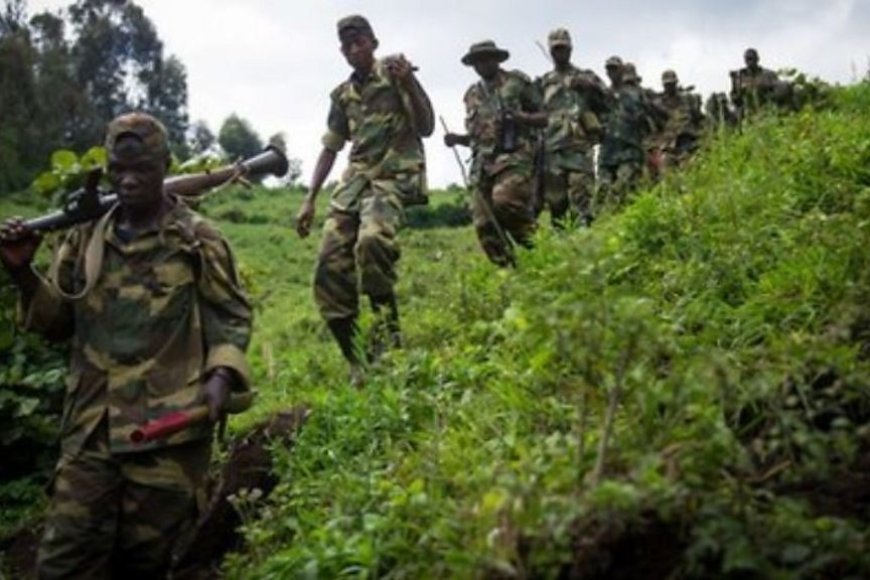
The AFC/M23 leadership has continued to expand the areas it controls in eastern DRC, seizing the Sange area in the Uvira Territory, South Kivu Province. Photo source: @dean_irak|X
South Kivu Crisis Exposes Limits of Washington Accord
Parallel Governance Rises as Accord Fails in Congo
Chaos Returns to South Kivu — Civilians Pay the Price
Kinshasa/Uvira: The eastern frontier of the Democratic Republic of the Congo is unravelling once again. In the highlands, valleys, and borderlands of South Kivu, the war is no longer just a contest of weapons but a contest for authority and legitimacy. The March 23 (M23) Movement, widely believed to enjoy backing from the Rwanda Defence Force, is consolidating territorial control, while civilian life is caught in a relentless cycle of flight, fear, and uncertainty.
Barely days after regional leaders hailed the Washington-brokered cease-fire as a “historic breakthrough,” Uvira’s hills and surrounding villages were convulsed with explosions, mortars, and drone strikes. Villages such as Luvungi and Rurambo changed hands, strategic roads fell silent under checkpoints, and families ran with what little they could carry. Aid workers estimate that approximately 200,000 people have been displaced in the past week alone, streaming into makeshift camps, crossing borders, or seeking shelter in towns ill-equipped to accommodate them. Children clutch school certificates alongside blankets, the familiar symbols of hope now secondary to survival. Fields lie untended, homes are reduced to rubble, and clinics operate under constant threat.
Inside M23-controlled areas, the transformation is not merely martial but administrative. The rebel group has been appointing local officials, reorganising courts and civic offices, and establishing revenue mechanisms. In effect, a parallel administration is emerging, projecting governance in a vacuum left by the state. These moves suggest a strategic vision: M23 is building permanence, not waiting for negotiation, and demonstrating that territorial control, rather than treaties, will dictate South Kivu’s future.
The Washington Accord, signed on December 4, 2025, under the auspices of Donald J. Trump, was intended to reset the region’s trajectory. It promised the withdrawal of foreign troops, the containment and disarmament of armed groups, and a framework for economic integration leveraging the DRC’s vast mineral wealth. Yet the accord coincided almost immediately with the M23’s most aggressive advance in years, exposing a critical gap: the agreement excluded the very actors now dictating the ground reality.
The cease-fire’s collapse, barely hours after its ceremonial signing, has laid bare the limits of diplomacy built on optimism rather than enforceable mechanisms. Government and rebel spokespeople exchange accusations of violations, each claiming the other fired first. But the facts on the ground — captured villages, expanded rebel administration, and mass displacement — speak more clearly than statements from distant capitals.
On December 9, the International Contact Group for the Great Lakes (ICG) stated profound concern. Comprising the United States, the European Union, and other Western governments, the ICG highlighted the “destabilising potential” of renewed M23 offensives near Uvira and denounced the increased use of attack and suicide drones, which place civilians at acute risk. The statement called for the immediate halt of offensive operations, the withdrawal of RDF forces, the return of M23 to pre-offensive positions, and the full respect of territorial integrity. The ICG also emphasised the urgent need for unrestricted humanitarian access, reiterating that civilians must not be caught between diplomacy and violence.
Yet these calls have had little impact on the ground. For the displaced, diplomatic language travels faster than aid convoys. Markets remain empty, clinics struggle to operate, and the roads leading to Uvira are congested with the exhausted and the frightened. Every new drone strike pushes families further from security, while M23’s consolidation reshapes the political geography in real time.
This reality underscores a fundamental weakness in the Washington Accord. By excluding a principal belligerent, the agreement relied on the assumption that the threat of diplomacy or international pressure would influence M23’s actions. That assumption has proven flawed. The accord lacked enforcement mechanisms and real-time monitoring capable of constraining an actor with both territorial ambition and military backing.
The consequences of this failure extend beyond South Kivu. With M23 consolidating administrative authority, controlling checkpoints, and regulating trade and taxation in captured territories, regional stability is at risk. Cross-border trade routes, including those linking mineral-rich areas to Burundi and other neighbours, are vulnerable to disruption. Refugee flows into neighbouring states threaten humanitarian systems already under strain, and renewed clashes heighten the possibility of wider regional involvement, drawing in Burundi, Rwanda, or even other armed factions.
Economically, the accord’s failure is also stark. The Washington Agreement envisioned peace as a precondition for economic growth: access to copper, cobalt, lithium, and other strategic minerals would fuel development and attract investment. Instead, the advance of M23 and the establishment of parallel governance threaten to put mineral-rich territories under informal control, reducing investor confidence and potentially fostering smuggling, illicit trade, and unregulated exploitation. Without the state’s presence, economic promises remain theoretical.
The human cost is immediate. United Nations estimates suggest as many as 200,000 displaced civilians, with at least dozens killed and many more injured in the renewed clashes. Schools and clinics are damaged or destroyed, and humanitarian access remains severely constrained. In camps and temporary shelters, communities cope with inadequate sanitation, limited food supplies, and the psychological trauma of violence. The promise of peace, celebrated in Washington with handshakes and photo opportunities, has translated into a harsh reality for those on the front lines: survival, not negotiation.
Politically, the accord’s failure represents a setback for U.S. diplomacy. Trump’s initiative, framed as a major global achievement, now confronts the tangible evidence of M23’s continued expansion. While the accord was meant to showcase the United States as a mediator capable of bridging longstanding conflicts and facilitating economic opportunity, the reality undermines those claims. Analysts point to a gap between ceremonial diplomacy and enforceable action: agreements without the buy-in of key actors or oversight mechanisms cannot withstand the pressures of active conflict.
The regional implications extend further. M23’s control over strategic towns and roads in South Kivu affects not only the Democratic Republic of the Congo but also the regional balance of power in the Great Lakes. Border security, refugee management, and trade corridors are all jeopardised. Neighbouring countries may respond with defensive postures, interventions, or new alliances, potentially escalating what has been a localised conflict into a broader regional crisis. The International Contact Group’s warnings underscore this risk: unchecked military advances have a destabilising potential for the entire region, far beyond South Kivu.
The accord’s collapse also reflects the challenge of sequencing diplomacy, enforcement, and economic planning. The Washington Accord sought to link troop withdrawal and militia containment with a vision of economic growth. Yet without security guarantees on the ground, the economic element becomes irrelevant. Investors and international actors cannot operate in a conflict zone where control over territory and resources is determined by armed groups rather than legal frameworks.
Furthermore, M23’s emergent administration raises questions about the nature of governance in conflict zones. By appointing officials, restructuring judicial processes, and levying revenue, the movement demonstrates that non-state actors can supplant the state where institutions are weak or absent. This development complicates any future negotiation: peace cannot simply be brokered in conference rooms; it must be enforced on the ground and must account for the ambitions of actors who already wield de facto authority.
Humanitarian access remains a pressing concern. The ICG emphasised that civilians must be protected and that aid should reach those in need without obstruction. Yet ongoing hostilities hinder such efforts. Roads are dangerous, checkpoints manned by armed groups restrict movement, and the risk of drone strikes deters aid convoys. The longer these conditions persist, the deeper the humanitarian crisis will become, and the more difficult it will be to stabilise the region once a political solution is reached.
In South Kivu, the contrast between the Washington Accord’s vision and reality is stark. Where diplomats envisioned handshakes, cease-fires, and economic collaboration, civilians confront fear, displacement, and insurgent governance. Where political leaders spoke of peace, bullets and drones dictate life. Where foreign capitals see achievement, local populations see loss, uncertainty, and the absence of authority.
This discrepancy underscores a critical lesson: peace agreements must be anchored in enforceable, monitored mechanisms and inclusive participation. Excluding principal belligerents or failing to provide credible incentives and deterrents renders agreements ceremonial. In South Kivu, that lesson is evident in the rapid advance of M23, the displacement of hundreds of thousands, and the ongoing restructuring of local governance by a non-state actor.
As night falls over Uvira, the glow of fires in makeshift camps competes with the distant flashes of drones and artillery. For the residents, the promise of peace remains intangible; the Washington Accord is a blueprint whose execution has yet to materialise. The reality on the ground — displacement, parallel administration, and continued violence — shapes their daily lives far more than any televised ceremony ever could.
In broader terms, the failure of the accord challenges the assumptions of high-profile diplomacy in complex conflicts. Agreements cannot substitute for enforcement, monitoring, or genuine buy-in from all armed actors. Without these elements, even a deal hailed as historic may collapse almost as soon as it is signed. South Kivu stands as a testament to this truth, where the distance between ceremony and reality is measured in destroyed villages, fleeing families, and an insurgent administration that refuses to yield.
Ultimately, the story of South Kivu is a cautionary tale for policymakers, diplomats, and international observers. It is a reminder that peace requires more than signatures, handshakes, or photo opportunities. It demands presence, oversight, accountability, and the inclusion of those who hold power on the ground. Until these conditions are met, agreements like the Washington Accord, however well-intentioned, remain aspirations — fragile, symbolic, and insufficient in the face of the region’s enduring conflicts.
– global bihari bureau