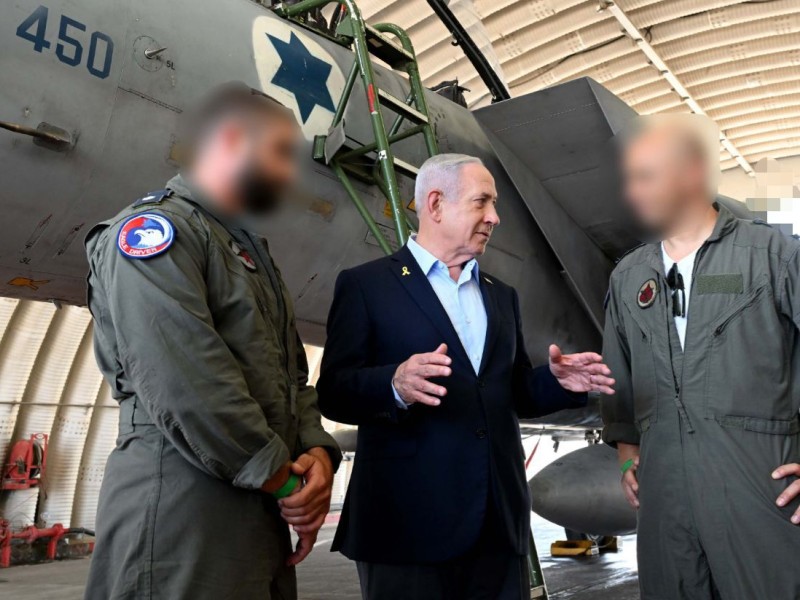
Israeli Prime Minister Benjamin Netanyahu at the Tel Nof Air Force base today.
Tehran/Tel Aviv: The Middle East teeters on the brink of a broader conflict as Israel’s relentless airstrikes on Iran’s nuclear and military infrastructure, met by Iran’s retaliatory missile attacks on Israeli targets, escalate into a crisis threatening regional stability. While Iranian missiles impacted multiple Israeli cities, leading to the deaths of at least eight individuals, according to reports from Israeli officials, Israel targeted the command centre of the Quds Force, a secretive and elite division of the military involved in training and arming proxy groups such as Hezbollah. Israel also carried out an assault on the headquarters of Iran’s state television after directing residents to evacuate specific sections of Tehran. While a female news anchor was on live air, an explosion shook the building. The scene was clouded with smoke and debris, and the sounds of shattering glass and screams were heard as the anchor hurriedly fled.
Iranian Foreign Minister Seyed Abbas Araghchi today delivered a searing condemnation of Israel’s “blatant aggression,” spotlighting the attack on the Natanz nuclear facility as a “grave violation” of international law and vowing resolute self-defence. Concurrently, Israeli Prime Minister Benjamin Netanyahu, visiting Tel Nof Air Force Base, hailed the Israeli Air Force’s dominance over Tehran’s skies, declaring that Operation Rising Lion is on track to eliminate Iran’s nuclear and missile threats.
The intensifying violence, marked by significant civilian and military casualties, has sparked urgent international calls for de-escalation, with China warning that continued escalation could destabilize the entire region, Russia and Turkey expressing alarm over the conflict’s potential to cause long-term regional devastation, and all three nations today emphasizing that failure to return to diplomatic solutions could lead to catastrophic consequences, including a wider war engulfing the Persian Gulf and beyond.
Under Tehran’s smoke-filled skies, Araghchi stood before the international community today, his voice trembling with indignation as he denounced Israel’s onslaught. The attacks, he said, had struck Natanz, a lynchpin of Iran’s nuclear programme, and sites across Tehran and other cities, leaving a trail of civilian casualties—families, women, children, and nuclear scientists—alongside military commanders killed in their homes, far from any battlefield.
“The Israeli regime recognises no boundaries in violating international law,” Araghchi thundered, drawing parallels to Israel’s actions in Gaza, where he claimed human rights and global standards were trampled. He accused Israel of orchestrating a deliberate assault on diplomacy, targeting Iran amid nuclear talks with the United States, set for their sixth round in Muscat that day. Iran, he revealed, had crafted a counterproposal to address contentious U.S. terms from prior rounds, believing it could pave the way for an agreement. “It is abundantly clear that the Israeli regime does not want any nuclear agreement, negotiations, or diplomacy,” he said, invoking Israel’s 2021 sabotage of Natanz during the Joint Comprehensive Plan of Action (JCPOA) talks, which prompted Iran to boost enrichment to 60% and deploy advanced centrifuges.
Araghchi’s accusations extended to the United States, which he charged with complicity based on “solid evidence” of U.S. forces and bases aiding Israel, bolstered by the U.S. president’s public support. He dismissed private U.S. messages denying involvement as inadequate, demanding a public condemnation of the nuclear facility attack. “If the US truly holds this position, it should publicly and explicitly state its stance,” he insisted. He lambasted the UN Security Council’s silence and some European nations for condemning Iran rather than Israel, while thanking regional allies for denouncing the aggression. Araghchi urged an emergency International Atomic Energy Agency (IAEA) Board of Governors meeting, convened today to issue a “strong condemnation” and consider punishing Israel for its “blatant violation” of international law by targeting a nuclear facility—a “new red line.” “This may be the last red line in international law that the Zionist regime has crossed,” he warned, pressing ambassadors to relay Iran’s demand to their capitals. Thereafter, the U.S. Secretary of State, Marco Rubio, spoke with French Foreign Minister Jean-Noël Barrot today about the developing situation in the Middle East, and both agreed to continue to work together closely to encourage a diplomatic path that ensures Iran “never develops” a nuclear weapon. Marco also spoke today with European Union High Representative for Foreign Affairs and Security Policy and Vice President of the European Commission, Kaja Kallas, about the ongoing Israel-Iran conflict, and they reaffirmed their commitment to staying in close contact with Allies and partners.
Across the region, Netanyahu strode through Tel Nof Air Force Base, flanked by Defence Minister Israel Katz and Israel Defense Forces (IDF) Chief of Staff Lieutenant-General Eyal Zamir, his words brimming with defiance. “The Israeli Air Force controls the skies over Tehran. This changes the entire campaign,” he proclaimed, asserting that Israel’s strikes pinpoint “regime targets” unlike the “criminal Iranian regime, which targets our civilians and comes to kill women and children.” He outlined Israel’s mission to eliminate Iran’s nuclear and missile threats, saluting the “heroic pilots” and “magnificent ground crews” for their “amazing” work. Katz reinforced this resolve, reflecting on the weight of the decision to attack. “These decisions are not simple ones, but we knew one thing, and that tipped the balance: When the decision is made, we have whom we can rely on – you,” he told the forces, urging them to “keep going.”
As tensions surged, global leaders scrambled to contain the crisis. Russian President Vladimir Putin and Turkish President Recep Tayyip Erdogan, in a phone call today, condemned Israel’s “act of force” as a violation of the UN Charter and international law, voicing “most serious concern” over the conflict’s mounting death toll and its potential to destabilise the region for decades. They warned that unchecked hostilities could spiral into a broader war, disrupting the Persian Gulf’s critical energy routes and triggering severe humanitarian and geopolitical fallout. They urged an immediate halt to fighting and a diplomatic resolution, including on Iran’s nuclear programme, pledging close cooperation between their authorities.
In Beijing, Chinese Foreign Ministry spokesperson Guo Jiakun warned today that if the conflict escalates or spills over, “the other countries in the Middle East will inevitably bear the brunt,” risking widespread turmoil and economic chaos. “Force cannot bring lasting peace,” Guo declared, affirming China’s push for dialogue to foster a political settlement of the Iranian nuclear issue and urging all parties to “put the brake on the escalation.”
Days earlier, the conflict had taken a perilous turn when Israel broadened its assault to economic targets yesterday, striking the Tehran refinery and facilities in Asaluyeh, a vital energy hub in Iran’s Persian Gulf region. Iran retaliated that night, launching missile strikes on economic targets and refineries in Israel’s occupied territories, which Araghchi framed as self-defence against Israel’s “extremely dangerous act of aggression.” Speaking today, he warned that targeting Asaluyeh was a “major strategic mistake, likely intentional, aimed at widening the war beyond Iran’s borders,” emphasising the Persian Gulf’s volatility. “This is what the Zionist regime has initiated, and we hope the international community will act swiftly to stop these crimes,” he said, underscoring the risk of a global conflict.
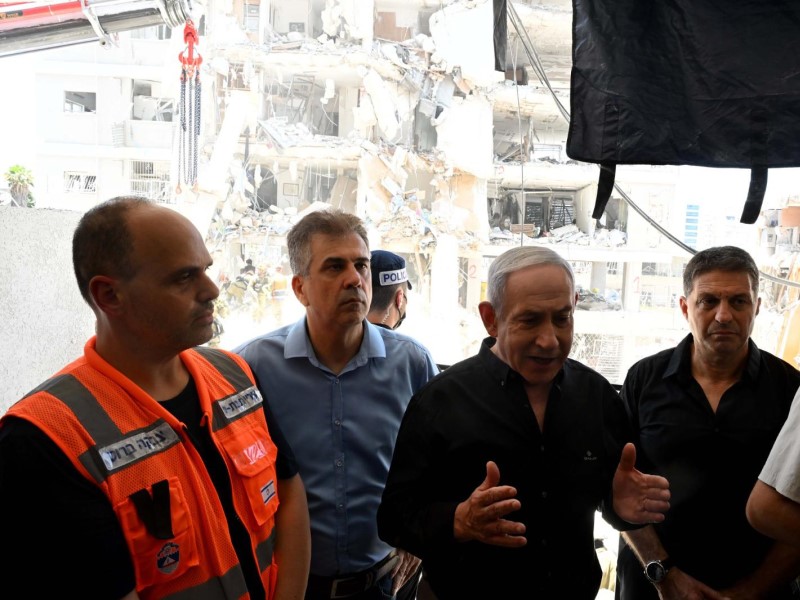
In Israel, Netanyahu visited Bat Yam, where an Iranian missile strike had claimed lives, joined by Katz, Energy Minister Eli Cohen, Israel Police Inspector General Yaakov Shabtai, Fire and Rescue Service Commissioner Eyal Caspi, Bat Yam Mayor Tzvika Brot, and Chairman of the Federation of Local Authorities Haim Bibas. “Iran will pay a very heavy price for deliberately murdering our citizens, women and children,” he vowed, urging citizens to follow Home Front Command directives. “Whoever was in a protected space – was saved. Whoever was not, to our regret, was hit,” he said, casting the conflict as an “existential campaign” to thwart Iran’s nuclear ambitions and missile arsenal, which he warned could number 20,000. Rejecting “cheers of rejoicing” over civilian deaths, he stressed unity: “The missile makes no distinction. It harms Jews as well as Arabs. They’re coming to destroy all of us.” Quoting Deuteronomy 4:15, “Take good heed unto yourselves,” he rallied for resilience, declaring, “We are on the road to victory.”
IDF Chief of Staff Zamir, speaking yesterday, described Operation Rising Lion as a “historic and unprecedented operation aimed at delivering a significant blow to an existential threat that Iran has built over the years with the goal of annihilating us.” He detailed an aerial breaching battle over Tehran, with pilots risking their lives to strike hundreds of targets with precision while neutralising missile launchers firing at Israel. “We knew there would be a price, and it underscores why we acted now, before it became too late,” Zamir said, mourning civilian losses, including four fatalities in Tamra, and the death of Sergeant First Class Noam Shemesh in Gaza, where Israel continues operations against Hamas and efforts to free hostages. He urged adherence to Home Front Command guidelines, praising IDF troops’ “exceptional courage” and Israel’s spirit. “People of Israel, I promise you – anyone who harms you will pay and is paying a heavy price,” he vowed, concluding, “Like a lion, the people rise.”
The Home Front Command proved vital, with rescue forces active at impact sites yesterday, deploying advanced equipment in coordination with emergency organisations. The previous day, the Commander of the Tel Aviv District emphasised the command’s nationwide efforts, noting that compliance with guidelines had minimised injuries in a heavily damaged building. “The building you see behind me was almost completely destroyed, but thanks to civilians following the guidelines, there are relatively few injuries, all minor,” the commander said, stressing, “Victory on the front line cannot be achieved without a strong home front.”
As the conflict deepened on Saturday, June 14, 2025, Iran launched missile strikes on Israeli military targets, which Araghchi described as a “legitimate right of every nation” in response to Israel’s “completely unprovoked” aggression. That day, Chinese Foreign Minister Wang Yi held urgent calls with Araghchi and Israeli Foreign Minister Gideon Sa’ar. With Araghchi, Wang condemned Israel’s violation of Iran’s sovereignty and its attacks on nuclear facilities and civilians as a “dangerous precedent with potentially catastrophic consequences,” supporting Iran’s right to defend its interests and urging global action. Araghchi thanked China for its “consistent understanding” and expressed confidence in its role in fostering peace. With Sa’ar, Wang opposed Israel’s use of force, especially amid nuclear talks, stating, “Israel and Iran are both important countries in the Middle East. The relationship between Israel and Iran bears on the overall situation of war and peace.” He urged dialogue and the safety of Chinese institutions, which both sides affirmed. “The Middle East cannot remain forever under the shadow of conflict,” Wang said, noting that diplomatic options for the Iranian nuclear issue remained open.
The crisis erupted on Friday, June 13, 2025, when the IDF launched Operation Rising Lion, deploying over 200 fighter jets to strike more than 100 targets across Iran, including Natanz and hideouts of senior military commanders, eliminating Chief of Staff Mohammad Hossein Bagheri, Commander of the Islamic Revolutionary Guard Corps Hossein Salami, and Commander of Khatam al-Anbiya Gholam-Ali Rashid. The strikes destroyed dozens of radars, surface-to-air missile launchers, and ballistic missiles, citing Iran’s support for Hamas and direct attacks during the “Swords of Iron” War. “The Iranian regime has proclaimed that its objective is to destroy the State of Israel,” the IDF stated, warning of Iran’s nuclear threat. Netanyahu, addressing Iranians, claimed Israel had neutralised top commanders, nuclear scientists, Natanz, and a vast missile arsenal. “The regime does not know what hit them, or what will hit them,” he said, urging rebellion with “Woman, Life, Freedom” and ties to Cyrus the Great.
The strikes’ timing, amid Muscat talks, fueled accusations of sabotage. Araghchi cited Israel’s 2021 Natanz attack, criticised the UN Security Council’s inaction, and affirmed Iran’s peaceful nuclear doctrine. Today’s IAEA meeting tests global resolve, with Araghchi warning of consequences for inaction. The Persian Gulf’s targeting risks global escalation, with international calls underscoring the stakes as Israel and Iran remain locked in a perilous standoff.
– global bihari bureau