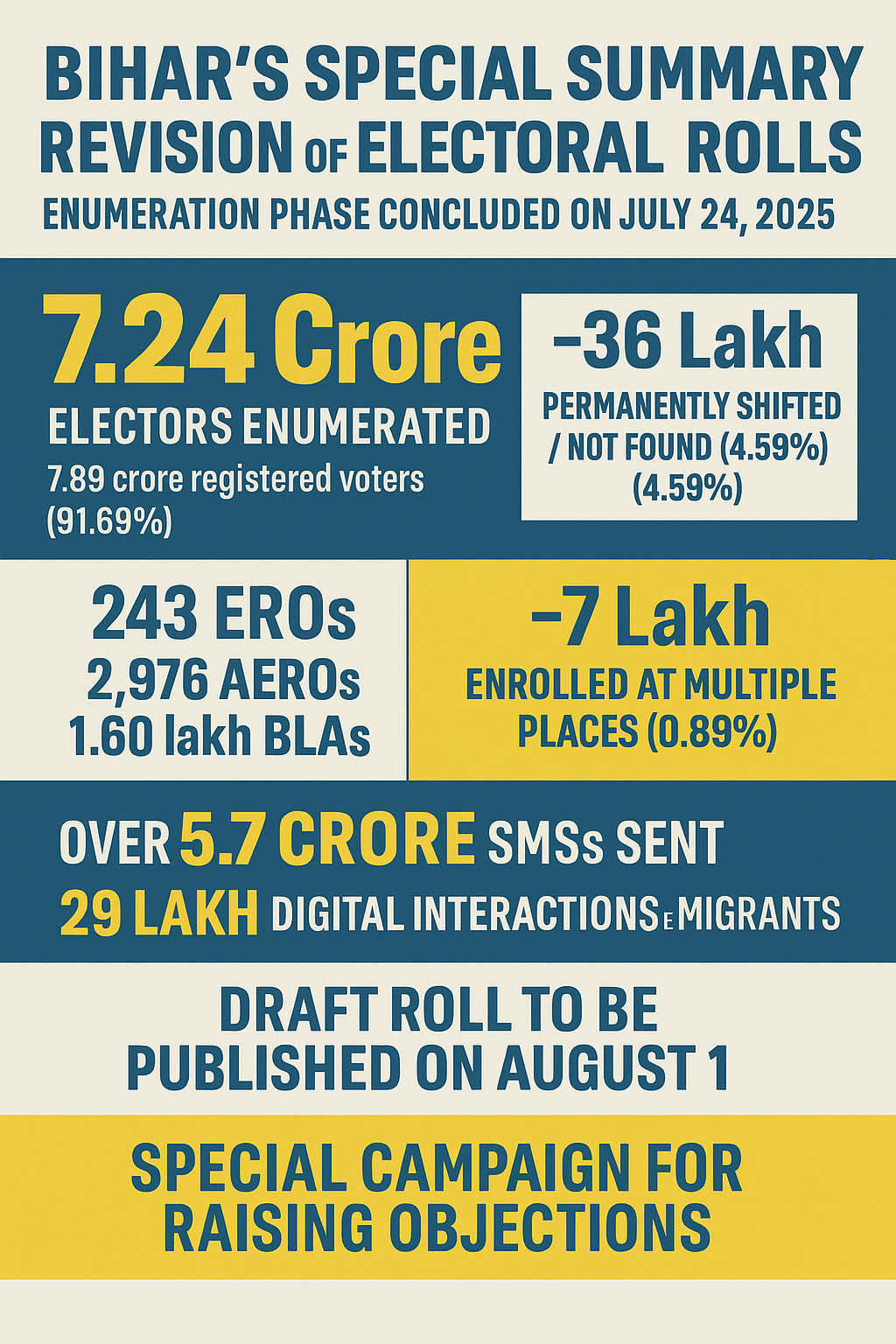
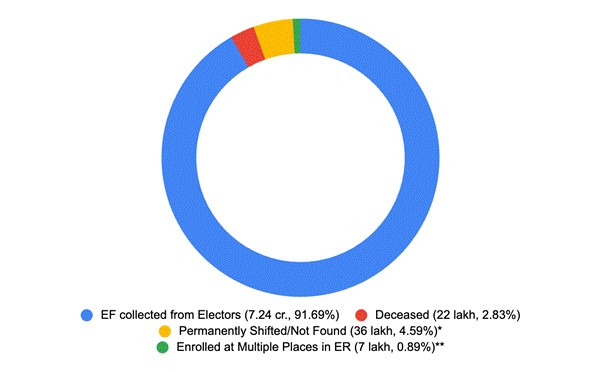
New Delhi/Patna: Amid protests from the opposition parties, the Enumeration Phase of Bihar’s Special Summary Revision (SIR) of electoral rolls concluded on July 25, 2025, with the Election Commission of India (ECI) today claiming data from over 7.24 crore electors successfully collected. This figure represents a significant 91.69 per cent of the state’s 7.89 crore registered voters as of June 24, 2025.
The SIR was undertaken with the goal of ensuring that no eligible elector—be it young, migrated, urban, disabled, or otherwise marginalised—is left behind, while maintaining the integrity of the voter list.
According to official findings now made public, nearly 36 lakh electors—amounting to 4.59 per cent—were found to have either permanently shifted residence or were not traceable at their registered address. Another 7 lakh electors, or 0.89 per cent, were identified as being enrolled at multiple locations. Officials clarified that these findings emerged from the Enumeration Forms (EFs) submitted voluntarily by electors and do not amount to deletions from the rolls. Any correction or removal will follow only after the draft electoral roll is published for public scrutiny beginning August 1, 2025.
 The enumeration involved an intensive field operation comprising 38 District Election Officers, 243 Electoral Registration Officers, 2,976 Assistant Electoral Registration Officers (AEROs), 77,895 Booth Level Officers (BLOs), and an active involvement of 1.60 lakh Booth Level Agents (BLAs) from 12 recognised political parties. The success of this intensive enumeration effort is attributed not only to the Chief Electoral Officer (CEO) of Bihar and the administrative machinery but also to the BLAs.
Political participation in the SIR exercise, especially through BLAs, saw a 16.46 per cent increase during this phase. BLOs carried out multiple home visits and helped over 11 lakh electors without documentation to complete their EF submission, while volunteers were deployed to assist voters with disabilities, senior citizens, and vulnerable groups in both urban and rural areas. SMS messages were sent to 5.7 crore mobile numbers registered with electors, and more than 10.2 crore SMSs were dispatched overall to acknowledge EF submissions and keep electors informed. BLOs visited every household and followed up multiple times to ensure maximum form collection, while political parties’ BLAs were permitted to submit up to 50 forms per day to ease participation.
Migrants from Bihar residing outside the state were also covered through a massive media and coordination effort. An all-India advertisement campaign ran in 246 newspapers with a total circulation of nearly 2.6 crores, while the CEO of Bihar wrote to counterparts in all states and Union Territories, urging outreach to Bihari migrants. As a result, over 16 lakh EFs were submitted online, and 13 lakh more were downloaded, totalling nearly 29 lakh online or self-initiated submissions from outside Bihar.
In the urban context, special camps were set up across 5,683 wards in 261 Urban Local Bodies to ensure no urban voter was excluded. For young voters who have turned or will turn 18 years of age between July 1 and October 1, 2025, special drives have been announced from August 1 to September 1, 2025, during which Form 6 applications, along with a declaration form, will be encouraged.
All major political parties were kept in the loop through multiple meetings conducted by CEO, DEOs, and BLOs. They were provided with booth-level data on electors whose forms were missing, or who were marked as deceased, migrated, or untraceable. Based on political parties’ feedback and field inputs, updated lists were shared again to maximise transparency and allow re-verification.
In parallel, the entire election staff, including thousands of volunteers, is assisting vulnerable electors like senior citizens, PwDs, and economically disadvantaged groups in obtaining documentation, often coordinating with relevant departments on their behalf.
During the enumeration, any issue raised through print, TV, or social media platforms was addressed by the DEOs of all 38 districts, the ECI claimed. Public grievances have been systematically resolved to maintain trust in the process, it added.
The next crucial phase begins with the publication of the Draft Electoral Roll on August 1, 2025, in both digital and print formats, available on the CEO Bihar website and at respective booths. Claims and objections may be filed until September 1, 2025, and decisions will be handled by the 243 EROs and 2,976 AEROs, including 1,470 AEROs specifically notified for SIR on July 8.
Importantly, no name will be deleted from the draft list without a formal notice and a speaking order by the ERO or AERO, as mandated under Para 5(b) of the SIR guidelines. Aggrieved electors can appeal such decisions to the District Magistrate or to the CEO under Section 24 of the Representation of the People Act, 1950. Standardised forms for filing such appeals are being developed and will be widely circulated, with trained volunteers deployed to assist in filing.
Despite the Commission’s assurances, the SIR exercise has triggered political unrest in Bihar. Opposition parties under the INDIA bloc have raised serious concerns about the process, alleging that it disproportionately affects voters from marginalised and minority communities. While the ECI has firmly denied that deletions were based on caste, religion, or socioeconomic status, the opposition remains unconvinced.
Although no major protests were reported today, the SIR has been at the heart of a sustained campaign led by the INDIA bloc leaders in recent weeks. On July 9, a statewide bandh saw mass participation across Bihar. On July 24 and 25, senior opposition leaders, including the Leader of the Opposition in Lok Sabha, Rahul Gandhi (Congress), staged symbolic black-clad demonstrations in Patna and Delhi, accusing the government of orchestrating voter suppression. Inside the Bihar Assembly, the issue had already led to chaos during the monsoon session, which was adjourned sine die on July 26.
The Bihar government and ruling National Democratic Alliance coalition have countered the opposition’s allegations, with Janata Dal (United) and Bharatiya Janata Party leaders defending the SIR as a constitutional and administrative necessity. They accuse the opposition of stoking fear and misinformation for electoral gain. The ECI has reiterated its commitment to transparency and due process, stating that the final electoral roll will reflect only legitimate, verified corrections.
The coming phase—starting August 1—will now be critical, as the draft electoral roll is made public and the onus shifts to electors, political parties, and civil society to verify the data and raise valid objections. The Commission has emphasised that it is committed to ensuring that no eligible voter is left behind and that the SIR process remains transparent, inclusive, and fair.
With Assembly elections approaching, the SIR data and its implications are likely to remain central to Bihar’s political discourse, shaping strategies on both sides of the aisle.
– global bihari bureau