Singur Again in Spotlight as Bengal Heads to Polls
From Tata Nano Protests to Vande Bharat, PM Showcases Growth-focused Agenda
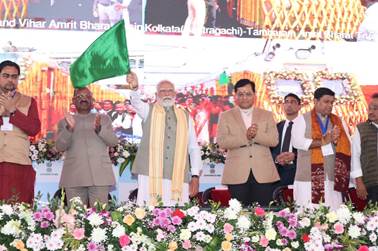
Singur: With West Bengal heading toward Assembly elections due in 2026, Prime Minister Narendra Modi’s choice of Malda and Singur—two locations carrying distinct political and historical resonance—has foregrounded infrastructure-led development in the Union government’s engagement with the state. The Prime Minister inaugurated, laid the foundation stone of and flagged off development works worth over ₹830 crore from Singur in Hooghly district today, while rail and road projects worth more than ₹3,250 crore were unveiled a day earlier in Malda, as part of consecutive visits to West Bengal.
The timing and choice of venues place development and connectivity at the centre of political discourse in a state where debates over industrialisation, land acquisition and livelihoods have long shaped electoral outcomes.
The choice of Singur as the venue carries particular political resonance. The area occupies a central place in West Bengal’s recent political history, having emerged as the epicentre of mass protests during 2006–08 against the Left Front government’s acquisition of nearly 1,000 acres of multi-crop agricultural land for the Tata Motors Nano project. Mamata Banerjee, then in opposition, led the agitation, foregrounding issues of land rights, consent and livelihoods. Tata Motors’ withdrawal from Singur in 2008 and relocation of the project to Gujarat reshaped the state’s political landscape and contributed to the rise of the Trinamool Congress, which went on to end 34 years of Left rule in 2011. A 2016 Supreme Court verdict directing the return of land to farmers further entrenched Singur in debates over development models and governance.
Singur’s Electoral Legacy
Singur has remained an enduring electoral touchpoint in Bengal politics. The 2006–08 land acquisition agitation not only catalysed Mamata Banerjee’s rise to prominence but also became a defining issue contrasting industrialisation and local livelihoods. The area has been repeatedly cited in political narratives on land rights, industrial policy, and governance models, and continues to serve as a symbolic barometer of voter sentiment in the state’s northern and central constituencies. In the run-up to the 2026 Assembly elections, Singur’s history amplifies the electoral significance of infrastructure announcements, making them both a development and political signal.
As West Bengal approaches the Assembly elections, Singur continues to function as a symbolic reference point in competing political narratives seeking to balance infrastructure-led growth with assurances on livelihoods and local participation—an undercurrent that framed the Prime Minister’s development messaging at the event.
Addressing the gathering, Modi said projects related to ports, inland waterways and railways were “very important for the development of West Bengal and for the development of India,” adding that these were “the pillars upon which West Bengal can be made a big hub of manufacturing, trade and logistics.” He emphasised multimodal connectivity, green mobility and employment generation, noting that reduced logistics costs and travel time were key objectives of the initiatives unveiled.
The Prime Minister inaugurated port and inland waterways projects worth ₹552 crore, including the Extended Port Gate System at Balagarh, developed by the Syama Prasad Mookerjee Port Authority. Located around 45 nautical miles upstream from Kolkata, the facility is aimed at easing congestion at the Kolkata Dock System while enabling efficient cargo movement through National Waterway-1 (Ganga–Bhagirathi–Hooghly). The Balagarh terminal comprises two berths capable of handling containerised and coal cargo, with a projected capacity of 2.7 million tonnes per annum, and is supported by road and rail connectivity. Supporting infrastructure includes a newly constructed road overbridge and advanced dredging facilities to ensure uninterrupted year-round navigation and improved turnaround time.
As part of the clean transport initiative, Modi also launched a 50-passenger hybrid electric aluminium catamaran for inland waterways in Kolkata. Developed at a cost of ₹12 crore and powered by lithium-titanate battery technology, the vessel is positioned as an energy-efficient and environmentally sustainable option for passenger movement. The Prime Minister said hybrid electric boats would support green mobility, reduce pollution and give a boost to river-based tourism along the Hooghly.
Railway infrastructure projects worth ₹280 crore were inaugurated from Singur, including the commissioning of the 15-km Jayrambati–Barogopinathpur–Maynapur section, part of the 83-km Tarakeswar–Bishnupur rail project, expected to spur socio-economic development in Bankura district. A new passenger train service between Jayrambati and Maynapur was flagged off, benefiting daily commuters and students. In addition, three Amrit Bharat Express services—Santragachi–Tambaram, Howrah–Anand Vihar Terminal and Sealdah–Banaras—were launched to strengthen long-distance connectivity, reinforcing economic, cultural and religious corridors across the country.
Union Minister of Ports, Shipping and Waterways Sarbananda Sonowal said the ₹830-crore package marked a major step in scaling up waterways and rail-based transportation in West Bengal, adding that inland waterways were emerging as a vital pillar of India’s multimodal logistics network, helping reduce congestion on roads and railways, lower logistics costs and generate employment.
The Singur programme followed the Prime Minister’s visit a day earlier to Malda, where rail and road infrastructure projects worth more than ₹3,250 crore were inaugurated and foundation stones laid to strengthen connectivity across West Bengal and the North-Eastern region. At Malda, Modi flagged off India’s first Vande Bharat Sleeper Train between Howrah and Guwahati (Kamakhya), a fully air-conditioned service expected to reduce travel time on the route by around 2.5 hours and support long-distance travel, religious tourism and passenger comfort.
During the Malda event, four new Amrit Bharat Express trains—New Jalpaiguri–Nagercoil, New Jalpaiguri–Tiruchirappalli, Alipurduar–Bengaluru and Alipurduar–Mumbai—were introduced to strengthen connectivity between North Bengal and southern and western India. Two LHB-coach services—Radhikapur–SMVT Bengaluru Express and Balurghat–SMVT Bengaluru Express—were also flagged off to improve links with major employment hubs.
The Malda visit also saw the foundation stone laid for four major railway projects, including the new Balurghat–Hili rail line, next-generation freight maintenance facilities at New Jalpaiguri, upgradation of the Siliguri Loco Shed and modernisation of Vande Bharat maintenance facilities in Jalpaiguri district. Rail electrification of the New Coochbehar–Bamanhat and New Coochbehar–Boxirhat sections was dedicated to the nation, and the foundation stone was laid for the rehabilitation and four-laning of the Dhupguri–Falakata section of National Highway-31D.
Governor C V Ananda Bose and Union Ministers Ashwini Vaishnaw, Sarbananda Sonowal, Shantanu Thakur and Sukanta Majumdar were present at the events.
– global bihari bureau