Photo source: Sansad TV
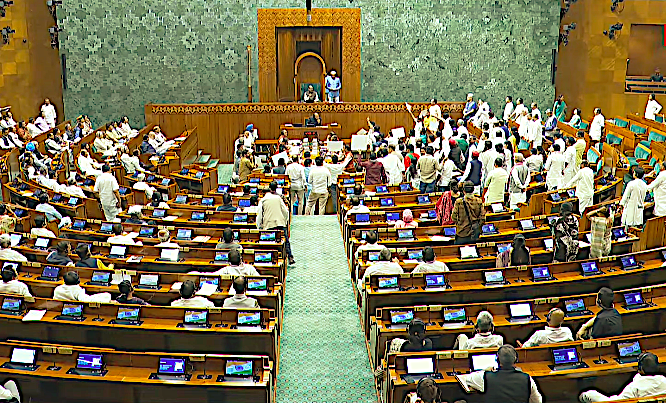
New Delhi: The Lok Sabha today convened a 16-hour debate on Operation Sindoor, India’s military response to the April 22, 2025, Pahalgam terror attack in Jammu and Kashmir, where 26 civilians, including 25 tourists and one Nepali citizen, were killed after being targeted for their religion. The attack, claimed by The Resistance Front, an offshoot of Lashkar-e-Taiba, prompted India to launch Operation Sindoor on May 6 and 7, 2025, targeting nine terrorist sites in Pakistan and Pakistan-occupied Jammu and Kashmir (PoJK), including Muridke and Bahawalpur, operational hubs of Lashkar-e-Taiba, Jaish-e-Mohammed, and Hizbul Mujahideen. The debate, held in a charged atmosphere, saw intense exchanges between the ruling National Democratic Alliance (NDA) and the opposition, focusing on national security, foreign policy, the operation’s execution, and security lapses.
The Rajya Sabha is scheduled to hold a parallel 16-hour discussion on July 29, following a week of parliamentary disruptions over the Pahalgam attack, the Special Intensive Revision (SIR) of electoral rolls in Bihar, and other issues.
Defence Minister Rajnath Singh initiated the debate today, describing Operation Sindoor as a 22-minute precision strike authorised by Prime Minister Narendra Modi after a high-level security meeting convened immediately after the Pahalgam attack, which he called the “vilest example of inhumanity” that tested India’s tolerance. He termed Pakistan-sponsored terrorism a “well-planned strategy” and “fundamental rage,” emphasising that the operation’s politico-military objective was to punish Pakistan for its proxy war, not to cross borders or capture territory, but to eliminate terror nurseries and provide justice to families of victims. Using stand-off weapons, including air-launched cruise missiles, loitering munitions, and long-range drones, the Indian Armed Forces destroyed seven terror camps, eliminating over 100 terrorists, trainers, handlers, and associates, most affiliated with Jaish-e-Mohammed, Lashkar-e-Taiba, and Hizbul Mujahideen, which receive open support from Pakistan’s Army and Inter-Services Intelligence (ISI). Singh stressed that the action was in self-defence, neither provocative nor expansionist, and caused no harm to Pakistani civilians or Indian soldiers. He highlighted the armed forces’ maturity and strategic wisdom, noting that multiple options were considered, but the chosen strategy maximised damage to terrorists while sparing civilians, demonstrating India’s military capability, national resolve, morality, and political acumen.
Singh detailed Pakistan’s retaliatory attacks on May 10, 2025, which involved missiles, drones, rockets, and electronic warfare targeting Indian Air Force (IAF) bases, Indian Army ammunition depots, airports, and military cantonments. India’s air defence systems, including the S400, Akash Missile System, and air defence guns, thwarted these attacks, ensuring no damage to Indian assets. The Indian Air Force responded by targeting Pakistan’s airbases, command and control centres, military infrastructure, and air defence systems on the Western Front, with swift, proportionate, and precise strikes. Singh praised the Tri-services coordination, with the Air Force striking from the sky, the Army delivering a befitting reply along the Line of Control (LoC), and the Indian Navy strengthening its deployment in the North Arabian Sea, signalling readiness to attack Pakistani bases from sea to land. He noted that the operation compelled Pakistan to bow down through demonstrative use of force, with no intent to wage war. On May 10, Pakistan’s Director General of Military Operations (DGMO) contacted India’s DGMO, appealing to halt operations, and formal talks on May 12 led to a mutual halt, with Singh clarifying that the operation was paused, not ended, and could resume if Pakistan engages in further “misadventure.” He rejected claims of external pressure, particularly United States (U.S.) President Donald Trump’s assertions, made 26 times since May 10, of brokering a ceasefire through trade threats, calling them “baseless and incorrect.” Singh visited border areas post-operation, witnessing the soldiers’ unwavering resolve to protect India’s borders and national self-respect, describing them as safeguarding India’s sovereignty and identity.
During the debate, Congress Member of Parliament (MP) Gaurav Gogoi raised concerns about alleged Indian fighter jet losses, citing unverified Pakistani claims and the high cost of each Rafale aircraft. Singh responded by dismissing such claims as “propaganda” and urged the opposition to focus on the operation’s success in neutralising terror camps rather than raising unverified allegations that could undermine the armed forces’ morale. He emphasised that India’s air defence systems ensured no damage to critical assets, reinforcing the operation’s effectiveness and the government’s commitment to transparency through official channels. “If a child performs well in an exam, we don’t ask whether he broke a pencil or not in the examination hall. What matters is the result,” he quipped cryptically.
Singh accused Pakistan of nurturing terrorism as state policy, citing state funerals for terrorists attended by military officers, and described Pakistan’s inability to confront Indian soldiers directly, instead targeting innocent civilians, children, and pilgrims. He framed India’s conflict with Pakistan as civilisation versus barbarism, fought on ideological and border fronts, and asserted that India has never occupied foreign land or competed with Pakistan, which he described as inferior in size, strength, power, and prosperity. Singh referenced prior counter-terrorism actions—the 2016 surgical strike, 2019 Balakot air strike, and 2025 Operation Sindoor—to underscore the “New India” under Modi’s leadership, which responds decisively to terrorism and refuses to bow to nuclear blackmail or other pressures. He reiterated that terrorism and talks cannot coexist, as talks are for civilised, democratic nations, not those driven by religious fanaticism, terrorism, and hatred against India. Singh expressed gratitude to political parties for setting aside differences to show solidarity with the nation, soldiers, and government, and to seven multi-party delegations, including NDA MPs Shrikant Shinde (who addressed the United Arab Emirates and African nations), Lavu Sri Krishna Devarayalu, and Ganti Harish Madhur Balayogi, who visited over 30 countries to present India’s zero-tolerance policy on global forums. He assured the House that the government, armed forces, and democratic institutions are committed to taking every step necessary for India’s unity, integrity, and security, prepared for “even more intense and decisive action” if Pakistan attempts further nefarious acts.
External Affairs Minister S. Jaishankar elaborated on India’s diplomatic efforts, noting that only three of 193 United Nations (UN) members opposed Operation Sindoor, while multilateral groups like Quad and BRICS (Brazil, Russia, India, China, South Africa) condemned the Pahalgam attack. He clarified that no trade-related discussions with the U.S. occurred, countering Trump’s claims, and highlighted the diplomatic push that led to The Resistance Front being designated a global terrorist organisation. Jaishankar questioned whether the opposition, during its tenure, considered striking terror hubs like Bahawalpur and Muridke, asserting that Operation Sindoor established a new standard for India’s counter-terrorism policy. He confirmed that Pakistan’s DGMO initiated the ceasefire, reinforcing the bilateral decision.
Home Minister Amit Shah intervened on July 28 when opposition leaders disrupted Jaishankar’s speech with protests over security lapses and unverified claims. Shah rebuked the opposition, particularly Congress, for questioning Jaishankar’s credibility while seemingly trusting Trump’s statements. He argued that their tendency to prioritise foreign perspectives explained their prolonged presence on the opposition benches, predicting they would remain there for another 20 years. Shah defended Operation Sindoor as a decisive response, criticising the opposition for raising doubts that could undermine the armed forces. He addressed Gogoi’s questions about security failures in Pahalgam, promising a comprehensive response in his scheduled address on July 29 at noon, where he vowed to expose the opposition’s “lies” regarding alleged losses and other claims. Shah urged the opposition to support the armed forces’ efforts and listen patiently to the government’s account.
The opposition, led by Congress MPs Rahul Gandhi, Mallikarjun Kharge, and Gaurav Gogoi, pressed for accountability. Gogoi held Shah accountable for the intelligence failure in Pahalgam, questioning how terrorists accessed Baisaran meadows and why no security forces were present, asserting it was the opposition’s duty to scrutinise national security. Shiv Sena (Uddhav Balasaheb Thackeray faction) MP Arvind G. Sawant sought details on the absence of armed forces and who ordered their non-deployment. Congress MP P. Chidambaram’s query about the attackers’ nationality sparked controversy, with Bharatiya Janata Party (BJP) MP Anurag Thakur accusing Congress of echoing Pakistan’s narrative. Thakur highlighted Modi’s peace efforts with Pakistan, contrasting them with Pakistan’s terrorism. Congress leader Jairam Ramesh cited Group Captain Shiv Kumar, India’s Defence Attaché in Indonesia, who suggested political decisions constrained the operation’s scope, and Lieutenant General Rahul R. Singh, who noted challenges from Chinese hardware and software support to Pakistan. Congress MPs Prithviraj Chavan and Udit Raj criticised the operation’s name, “Sindoor,” for its religious connotations, suggesting a neutral name. Samajwadi Party chief Akhilesh Yadav demanded Modi’s presence, who attended and may intervene on July 29. Nationalist Congress Party (Sharad Pawar faction) MP Supriya Sule, while complimenting the security forces, called for a detailed report on Operation Sindoor, highlighted terror attacks in Rajouri and Poonch, and condemned trolling of Indian Army officer Colonel Sofiya Qureshi and Foreign Secretary Vikram Misri. Congress MP Shashi Tharoor, who led a delegation to the U.S. and UN, declined to speak, citing a “maunvrat” (vow of silence) and aligning with the government’s stance. Speaker Om Birla adjourned the House multiple times till 2 p.m. due to opposition protests, reprimanding members for disrupting proceedings.
Parliamentary Affairs Minister Kiren Rijiju urged the opposition to avoid statements that could undermine the armed forces or be exploited by Pakistan, comparing Pakistan’s actions to crossing a “Lakshman Rekha” from the Ramayan. He emphasised that Operation Sindoor reflected the Indian people’s will, with the government planning a resolution to commend the armed forces.
The debate highlighted national pride but exposed divisions, with the opposition pressing for transparency and the government defending the operation’s success.
– global bihari bureau