

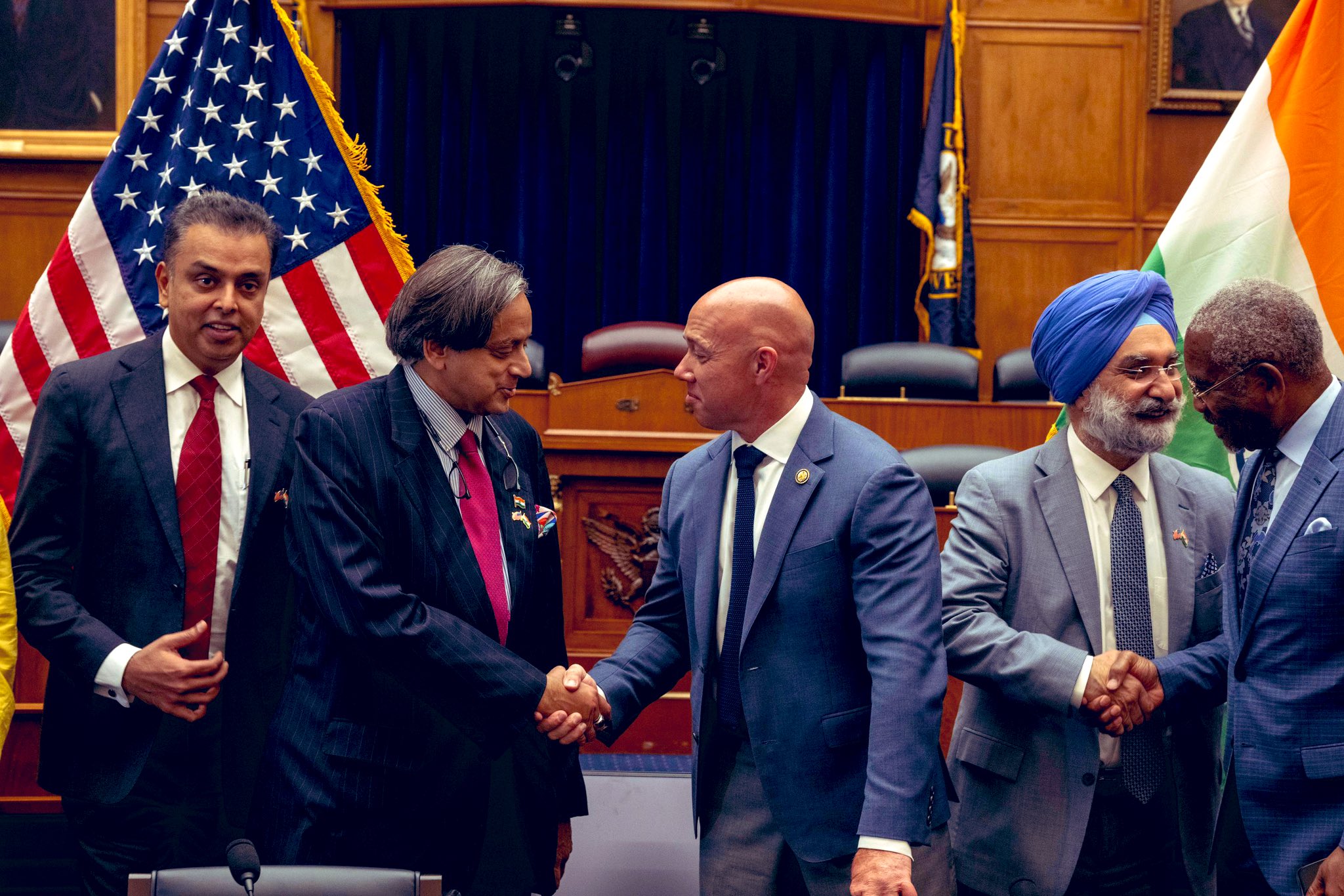
An Indian delegation of parliamentarians with the House Foreign Affairs Committee (HFAC) Leadership in Washington on June 5, 2025. Photo source: @ShashiTharoor|X

When US Deputy Secretary of State Christopher Landau welcomed an Indian parliamentary delegation to Washington on June 6, 2025, his pledge of support for India’s fight against terrorism carried weight. Landau and the Indian delegation discussed the strategic partnership between the two countries and the importance of advancing key areas of the bilateral relationship, including expanding trade and commercial ties to foster economic growth and prosperity in both countries. It signalled that India’s diplomatic push, launched in the wake of Operation Sindoor, was gaining traction in key global capitals.
Seven all-party delegations from India, comprising members from the Bharatiya Janata Party, Congress, Janata Dal (United), Dravida Munnetra Kazhagam, and Nationalist Congress Party (Sharad Pawar), had fanned out to 33 countries, tasked with countering Pakistan’s narrative, showcasing national unity, and rallying international backing. Led by MPs like Shashi Tharoor, Sanjay Kumar Jha, Supriya Sule, and Baijayant Jay Panda, these groups engaged leaders, policymakers, and diasporas across Western democracies, Muslim-majority nations, and emerging economies from late May to early June 2025, aiming to project national unity and reinforce India’s zero-tolerance policy on terrorism.
The catalyst was a terror attack on April 22, 2025, in Pahalgam, Jammu and Kashmir, claiming 26 civilian lives. Indian intelligence attributed it to Pakistan-backed groups like Jaish-e-Mohammed and Lashkar-e-Taiba. On May 7, 2025, India launched Operation Sindoor, with air strikes targeting terrorist camps and Pakistani military assets in Pakistan and Pakistan-occupied Jammu and Kashmir, neutralising over 100 operatives, per military briefings. Pakistan sought a ceasefire within four days but claimed civilian casualties in Attock and Peshawar, which India dismissed as propaganda, asserting all strikes were precise.
Did the sweeping Indian campaign reshape the world’s view of India’s anti-terrorism stance, or did domestic divisions and geopolitical complexities limit its impact? Pakistan, in turn, launched its own outreach, led by the chairman of the Pakistan People’s Party and former foreign minister Bilawal Bhutto-Zardari and Defence Minister Khawaja Asif, with Prime Minister Shehbaz Sharif himself undertaking key visits. So, how did India’s parliamentary push to reshape global perceptions fare against Pakistan’s counter-effort? To what extent could it rally global backing?
The answer lies in a complex interplay of diplomatic gains, specific assurances, domestic challenges, and competing narratives, with Muslim and opposition MPs shaping India’s outreach, though limited support from key powers and Pakistan’s regional ties tempered its global consensus.
Pakistan’s outreach, announced on May 17, 2025, hours after India’s plan, mirrored New Delhi’s strategy but diverged in execution. Shehbaz Sharif tasked Bilawal Bhutto-Zardari and Khawaja Asif with leading a delegation including former ministers Khurram Dastgir Khan and Hina Rabbani Khar, and former foreign secretary Jalil Abbas Jilani. They targeted Muslim-majority nations like Malaysia, Saudi Arabia, and Qatar, and Western capitals, including a UN visit in New York to meet Secretary-General António Guterres. Pakistan emphasised alleged civilian casualties and the Kashmir issue, framing itself as a victim. Shehbaz’s visits to Saudi Arabia on May 24, 2025, and the UAE thanked leaders for de-escalation support and discussed economic ties, but were less integrated with the delegation’s efforts.
India’s broader outreach across 33 countries, leveraging diverse MPs and cultural gestures, secured endorsements from the US, Saudi Arabia, Malaysia, France, South Africa, and Egypt, and Colombia’s policy shift, outpacing Pakistan’s narrower effort, which struggled beyond select Gulf capitals.
Delegations Advance India’s Case, Overshadow Pakistan
India’s Opposition MPs, including Congress’s Shashi Tharoor, Manish Tewari, and Amar Singh, Shiv Sena (UBT)’s Priyanka Chaturvedi, and CPI(M)’s John Brittas, projected bipartisan unity, despite domestic tensions. Tharoor’s leadership in the US, Panama, Guyana, Brazil, and Colombia secured Colombia’s retraction of a condolence for alleged Pakistani civilian losses. Tewari and Chaturvedi, in Europe and the Gulf, engaged parliamentarians and media to highlight India’s evidence-based approach.
India’s delegations secured concrete assurances that bolstered their campaign. In Malaysia, Pakistan’s embassy urged authorities to cancel India’s 10 outreach events, citing Islamic solidarity and Kashmir, but Kuala Lumpur rejected this, allowing all events led by Jha, with Malaysia’s Democratic Action Party deputy leader affirming India’s anti-terrorism stance on June 3, 2025. Pakistan’s Kashmir narrative gained limited traction in Kuwait, where officials expressed concerns about nuclear escalation, aligning with Pakistan’s stability-focused framing. In Washington, Landau committed to enhanced counter-terrorism cooperation, including intelligence-sharing and joint exercises, alongside a pledge to boost trade in technology and defence, per a State Department readout on June 6, 2025. A 9/11 Memorial visit by Tharoor’s delegation in New York underscored shared anti-terrorism resolve. Saudi Arabia’s Deputy Speaker of the Shura Council, during Panda’s visit, assured support for India’s anti-terrorism measures and expressed interest in expanding energy and investment ties, as reported by Arab News on June 5, 2025. Malaysia’s leadership, after Jha’s engagements, agreed to collaborate on countering terror financing, a commitment noted by India’s High Commissioner on June 3, 2025. France’s foreign ministry, following Tewari’s delegation, supported India’s right to self-defence and proposed defence technology partnerships. South Africa’s Department of International Relations endorsed India’s call for global anti-terrorism frameworks and committed to trade discussions. Sule’s delegation in Cairo debunked Pakistan’s claims, gaining Egypt’s support. Egypt’s assurances, secured by Sule’s delegation, included diplomatic support at the UN and cooperation on counter-terrorism training. As mentioned, in Malaysia, Jha’s team overcame Pakistan’s obstruction, earning approval through diaspora events. Panda’s team engaged officials in Bahrain, Saudi Arabia, Kuwait, and Algeria, with Bahrain and Saudi Arabia affirming India’s stance. In Colombia, Tharoor’s group prompted a retraction of a condolence for alleged Pakistani losses. These commitments strengthened India’s diplomatic leverage and countered Pakistan’s narrative.
Cultural outreach also amplified India’s global efforts. In Malaysia, honouring Netaji Subhas Chandra Bose tapped historical ties. In Egypt, the Heliopolis War Memorial visit commemorated Indian soldiers. In Kuwait, a Grand Mosque visit resonated locally. These gestures, paired with diaspora engagement, bolstered India’s narrative. The campaign yielded endorsements from six major nations and Colombia’s shift, showing influence across blocs.
The inclusion of Muslim MPs—Asaduddin Owaisi, Ghulam Nabi Azad, E.T. Mohammed Basheer, Mian Altaf Ahmad, and Sarfaraz Ahmad—strengthened India’s outreach, especially in Muslim-majority nations. Owaisi, leader of the All India Majlis-e-Ittehad Muslimeen, countered Pakistan’s religious framing during engagements in Bahrain, where his visit to Manama Souq highlighted India’s pluralism. Azad, a former Jammu and Kashmir Chief Minister, brought regional expertise to Saudi Arabia, Kuwait, and Algeria, emphasising the toll of Pakistan-backed terrorism in talks with figures like Algeria’s Committee on Foreign Affairs chairman. Basheer, from the Indian Union Muslim League, and Ahmad, from the National Conference, reinforced India’s secular credentials in the United Arab Emirates (UAE) and Russia. Sarfaraz Ahmad, from the Jharkhand Mukti Morcha (JMM), joined Tharoor’s delegation to the Americas, bolstering India’s diverse image. Their presence helped secure endorsements from Saudi Arabia and Malaysia, though stability concerns persisted in some Gulf capitals.
India’s Diplomatic Blitz: Bold, but Not Flawless
However, despite these gains, the absence of support from China, Russia, and most European nations, beyond France, limited India’s global consensus. China, a key ally of Pakistan, expressed regret over India’s strikes on 7 May 2025, urging restraint and prioritising regional peace, without endorsing India’s actions. China’s move to water down a UN Security Council condemnation of the Pahalgam attack signalled reluctance to back India, reflecting its “all-weather” ties with Pakistan. Russia, a traditional Indian partner, issued a neutral statement on May 7, 2025, calling for dialogue, avoiding support for India’s strikes or condemnation of Pakistan’s terror networks. Russia’s $2.6 billion steel mill deal with Pakistan, announced in May 2025, suggested a balancing act. Most European nations issued a vague European Union statement on May 8, 2025, condemning the Pahalgam attack but emphasising dialogue, with only France offering clear support.
This limited alignment, driven by concerns over nuclear escalation and economic ties, constrained India’s coalition-building. Pakistan’s agreements with Gulf states and Russia, though unrelated to Sindoor, fed perceptions that India didn’t fully isolate Pakistan. Kuwait’s MoU with Pakistan on May 30, 2025, for oil and gas, and the UAE’s trade commitments during Shehbaz’s visit, alongside Russia’s investment, signalled Pakistan’s sustained regional influence, amplified by China’s UN support.
Yet, India faced hurdles, Pakistan’s allegations, though unverified, raised concerns in Kuwait and Algeria about nuclear escalation. India’s suspension of a water-sharing treaty fueled unease in some Gulf nations. Domestic fractures challenged India’s unity narrative. The Congress party criticised the government for bypassing nominees like Gaurav Gogoi and Syed Naseer Hussain, sparking disputes that risked undermining the unity narrative abroad, as foreign observers noted India’s internal friction.
Congress’s criticism of the government’s delegation selection and Rahul Gandhi’s doubts about the operation’s fallout, coupled with the government’s refusal to debate Sindoor in Parliament, reached foreign audiences, potentially weakening India’s message.
The delegations’ strategy—targeting diverse nations and leveraging diasporas—was ambitious but may have prioritised breadth over depth. Cultural gestures, while resonant, were secondary to strategic talks. As Prime Minister Narendra Modi prepares to meet the delegations on June 9 or 10, 2025, India’s effort reflects bold ambition, tempered by domestic discord and partial global traction, significantly outpacing Pakistan’s limited outreach.
*Senior journalist


A new way of involving elected members cutting across party lines is a good move, but if it’s just cosmetic, it will never serve the genuine purpose of combating terrorism.
A man who is self-obsessed, Me and only Me, looks like he has realised the heat of 240 numbers. This is the first time all party delegations under Modi’s regime have taken place, though late, it’s welcome.
Unfortunately, no government head of any country met the Indian delegations, so was the mission helpful to India, which has spent millions of dollars for their travel, stay and PR work?
Cosmetic makeup will not solve the issue. Instead India, as Big Brother, can play a major role in its neighbourhood – Pakistan, Sri Lanka, Bangladesh, Nepal, Myanmar.
As Trump claimed, showing a carrot as trade for a Ceasefire, why can’t India play a similar role by expanding its own trade with its neighbours.
Interesting read! It’s great to see such high-level engagement between India and the U.S. on foreign affairs. The photo shared by Shashi Tharoor adds a personal touch to the event. I wonder what specific topics were discussed during this meeting—was it focused on trade, security, or perhaps climate initiatives? The timing of this delegation also seems significant; was there a particular reason for June 2025? I’d love to hear more about the outcomes or agreements reached. Do you think this meeting will lead to any tangible changes in bilateral relations? Looking forward to more updates on this collaboration!