Akashteer
It was just past midnight on May 9, 2025, when the skies over northern India turned treacherous. A swarm of missiles and drones, launched by Pakistan in a brazen assault on military bases and civilian towns, cut through the darkness, their deadly intent cloaked in silence. On the ground, families slept, soldiers stood watch, and a nation was unaware of the peril closing in. But high above, an invisible guardian was already awake, its sensors humming, its calculations relentless. This was Akashteer, India’s homegrown Air Defence Control and Reporting System, and in those tense hours, it became the unseen force that turned a potential tragedy into a story of resilience and triumph.
The attack, now etched into history as Operation SINDOOR, was Pakistan’s boldest in years, a calculated strike meant to overwhelm India’s defences. Yet, every projectile was intercepted, every threat neutralised, before a single one could reach its target. Akashteer didn’t roar like a fighter jet or blaze like a missile. It listened, processed, and struck with a precision that left no room for error. While Pakistan’s imported HQ-9 and HQ-16 systems faltered, unable to detect or counter India’s swift retaliation, Akashteer stood as a testament to a nation’s grit, outpacing its adversaries with a speed that felt almost otherworldly.
This wasn’t just technology at work—it was the heartbeat of a nation’s resolve, forged through years of labour under the Atmanirbhar Bharat initiative. For the engineers who spent sleepless nights perfecting its algorithms, the scientists who calibrated its sensors, and the soldiers who trusted it in the crucible of war, that night was personal. Akashteer, a name once whispered in defence circles, had become India’s shield, a silent warrior that rewrote the rules of modern combat.
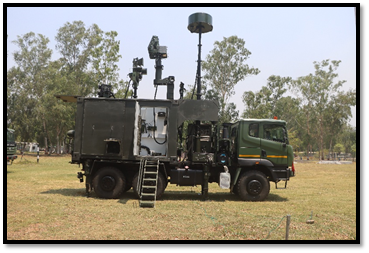
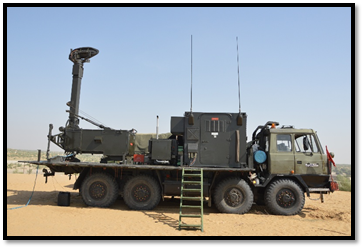
What makes Akashteer extraordinary isn’t brute force but its brilliance in orchestrating chaos. It weaves together a network of sensors—Tactical Control Radar REPORTER, 3D Tactical Control Radars, Low-Level Lightweight Radar, and the radar of the Akash Weapon System—into a single, seamless tapestry. It pulls data from every corner of the battlefield, processes it in real time, and makes autonomous decisions that outstrip human reflexes. Unlike older systems tethered to ground-based radars and manual commands, Akashteer patrols low-level airspace, directing ground-based weapons with an efficiency that feels alive. Its vehicle-mounted design lets it move with the fluidity of a soldier, thriving in the hostile, shifting terrain of war zones.
That night, as missiles streaked toward India, Akashteer’s integration with the broader C4ISR framework—Command, Control, Communications, Computers, Intelligence, Surveillance, and Reconnaissance—proved its genius. It linked the Indian Army’s Air Defence system, the Air Force’s IACCS, and the Navy’s TRIGUN, painting a crystal-clear picture of the battlefield. This unity didn’t just prevent friendly fire; it turned India’s forces into a single, unstoppable entity. In control rooms, officers watched as Akashteer’s real-time data guided their decisions, transforming a chaotic assault into a masterclass in precision. For those on the front lines, it was a lifeline, a quiet assurance that the skies were theirs.
The victory belonged to more than the military—it belonged to a nation that dared to dream of self-reliance. Akashteer is part of a constellation of indigenous platforms reshaping India’s defense: the Dhanush Artillery Gun System, the Advanced Towed Artillery Gun System, the Arjun Main Battle Tank, the Tejas Light Combat Aircraft, the Advanced Light Helicopter, the Light Utility Helicopter, Weapon Locating Radar, 3D Tactical Control Radar, Software Defined Radio, and naval assets like destroyers, aircraft carriers, submarines, frigates, corvettes, fast patrol vessels, fast attack craft, and offshore patrol vessels. Where India once leaned on imports for 65-70% of its defence needs, it now produces 65% domestically, with ambitions to hit ₹3 lakh crore in defence production by 2029. The private sector, fueling 21% of this output, works alongside 16 Defence Public Sector Undertakings, over 430 licensed companies, and some 16,000 micro, small, and medium enterprises, building a defence ecosystem that pulses with innovation.
For those who built Akashteer, the night of May 9 was a reckoning. It was the moment their years of toil saved countless lives, when their belief in a self-reliant India held back the storm. Defence experts worldwide have called it a seismic shift, placing India among the elite few with fully integrated, automated air defence systems. Akashteer doesn’t just react—it anticipates, striking with a speed that leaves adversaries scrambling. It’s a response to asymmetric warfare, hybrid threats, and cross-border aggression, a signal that India’s future lies not in borrowed might but in its own ingenuity.
In the villages along India’s borders, where families live under the shadow of conflict, Akashteer is a quiet promise of safety. For the soldiers who stand guard, it’s a partner that never blinks. And for a nation watching its star rise, it’s a story of what happens when determination meets brilliance—a story that began in the dark of a May night and will echo for years to come.
– global bihari bureau