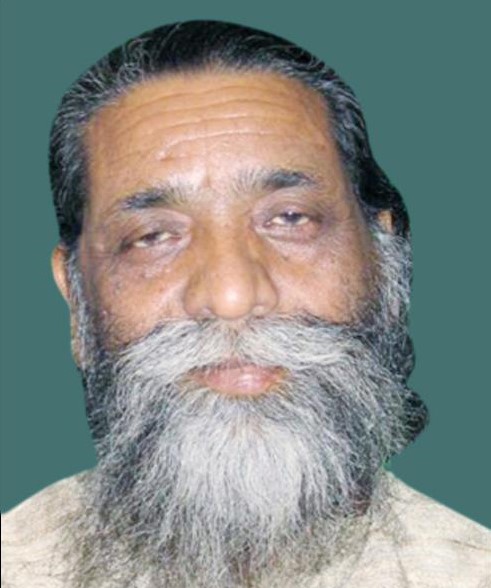
Shibu Soren. Photo courtesy Digital Sansad.
Dishom Guru Shibu Soren is gone. 10 times MP, 3 times Jharkhand Chief Minister, and more than that- the person who got the tribals of Bihar their rights not with bow and arrow but with struggle and his political moves. There were many who dreamt of a separate Jharkhand, but there was only one name who made it come true- Dishom Guru.
People say, “Guruji was not just a leader; he was the soul of the movement.” For his supporters, he was an idea, an identity of resistance. A roar arose from Nemra, which shook the whole of Bihar.
The Jharkhand movement in Indian politics is actually the story of tribal identity, which was written by Dishom Guru with his blood and sweat.
Born on 11 January 1944 in Nemra village of Ramgarh, Shibu Soren witnessed the looting by moneylenders and the greed of mining companies in his childhood. The famine of 1969, when grains were rotting in government warehouses and tribals were dying of hunger, filled him with fire. He vowed, “The battle for water, forest and land will be fought.”
Their voice, which rose from the streets of Nemra (Ramgarh), shook the people in the 1960s–70s. When the Dhankatni movement began, the tribal women would harvest paddy from the fields and take it away, while the men would stand guard with bows and arrows. But there was a system too—surrender, arrest, and even arrest warrants were issued.
His beginning was small, but the impact was huge. Shibu came into the limelight with the paddy seizure movement. Taking out grains from the godowns of moneylenders, guarded by tribal guards with bows and arrows—this was not just a protest, it was a direct challenge to the system.
One day, Shibu Soren hid himself in the jungles of Parasnath, from where he started the movement – drive out the “outsiders”, “free Jharkhand from exploitation” – this movement of dreams gave him the identity of ‘Dishom Guru‘.
In 1973, he formed the Jharkhand Mukti Morcha (JMM) along with A.K. Roy and Binod Bihari Mahto. At that time, his slogans used to echo – “Our land is ours, no diku (outsider) can snatch it.” With this, the Jharkhand movement started gaining momentum.
It was not easy to form JMM at that time—he kept the party alive amidst political opposition, divisions and mental tensions. Then the ruling party of Bihar, the Rashtriya Janata Dal’s supremo Lalu Yadav had said in 1998, “Jharkhand will be formed only over my dead body”.
But Shibu Soren overcame all opposition, formed an alliance with Congress, RJD and BJP and through negotiations brought the state’s issue to Parliament.
A master of political moves
Shibu Soren had understood that the dream of Jharkhand would not be fulfilled by merely staging dharnas in the jungles, for this, the doors of power in Delhi would have to be opened. And this is what he did.
Supporting V.P. Singh’s government in 1989, saving PV Narasimha Rao from the no-confidence motion in 1993, and then the deal with Atal Behari Vajpayee’s National Democratic Alliance (NDA) government in 1999—Shibu played the right bet at the right turn every time. Jharkhand was separated from Bihar on November 15, 2000. Jaipal Singh Munda had started the movement, but the name that took it to its destination was Shibu Soren.
War with corporate
The core of Shibu Soren’s politics was tribal identity and protection of water, forest and land. He made festivals like Sarhul a platform for protest. He organised the mine workers and troubled the mining companies. On his initiative, the PESA law came into force, which gave the Gram Sabhas the right to take decisions on land. The Forest Rights Act of 2006 was also a result of his persistence.
Festivals like Sarhul were turned into protest occasions, obstructing the companies’ checkpoints. But even then, the business power came in the way – the corporate caucus did not break. The companies’ hold on the mineral wealth remained intact. Coal and iron ore worth billions went from Jharkhand to Delhi, but only poverty reached the villages.
This is the irony – the state was formed, recognition was achieved, but economic justice is still incomplete. Jharkhand is one of the most mineral-rich states in the country. The Centre gets more than ₹40-45 thousand crore annually from coal, iron ore and other minerals, while the state earns about ₹34 thousand crore from its own taxes. The state gets only about half of the total revenue from the Centre, including tax share and grants. Local tax amount ₹34 thousand crores; Tax share and grants ~ ₹45-50 thousand crores.
In simple words-minerals are extracted from Jharkhand, and the benefit goes to Delhi. This has been the biggest fight. And this fight is still going on.
Trials, punishments and public trust
Dishom Guru‘s journey was full of black and white shadows and controversies of politics and lawsuits. No matter how many charges were levelled, Shibu Soren was finally acquitted.
He was charged with murder in the 1975 ‘anti-outsider campaign’, which resulted in 11 deaths. Accused of bribery in the 1993 no-confidence vote, the murder of his personal secretary Shashinath Jha in 1994, he was convicted in 2006, then acquitted in 2007.
Shibu Soren was burdened with lawsuits, punishments and controversies, but the public did not abandon him. He won elections even after coming out of jail. He became the Chief Minister three times. He was an MP ten times. A party leader said, “When a tribal leader stands up, he is also trapped in politics. Hemant Soren was also put in jail. But what was proved? The public has now started understanding these tricks very well.”
People remember his contributions—he dreamt of Jharkhand, brought tribal identity into national discourse, and most importantly, he challenged corporate power.
The pace of development today further deepens the question of economic rights—will the mineral wealth of the state be able to benefit the people who gave birth to it? Guruji left, but the questions remain the same.
Wisdom or bargaining?
Shibu Soren sometimes supported the Bharatiya Janata Party, then joined hands with the RJD, and sometimes joined hands with the Congress. At every step, he proved that the challenges of political determination and identity go through the coalition policy. “Guruji believed only in written promises, not in words.” Politics was done on the ground, not in speeches. This made him different.
Public trust and Hemant’s ordeal
Shibu Soren dreamt of Jharkhand, echoed it in Parliament, and finally won the fight for political rights as a state. History will write him not just as a leader, but as a symbol of rebellion and identity. But the struggle against poverty, unemployment, and economic self-reliance continues. Today, the JMM is in power again. Hemant Soren is the Chief Minister. This trust is not just in the son, but in the history that Shibu Soren wrote.
The challenge is huge—corporate control over mineral wealth, the need for development and the question of tribal identity. Hemant says, “Development is necessary, but it should not erase our identity.” The JMM has demanded ₹1.40 lakh crore of mining dues from the Centre. It has demanded an increase in the tax share.
Tribals got political rights, but the question of economic rights is still unfinished. This is the battle that Hemant has to fight today. Will Hemant be able to do what remained unfinished during Guruji‘s time? The demand for coal royalty to the Centre under the Narendra Modi government, pending dues, is an indication of the struggle towards economic self-reliance.
In front of Hemant Soren, who is moving cautiously and successfully, and making calculated political moves like a deft chess player, the slogan “Water, forest, land” still resonates. And this question is not limited to Jharkhand. After the success of JMM in Jharkhand, tribals of other states have started looking at this party with envy.
The question is whether this slogan will be limited to Jharkhand only or will Hemant Soren, following in his father’s footsteps, be able to establish Jharkhand Mukti Morcha as Adivasi Mukti Morcha.
*Senior journalist