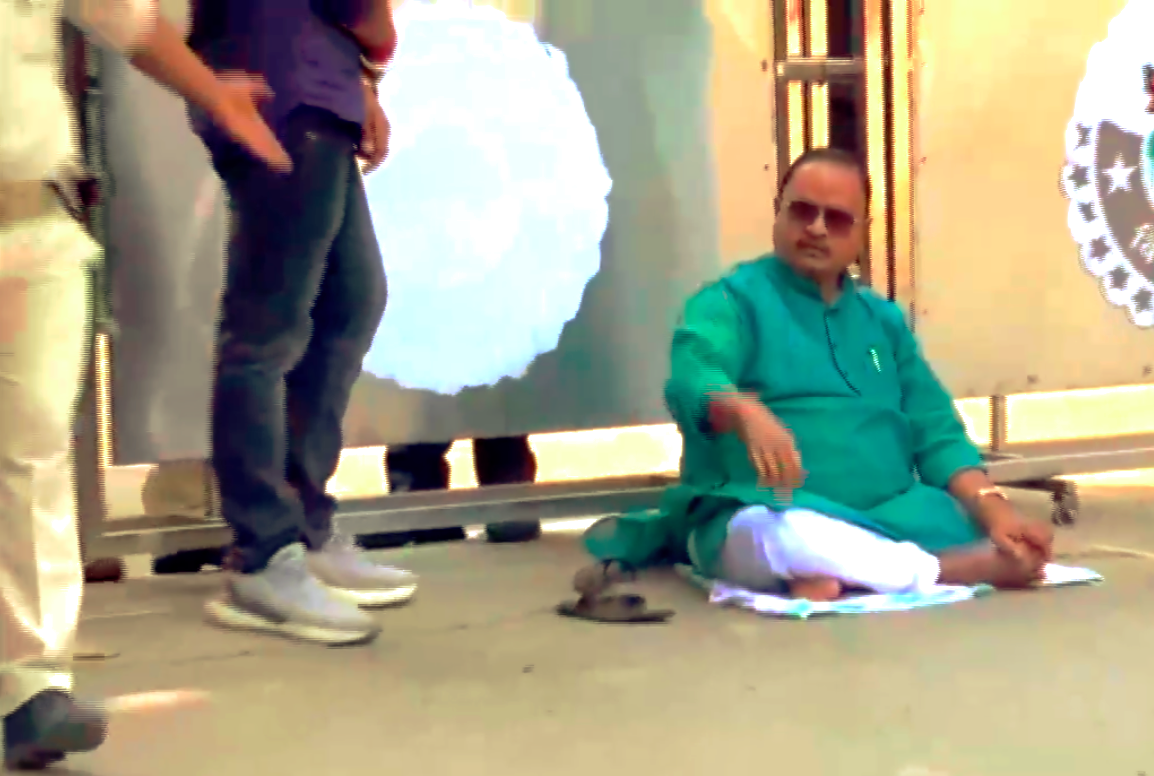
Gopal Mandal outside the Chief Minister's residence in Patna on October 14, 2025.
JD(U)’s 101 Haul Under Siege:
Ticket Protest Reveals Deep Caste Fault Lines
Patna: A dramatic sit-in protest by Janata Dal (United) [JD(U)] lawmaker Gopal Mandal outside Chief Minister Nitish Kumar’s official residence at 1 Anne Marg today, has laid bare simmering tensions within Bihar’s ruling National Democratic Alliance [NDA], just as the Bharatiya Janata Party [BJP] announced its first list of 71 candidates for the upcoming November 6-11 assembly elections.
Mandal, a four-term legislator from Gopalpur in Bhagalpur district, armed with a thermos of tea and placards decrying “injustice,” a key figure among the Extremely Backward Classes [EBCs] who make up 36.01 percent of voters according to the 2023 caste census, demanded his renomination ticket, staging the demonstration from 8:30 AM with 20-30 supporters chanting “Nitish ji, do justice.”
Police under Deputy Superintendent Anu Kumari cordoned the site by midday and dispersed the group peacefully by 3 PM under Model Code of Conduct [MCC] rules near the restricted Raj Bhavan area.
However, the episode—coupled with a resignation threat from JD(U) Member of Parliament [MP] Ajay Kumar Mandal over Bhagalpur ticket snubs and exclusions—underscores how the NDA’s ambitious 101-seat allocation to JD(U) risks unravelling due to sub-caste rivalries in a state where Other Backward Classes [OBCs] and EBCs together command 63.14 percent of the electorate, a revelation from the census that has redefined electoral arithmetic, intensified sub-caste mobilization, and sparked federal tensions.
The NDA’s 101-seat formula, finalised on October 12 and representing 41.56 percent of Bihar’s 243 assembly constituencies, matches BJP’s share to create a formidable 202-seat NDA core—83 percent of the house—but it functions more as a political lifeline for Nitish Kumar than a reflection of JD(U)’s electoral muscle, directly calibrated to the 2023 census data that elevated EBCs as kingmakers over Yadavs (14.27 percent) and upper castes (15.52 percent).
In 2020, JD(U) managed only 43 wins from 115 contested seats—a meagre 37.4 per cent strike rate down from 70 per cent in 2015—with its vote share dipping to 15.7 per cent amid anti-incumbency, Nitish’s health woes, and Chirag Paswan’s rebellion that cost 20 seats.
The current allocation nearly doubles that haul as a reward for Nitish’s high-stakes return to the NDA in January 2024 after briefly aligning with the opposition Mahagathbandhan, aiming to solidify his core support among Kurmis (2.87 per cent of the population) and the sprawling EBC bloc of over 100 sub-castes like Nonia and Kanu, particularly in regions such as Seemanchal and Magadh.
Also read: Bihar Polls: Chai, Paan, and Political Plans
The caste census, released on October 2, 2023, after a 2022 door-to-door survey adding caste to the 2011 framework and covering ~130 million people, not only validated Nitish’s “social justice” agenda—prompting a controversial 75 per cent reservation hike on November 7, 2023, to 65 percent for OBCs/EBCs/SCs/STs plus 10 percent EBC-specific (upheld by Patna High Court in June 2024 but stayed by Supreme Court in August)—but also intensified sub-caste mobilisation and policy shifts like EBC scholarships in the ₹3.95 lakh crore budget, with Lok Janshakti Party (Ram Vilas) [LJP(RV)] chief Chirag Paswan publicly endorsing Nitish as the chief ministerial face on October 13 to lock Paswan-Dusadh loyalty (5.31 percent SCs).
However, BJP’s candidate list—featuring heavyweights like Deputy Chief Minister Samrat Chaudhary (Tarapur), Vijay Kumar Sinha (Lakhisarai), Renu Devi (Bettiah), Nitin Nabin (Bankipur), former Union Minister Ram Kripal Yadav (Danapur after 2024 Lok Sabha loss), retaining 74 percent incumbents while dropping Speaker Nand Kishore Yadav for Ratnesh Kushwaha in Patna Sahib—prioritises its 15.52 percent forward-caste base (Brahmins 3.66 percent, Rajputs 3.45 percent) in urban pockets like Purnia and Bhagalpur while ceding “quality seats” like Sonbarsa to LJP(RV)’s Dalit strongholds (16 percent influence) and Tarapur to allies, igniting protests in JD(U) bastions such as Bhagalpur, where the party won 18 of 24 seats in 2020 and where Mandal’s EBC appeal secured a narrow 8,000-vote victory (down from 25,000 in 2015). The remaining 41 seats go to smaller partners—29 to LJP(RV) for Dalit voters after Chirag’s initial 40-seat demand, 6 to Hindustani Awam Morcha (Secular) [HAM(S)] under Jitan Ram Manjhi for Mahadalits (3-4 percent, e.g., Musahars), and 6 to Rashtriya Lok Morcha [RLM] for Koeri-Kushwaha communities (around 8 percent, down from 15-25 demands)—a slight 2 percent increase from 2020 levels to consolidate the NDA’s OBC/EBC dominance without empowering potential rivals like in 2020’s vote fragmentation, though it echoes the 2019 vote splits and now risks further erosion if census-fueled EBC demands for quotas and jobs go unmet amid NITI Aayog’s 75 lakh migrant crisis.
Mandal’s protest is the latest flashpoint in a career marred by controversies that have repeatedly embarrassed JD(U), including a 2021 viral video of him walking a Tejas Rajdhani first-class coach in undergarments drawing a show-cause notice he dismissed as private; 2016 suspension for threatening “hatya ki rajniti” (politics of murder with execution vows) by state president Bashishtha Narain Singh; extortion accusations against then-Deputy Chief Minister Tarkishore Prasad sparking defamation suits; and a 2023 incident where he brandished a revolver at Bhagalpur’s Jawaharlal Nehru Medical College hospital before abusing journalists (“Humare baap ho?”), resulting in First Information Reports [FIRs] under arms laws, plus recurring land grabs, doctor threats, and orchestra dances. Despite these, his EBC grassroots appeal secured a narrow 2020 victory with an 8,000-vote margin, but recent clashes, such as August’s video-recorded defamatory mistress remarks against Ajay Mandal (no relation), now fuel ticket disputes, signalling broader machinery weaknesses in an era defined by the caste census’s revelation that EBCs outnumber Yadavs, tilting power toward Nitish’s social engineering but exposing rifts in sub-caste loyalties amid Supreme Court stays on the 75 percent quota and BJP’s national resistance to a nationwide census.
Meanwhile, the opposition Mahagathbandhan—comprising Rashtriya Janata Dal [RJD], Indian National Congress [Congress], Left parties, and Vikassheel Insaan Party [VIP]—continues to lag in seat-sharing negotiations despite Lalu Prasad doling RJD tickets at his Patna home and Rahul Gandhi’s pending ally summit, with RJD tentatively eyeing around 134 seats (Yadav-centric), Congress 60, and Lefts 31 (including 21 for Communist Party of India (Marxist-Leninist) [CPI(ML)]), leveraging the census to demand credit for its original push while fielding candidates bolstered by Muslim (17.7 percent) consolidation in a stalled 29 percent Yadav-Muslim bloc. On October 14, CPI(ML) released 18 candidates targeting SC areas (19.65 per cent), such as Mehboob Alam in Balrampur, Jitendra Paswan in Bhore, and Divya Gautam (related to late actor Sushant Singh Rajput, appealing to upper castes) in Digha, aiming to mobilise landless Dalits against NDA welfare. The Aam Aadmi Party [AAP], spurning alliances for a full 243-seat solo run on urban infrastructure discontent, announced 48 more candidates that day (total 59), with caste-neutral picks like Brij Kishore Gupta in Gopalganj, Pankaj Kumar in Bankipur, and Arun Kumar Rajak in Phulwari to snag 5-10 per cent anti-incumbency from forward castes, Bhumihars/Kayasthas (3.62 per cent), and migrants. All India Majlis-e-Ittehadul Muslimeen [AIMIM] named 26 on October 11 in a “third front” bid after secular talks failed, contesting Muslim-heavy Seemanchal seats like Kishanganj (Akhtarul Iman), Purnia, Katihar, and Tejashwi’s Mahua to capture Pasmanda backward Muslims (17.7 per cent bloc) without fully splitting the opposition. Prashant Kishor’s Jan Suraaj party added 65 candidates (total 116, after initial 51 on October 9), emphasizing EBCs (33 per cent or 17/51 in first list, including 14 EBCs overall) and minorities (16 per cent skew) with challengers like Chanchal Singh against RJD’s Tejashwi Yadav in Raghopur, ex-Vice Chancellor KC Sinha in Kumhrar, advocate YB Giri in Manjhi, exploiting census-highlighted Pasmanda fractures through anti-liquor (₹28,000 crore revenue pledge) and anti-corruption vows to disrupt both NDA’s OBC lock and RJD’s Yadav-Muslim equation in a three-way fray.
Tejashwi Yadav has seized on these NDA rifts and the caste census’s quota fights—originally a Rashtriya Janata Dal [RJD] demand that he accuses the NDA of stealing—by slamming the alliance as a “gang of cheats” and “copycat government” that has created a “time bomb of corruption and unemployment.” In rallies like his September 28 Patna speech and May’s “Atipichda Jagao” event, he vowed to empower Extremely Backward Classes [EBCs] as a “power bank” with one job per household, which would require ₹7.8 lakh crore compared to the NDA’s ₹3.95 lakh crore budget. He directly attacked Nitish Kumar’s “unfit” welfare system, his alleged foot-touching submission to officers, exam paper leaks, and misuse of ₹4,000 crore in the Special Intensive Revision [SIR] process, while citing NITI Aayog figures on 75 lakh migrants, issuing a July 23 election boycott threat over “fake EPIC” voter deletions (refuted by the Election Commission of India [ECI]), and claiming vendettas after the IRCTC scam charges. JD(U) spokesperson Sanjay Kumar Jha hit back, saying Yadav overlooks Bihar’s progress since 2005 and labelling the Mahagathbandhan a “gang of cheats.”
With 7.4 crore electors eligible after Special Intensive Revision [SIR] adding 3.66 lakh names appeal-free, Electronic Voting Machines [EVMs] randomised for Phase II on October 13, 8.5 lakh officials deployed, and bulk Short Message Service [SMS] banned during silence periods, the ECI’s two-phase polls set a tight timeline with nominations closing October 17.
The NDA is targeting a majority exceeding 150 seats by promoting schemes like ₹1,200 pensions and free electricity up to 100 units. However, the caste census’s push for empowerment—leading to Patna High Court victories, Supreme Court stays, effects in states like Andhra Pradesh and Telangana, and tensions within the Bharatiya Janata Party [BJP] over its upper-caste support—could benefit challengers such as Prashant Kishor’s Jan Suraaj (targeting 100+ seats) or the Mahagathbandhan‘s census agenda.
This is especially true if caste-based protests, like Gopal Mandal’s thermos vigil and Ajay Mandal’s resignation threat, spread widely. Bihar is becoming a key battleground for India’s reservation policies, with high voter turnout (67 per cent in 2020) and swings among Extremely Backward Classes [EBCs] and Other Backward Classes [OBCs] (63 per cent of voters) playing a decisive role.
– global bihari bureau