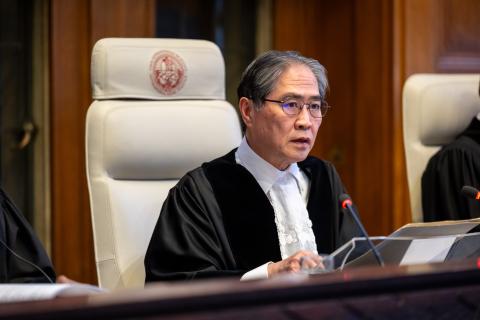
The International Court of Justice granted Guatemala permission to intervene as a non-party in the case concerning 'Sovereignty over the Sapodilla Cayes/Cayos Zapotillos (Belize v. Honduras)', today.
ICJ Admits Guatemala in Belize–Honduras Dispute
The Hague: A dispute over the Sapodilla Cayes/Cayos Zapotillos that already involves competing sovereignty claims by Belize and Honduras has drawn in a third State at the International Court of Justice (ICJ), after Guatemala was granted permission to intervene in the proceedings as a non-party, a procedural mechanism under Article 62 of the Statute that allows a State to participate to protect a legal interest that may be affected by the Court’s decision, without becoming a party to the case.
In its Judgment delivered today, the Court concluded that Guatemala satisfied the requirements under Article 62 of the Statute of the Court and Article 81 of the Rules of Court to intervene in the case brought by Belize against Honduras. The decision permits Guatemala to take part in the proceedings strictly within the limits of protecting its asserted legal interests relating to sovereignty over the same cays, while not conferring party status or expanding the scope of the dispute.
The case was instituted on November 16, 2022, when Belize brought proceedings against Honduras concerning sovereignty over the Sapodilla Cayes, a group of small islands located in the Gulf of Honduras near the southern end of the Belize Barrier Reef. Belize has requested the Court to adjudge and declare that, as between the two States, sovereignty over the cays belongs to it. In instituting the proceedings, Belize relied on Article XXXI of the American Treaty on Pacific Settlement (Pact of Bogotá), signed on April 30, 1948.
Guatemala filed its application to intervene on 1 December 2023 under Article 62 of the Statute, arguing that it has an interest of a legal nature that may be affected by the Court’s decision. It pointed to its longstanding claim over the Sapodilla Cayes and noted that the same territory is also the subject of a separate dispute pending before the Court in Territorial, Insular and Maritime Claim (Guatemala/Belize), in which both Guatemala and Belize assert sovereignty over the cays. That case arises from a special agreement notified to the Court on June 7, 2019, and reflects overlapping territorial and maritime claims involving the same features.
Public hearings on Guatemala’s request were held between November 24 and 26, 2025. During those hearings, Belize stated that it did not object to Guatemala’s intervention. Honduras opposed the application, characterising it as redundant and arguing that it constituted an abuse of the intervention procedure, and therefore should be declared inadmissible.
In its Judgment, the Court addressed the procedural framework governing intervention under Article 62 of the Statute and Article 81 of the Rules of Court, noting that the applicant State must identify an interest of a legal nature that may be affected by the Court’s decision, specify the precise object of its request, and indicate any claimed jurisdictional basis. The Court explained that, in this context, a State seeking to intervene need not establish that its rights will be affected, but only that its legal interests may be affected by the outcome of the case.
With respect to Guatemala’s asserted legal interest, the Court found that it is based on a real and concrete claim to sovereignty over the Sapodilla Cayes/Cayos Zapotillos, and that such a claim is inherently legal in nature as it concerns the determination of sovereignty under international law. The Court further observed that its eventual ruling on sovereignty in the present case may affect Guatemala’s legal interests, given that Guatemala asserts sovereignty over the same territory in its separate case with Belize, and that decisions concerning fishing rights in the surrounding waters may also have implications for those interests. The Court emphasised that the dispute between the parties concerns sovereignty over the Sapodilla Cayes/Cayos Zapotillos, and that Guatemala’s claimed interest is directly connected to that subject-matter through its own overlapping claim.
The Court also addressed the relationship between Article 59 and Article 62 of the Statute, explaining that Article 59 limits the binding force of a judgment to the parties and the case at hand, while Article 62 provides a mechanism for third States to seek protection where their legal interests may nevertheless be affected by a decision. The Court concluded that Article 59 may not sufficiently protect Guatemala from indirect effects of a judgment in this case, thereby supporting the relevance of intervention as a procedural avenue available to safeguard such interests.
Turning to the precise object of the intervention, the Court considered Guatemala’s stated aims, which included protecting its rights and interests over the Sapodilla Cayes and informing the Court of the nature and extent of those rights. The Court found these objects to be proper and consistent with the function of intervention, emphasising that the procedure is incidental in nature and must remain connected to the subject matter of the main dispute. The Court noted that intervention cannot be used to introduce a new dispute or alter the character of the proceedings, and that Guatemala’s request did not seek to establish sovereignty vis-à-vis the parties but rather to safeguard and present its legal interests within the existing dispute concerning sovereignty over the cays.
On the question of jurisdictional links, the Court recalled that no autonomous jurisdictional basis is required where a State seeks to intervene as a non-party. It clarified that intervention in such circumstances does not confer party status or impose obligations associated with participation as a party, and that the absence of a jurisdictional link between Guatemala and Honduras does not bar intervention. The Court thus treated Guatemala as seeking to intervene solely in a non-party capacity for the limited purpose of protecting its asserted legal interests.
The Court also considered Honduras’s argument that the application should be rejected for failure to comply with formal requirements relating to supporting documents. It concluded that Article 81 of the Rules requires the submission of documents only if the applicant chooses to rely on them, and that Guatemala had met its burden of demonstrating its asserted legal interest without any procedural deficiency warranting dismissal.
Rejecting Honduras’s broader contention that the application constituted an abuse of process, the Court stated that its role under Article 62 is to determine objectively whether the applicant has demonstrated an interest of a legal nature that may be affected by the decision. Having found that the requirements of Article 62 and the Rules of Court were satisfied, the Court held that it had no discretion to refuse the application on that basis and therefore declined to accept Honduras’s objection.
The Court further clarified that Guatemala’s participation is confined to issues concerning sovereignty over the Sapodilla Cayes/Cayos Zapotillos, including fishing rights in the surrounding waters. It emphasised that the intervention does not extend beyond that defined subject matter and does not affect the merits of the dispute between Belize and Honduras, nor does it alter the bilateral structure of the principal proceedings.
In the operative clause of its Judgment, which is final, without appeal, and binding on the parties, the Court decided that Guatemala is permitted to intervene as a non-party in the case pursuant to Article 62 of the Statute, within the scope and for the purposes set out in its reasoning.
Judge Charlesworth appended a separate opinion, in which she observed that the Judgment introduces certain interpretative complexities regarding the application of Article 62, including its treatment of Article 59 and additional considerations related to the assessment of the precise object of intervention and the connection between that object and the applicant’s legal interest. She noted that these elements did not alter the Court’s conclusions but, in her view, were unnecessary.
Judge Tladi appended a declaration to the Judgment.
– global bihari bureau